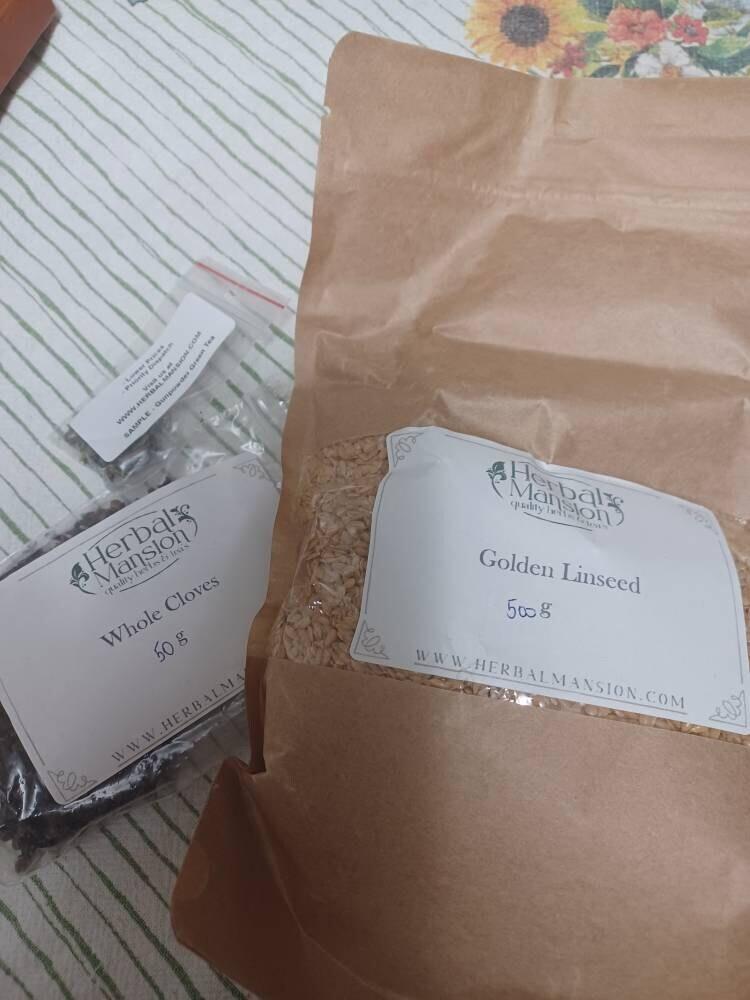
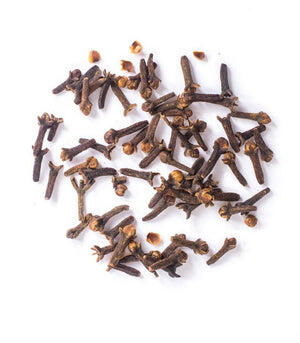
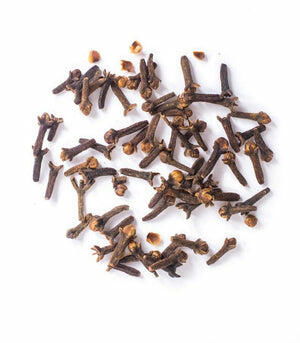
Whole cloves are the dried flower buds of Syzygium aromaticum, a tree of the myrtle family native to the northern Moluccas in Indonesia, the Spice Islands. Intense and sweet-spicy, a few cloves flavour a baked ham, a pan of mulled wine, a pot of rice or a batch of spiced biscuits.
A flower bud, picked before it opens
Each clove is a whole, unopened flower bud. The buds are picked at the last moment before flowering, while still pink, and turn brown as they dry. Good cloves are plump and oily, with their round heads intact. On older labels you may also see the former botanical name Eugenia caryophyllata, which refers to the same species.
From the Spice Islands
Cloves are native to the northern Moluccas, the islands of Ternate and Tidore among them. They were traded across Asia long before Europeans had heard of the Spice Islands. The Portuguese arrived in 1512, followed by the Spanish, the English and the Dutch, and European powers fought over these islands, for a time the only place cloves and nutmeg came from. In the end the Dutch took control. Today cloves are also grown far from the Moluccas, in countries such as Madagascar and Sri Lanka.
Flavour
Spice sellers describe cloves as sweet, intense and aromatic, with a slightly bitter edge. A little goes a long way.
How it is used today
- Baked ham. Whole cloves studded into a ham or a roast before it goes into the oven.
- Mulled wine and braises. Whole, with other spices, in mulled wine and slow-cooked meat dishes.
- Spice blends. In garam masala, and in Chinese five-spice powder alongside star anise and cinnamon.
- Rice. Whole in rice dishes such as biryani.
- Baking. Ground into spiced cakes, biscuits and desserts.
- Pomanders. An orange studded with whole cloves makes a fragrant decoration, not for eating.
For the star-shaped spice that joins cloves in five-spice powder and mulled wine, see Star Anise, and for a single berry whose flavour recalls cloves, see Allspice Berries. More are in our Whole Spices and Herbs & Spices collections.
Whole cloves in your kitchen
Use cloves sparingly: their flavour is strong. Add them whole to braises, rice and mulled wine and take them out before serving; a small muslin bag makes this easy. For baking, grind them just before use. As a guide, three whole cloves equal roughly a quarter of a teaspoon of ground cloves. Whole cloves keep their aroma much longer than ground: keep them in a tightly closed bag in a cool, dark, dry place and use them within about a year, checking the aroma. Taste varies between batches.
Frequently asked questions
Why are cloves called cloves?
The name means "nail". It comes from the Old French clou, from the Latin clāvus, a reference to the shape of the dried bud. A clove of garlic is a different word with a different history.
Are cloves flower buds?
Yes. Each clove is a whole flower bud, picked before it opens and then dried.
Should I buy whole or ground cloves?
Whole cloves keep their aroma longer and are easy to lift out of braises and mulled wine. Grind them for baking, just before use.
Where do our cloves come from?
Our cloves are grown in Madagascar or Sri Lanka, depending on the lot.
Sources
- The American Heritage Dictionary of the English Language, "clove", "pomander", "garam masala" and "five-spice powder", ahdictionary.com, accessed 23 November 2026.
- Dictionary.com, "clove", dictionary.com, accessed 23 November 2026.
- Encyclopaedia Britannica, "Moluccas", britannica.com, accessed 23 November 2026.
- The Spice House, Cloves, Hand-Selected, thespicehouse.com, accessed 23 November 2026.
- Burlap & Barrel, whole cloves product page, burlapandbarrel.com, accessed 23 November 2026.
- McCormick, article on grinding whole spices, mccormick.com, accessed 23 November 2026.