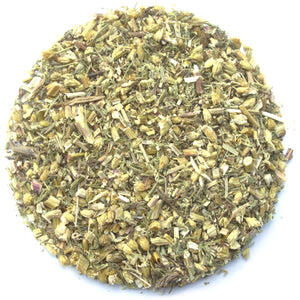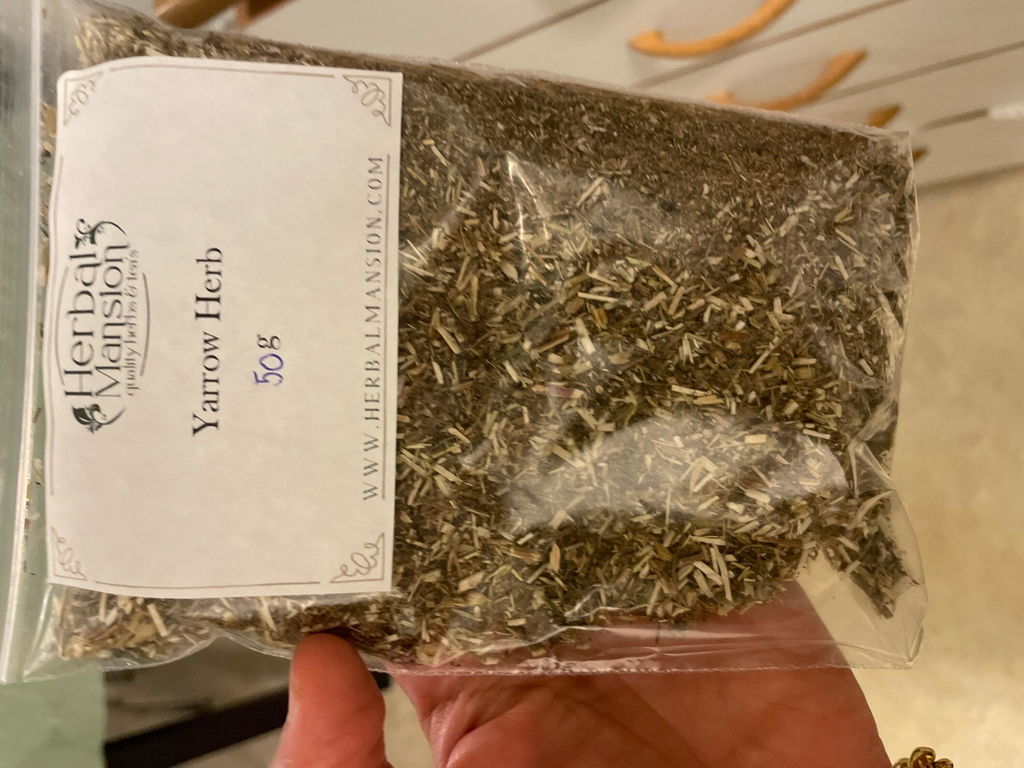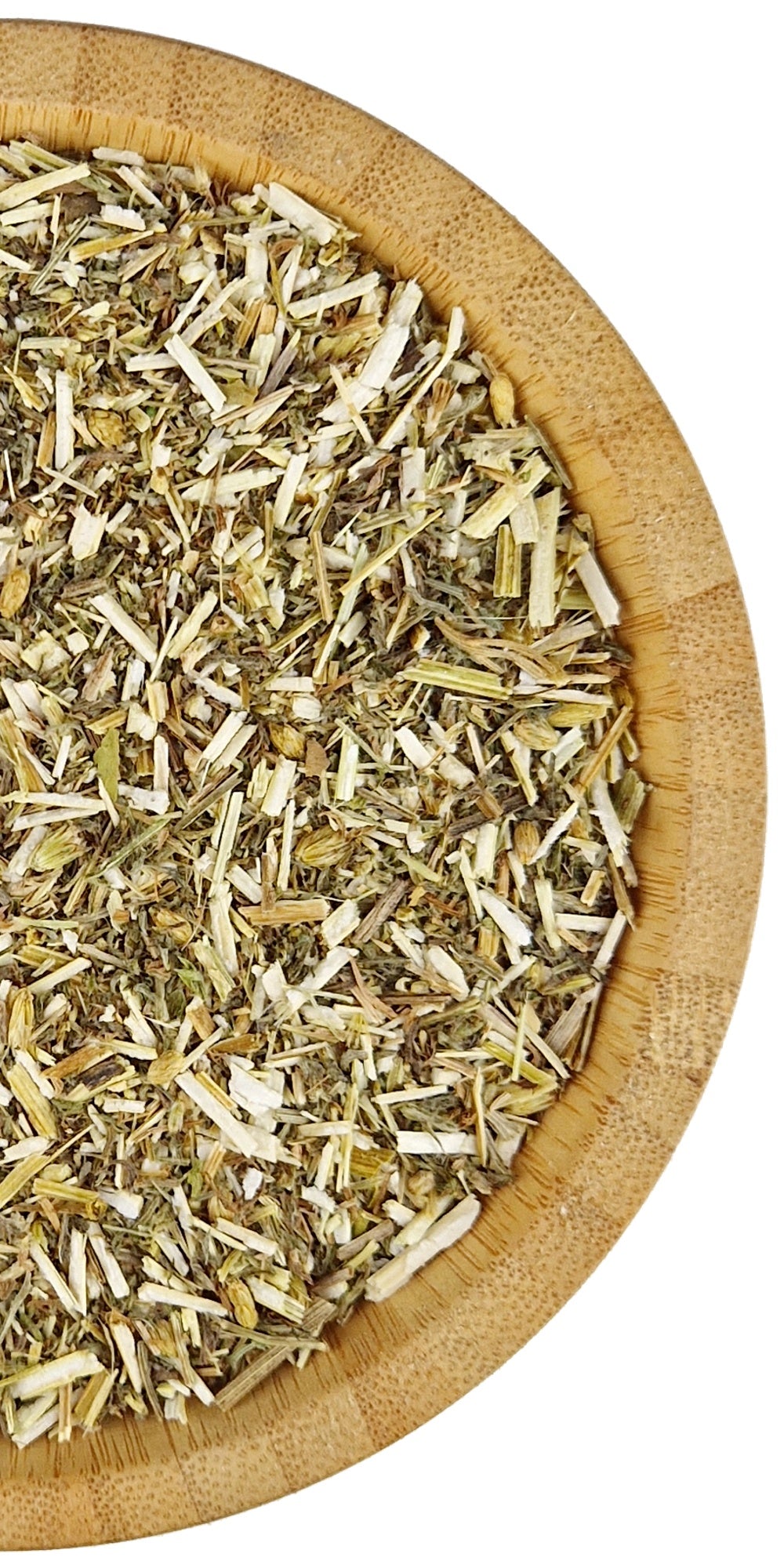
Dried yarrow herb brings together the feathery leaves and small flower heads of yarrow, Achillea millefolium, a strong-smelling perennial of meadows, lawns and roadsides. Its Latin name means “a thousand leaves”, after the many fine segments of each leaf.
A plant of meadows and roadsides
Feathery leaves, flat flower heads
Yarrow belongs to the daisy family, Asteraceae. It is a tough plant of many grasslands and grows to about 50 cm. The dark green leaves are cut into very fine segments, which gives them a feathery look. The flowers come in flat-topped clusters: each small head has pinkish-white ray florets around yellowish disc florets, so from a distance it looks like a single flower with a yellow centre. Yarrow flowers from June through summer.
Where it grows
Yarrow grows in meadows, pastures, lawns and roadsides, and in towns and gardens too. Its range covers Europe, including Britain, north to 71° and east to western Asia. In Britain it is widespread and common. It is sown with other native species when meadows are restored, and its cultivated varieties are favourite garden plants.
Names, beer and old customs
A thousand leaves
The genus Achillea is named after Achilles, the hero of Greek myth. The species name millefolium joins the Latin mille, a thousand, and folium, a leaf, and refers to the many segments of the leaf; the English word milfoil comes from the same Latin. The name yarrow itself goes back to the Old English gearwe. Old country names for the plant include Milfoil, Thousand Weed, Old Man’s Pepper and Devil’s Nettle.
A herb for beer
Yarrow has been used in place of hops to flavour beer, and in Sweden it was once known as Field Hop. The Oxford Companion to Beer describes gruit as the herb mixtures used in beer before hops became widespread, and it names yarrow among them, alongside bog myrtle and wild rosemary.
Dyes and old customs
Plants For A Future notes that yellow and green dyes can be obtained from the flowers, and that yarrow is one of the ingredients of the “Quick Return” compost activator. In old country custom, yarrow was carried as a charm against bad luck, and a sprig placed under the pillow was meant to bring a dream of a future husband or wife.
How it is used today
- Infusion. A small amount of the dried leaves and flowers, steeped in freshly boiled water.
- Home brewing. A herb once used to flavour beer.
- Natural dyeing. The flowers give yellow and green dyes.
For a herb whose name is linked to mead, try Meadowsweet Herb, and for a flowerless plant of fields and roadsides, see Horsetail Herb. More single herbs are in our Single Herbs collection, and other plants for the cup are in Herbal Tea.
Yarrow in your home cupboard
Yarrow is pleasantly bitter, aromatic and slightly pungent. Use a small amount and taste before steeping longer: a longer steep gives a stronger, more bitter cup. Taste varies between batches.
Frequently asked questions
What is dried yarrow herb?
It is the dried leaves and flowers of yarrow, Achillea millefolium, a perennial of the daisy family that grows in meadows and along roadsides.
Why is it called millefolium?
The name means “a thousand leaves” in Latin, after the many fine segments of each leaf.
Was yarrow used in beer?
Yes. Yarrow has been used to flavour beer in place of hops, and it is named among the herbs of gruit, the herb mixtures used in beer before hops became widespread.
Can I drink it during pregnancy or with medication?
If you are pregnant, breastfeeding, taking medication or have a health condition, ask your doctor before drinking herbal infusions.
Where does yarrow herb come from?
The current batch comes from Poland.
Sources
- The Wildlife Trusts, Yarrow, Wildlife Explorer, wildlifetrusts.org, accessed 19 November 2026.
- Plants For A Future, Achillea millefolium, PFAF Plant Database, accessed 19 November 2026.
- Cantwell, D., Gruit, in G. Oliver (ed.), The Oxford Companion to Beer, Oxford University Press, 2012.
- Wiktionary, millefolium, en.wiktionary.org, accessed 19 November 2026.