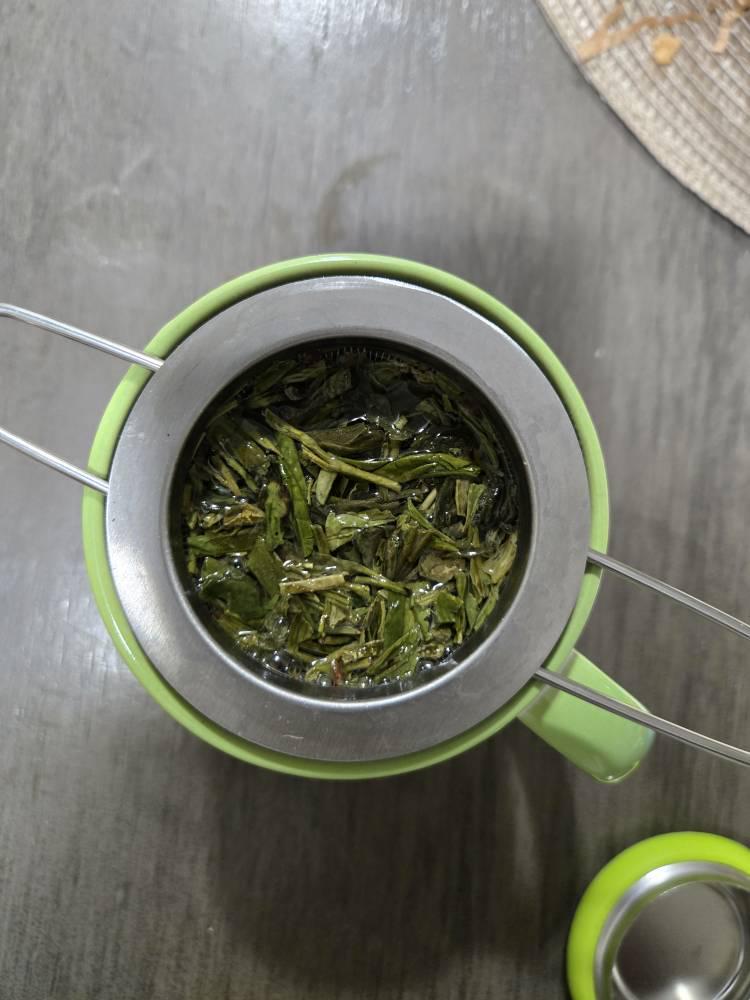
Dragon Well green tea, also known as Long Jing and Lung Ching, gives a pale yellow infusion with a chestnut and nutty taste, sweetish and with little bitterness. The flat leaves are pressed against a hot pan, which gives them their shape and a toasted note. The style comes from the area around Hangzhou in Zhejiang province and is imitated in many regions today. It is a tea for brewing in a glass, for several infusions, for people starting out with Chinese green teas and for those who already know it.
The Dragon Well by West Lake
A tea from Hangzhou
Long Jing means “Dragon Well” and is the name of a village and a spring in the hills above West Lake in Hangzhou. Describing the green teas of Zhejiang province in 1935, Ukers listed a grade called Longchin among the teas shipped from Hangzhou. The city was opened to foreign trade only in 1896, later than Shanghai or Fuzhou. In their encyclopedia, the Heisses list the traditional Long Jing areas, among them Lion Peak, Long Jing village and Man Jue Long, and reserve the name Xihu Long Jing for tea from West Lake.
The emperor and eighteen bushes
Gascoyne links Long Jing with the Qianlong Emperor of the Qing dynasty. A local legend, repeated in guidebooks to Hangzhou, adds that the emperor visited the Hugong temple below Lion Peak and was given a cup of Long Jing there. He is said to have granted imperial status to the eighteen bushes growing in front of the temple, and the bushes are still shown there today. The Heisses list Shi Feng Long Jing, tea from Lion Peak, as a separate grade.
How Long Jing is made
A bud with one or two young leaves is picked in spring. Straight after picking, the leaves go onto a hot pan, where they are pressed against the heated surface and moved until they dry flat. The Heisses describe the traditional method as shaping done directly in the pan, without separate rolling. Once cooled, the leaves are dried a second time at a lower temperature and sorted.
How it is used today
- In a glass. The leaves stand upright, then sink to the bottom.
- For several infusions. Two or three infusions from one portion.
- For cooking. Prawns with Long Jing leaves are a Hangzhou dish.
- Drunk plain. Its chestnut sweetness needs nothing added.
In our Loose Green Tea collection you will also find Green Snail and the Japanese-style Sencha. All three differ in the shape of the leaf, and Sencha also in its Japanese-style processing instead of pan-firing.
Long Jing in your tea cupboard
This is a green tea for people looking for sweetness and a nutty note, with little bitterness and without a grassy scent. It also suits those who like watching the leaves in a glass, and those who want to take it into the kitchen.
Frequently asked questions
Is this West Lake Long Jing?
Long Jing in this style is produced in many places, and the Heisses reserve the name Xihu Long Jing for tea from West Lake. This batch carries no regional designation.
Why are the leaves flat?
Because they are pressed against a hot pan while drying. This movement gives them their shape and a toasted, chestnut note.
Can I brew it with boiling water?
Better not. Boiling water brings out bitterness and covers the sweetness, and 80°C is quite enough.
Does Long Jing contain caffeine?
Yes. Like every tea from the tea plant it contains caffeine, and the amount in the infusion depends on the quantity of leaves and the brewing time.
Can I drink it during pregnancy or with medication?
It contains caffeine, so in these situations ask a doctor or pharmacist. A product description does not replace their advice.
Sources
- William H. Ukers, All About Tea, The Tea and Coffee Trade Journal Company, New York 1935, vol. I, chapter XIII “Tea Characteristics”, pp. 232–233 (green teas of Zhejiang, the Longchin grade) and chapter XIV “Cultivation and Manufacture of Tea”, pp. 267–269 (the Chinese green tea method); vol. II, chapter V “History of the Tea Trade in China”, pp. 104–105 (opening of Hangzhou in 1896).
- Mary Lou Heiss, Robert J. Heiss, The Story of Tea: A Cultural History and Drinking Guide, Ten Speed Press, Berkeley 2007, chapter “Manufacture: From Fresh Leaves to Distinctive Tea”, section “Green Tea”, pp. 122 and 124 (Longjing), encyclopedia of teas, p. 260 (Long Jing areas) and p. 386 (prawns with Longjing tea).
- Mary Lou Heiss, Robert J. Heiss, The Tea Enthusiast's Handbook, Ten Speed Press, Berkeley 2010, p. 48 (Longjing, Zhejiang).
- Kevin Gascoyne, François Marchand, Jasmin Desharnais, Hugo Américi, Tea: History, Terroirs, Varieties, Firefly Books, Richmond Hill 2011, chapter on China (the name Long Jing given by the Qianlong Emperor).
- EFSA, Scientific Opinion on the safety of caffeine, EFSA Journal 2015, 13(5):4102.