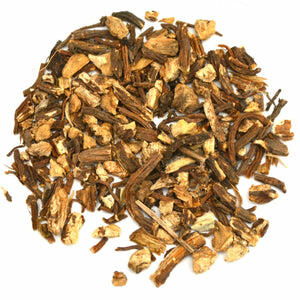
Dried angelica root is the cut root of Angelica archangelica, and the root is the part of the plant most often used to flavour gin. At home it is steeped as a root infusion, and it also goes into home-made liqueurs and syrups.
A tall plant of damp meadows
Two summers from seed to flower
The Missouri Botanical Garden describes angelica as a biennial: the plants die after producing seed in their second year. On the plant, it grows to about 0.9 to 1.8 metres tall. The yellow-green leaves are divided into many leaflets and have distinctive inflated bases where they join the stem. Numerous tiny greenish-white flowers form large, rounded umbels up to about 15 cm across. Its native range takes in Europe, Greenland and western Siberia, where it grows in moist meadows and along the banks of streams and ponds, in rich, moist, slightly acid soils.
Named for an archangel
The genus was formerly known as Herba angelica. In folklore the name is linked to the Archangel Michael, whose old feast day of 8 May was said to coincide with the plant’s flowering.
From gin stills to candied stems
A gin botanical
According to Gin Foundry, the root is the part of angelica most commonly used in gin production. Some gins use the seeds or flowers as well, and Beefeater, for example, uses both root and seed. Once distilled, angelica gives an earthy flavour that is a little bitter and a little herbal. Angelica also appears in some vermouths, bitters and herbal liqueurs.
Candied stems
The candied angelica used on cakes is made from the stems, not the root: the stems are crystallised in sugar for cake decorations or as a snack. In the French town of Niort, candied angelica is credited to the local nuns in the 18th century, and it traditionally decorates galettes charentaises.
How it is used today
- Root infusion. A small amount of cut root, steeped in freshly boiled water.
- Home-made liqueurs and syrups. Steeped in spirit or simmered into a syrup.
- Home gin. Added with other botanicals, as in home gin-making kits.
For another root with a long history in drinks, see Liquorice Root, and for a spice root, see Ginger Root. More single herbs are in our Single Herbs collection, and other plants for the cup are in Herbal Tea.
Angelica root in your home cupboard
Sellers describe angelica root as earthy, woody and musky, with a sweet, aromatic scent. A longer steep gives a stronger flavour, so start with a small amount and adjust. Keep the bag tightly closed in a cool, dry, dark place. Taste varies between batches.
Frequently asked questions
How is angelica root used?
It is best known as a gin botanical. At home it is steeped as a root infusion, or used in home-made liqueurs, syrups and gin.
Is angelica root the same as angelica herb?
No. This is the cut root of Angelica archangelica. The leaves and stems are separate parts of the plant, and the stems are the part that is candied.
How do I make angelica root tea?
Use no more than 2 teaspoons of cut root per 250 ml cup. Pour over freshly boiled water and steep for 7 to 12 minutes, then strain.
Can I drink it during pregnancy or with medication?
If you are pregnant, breastfeeding, taking medication or have a health condition, ask your doctor before drinking herbal infusions.
Where does angelica root come from?
The current batch comes from Poland.
Sources
- Missouri Botanical Garden, Angelica archangelica (Plant Finder), plantfinder.mobot.org, accessed 22 November 2026.
- Gin Foundry, Angelica (Botanicals), gin-foundry.com, accessed 22 November 2026.
- Herba Organica, Angelica Root (Angelica archangelica L.), herbaorganica.co.uk, accessed 22 November 2026.
- CREGENE, L’angélique de Niort, Marais poitevin, cregene.org.