





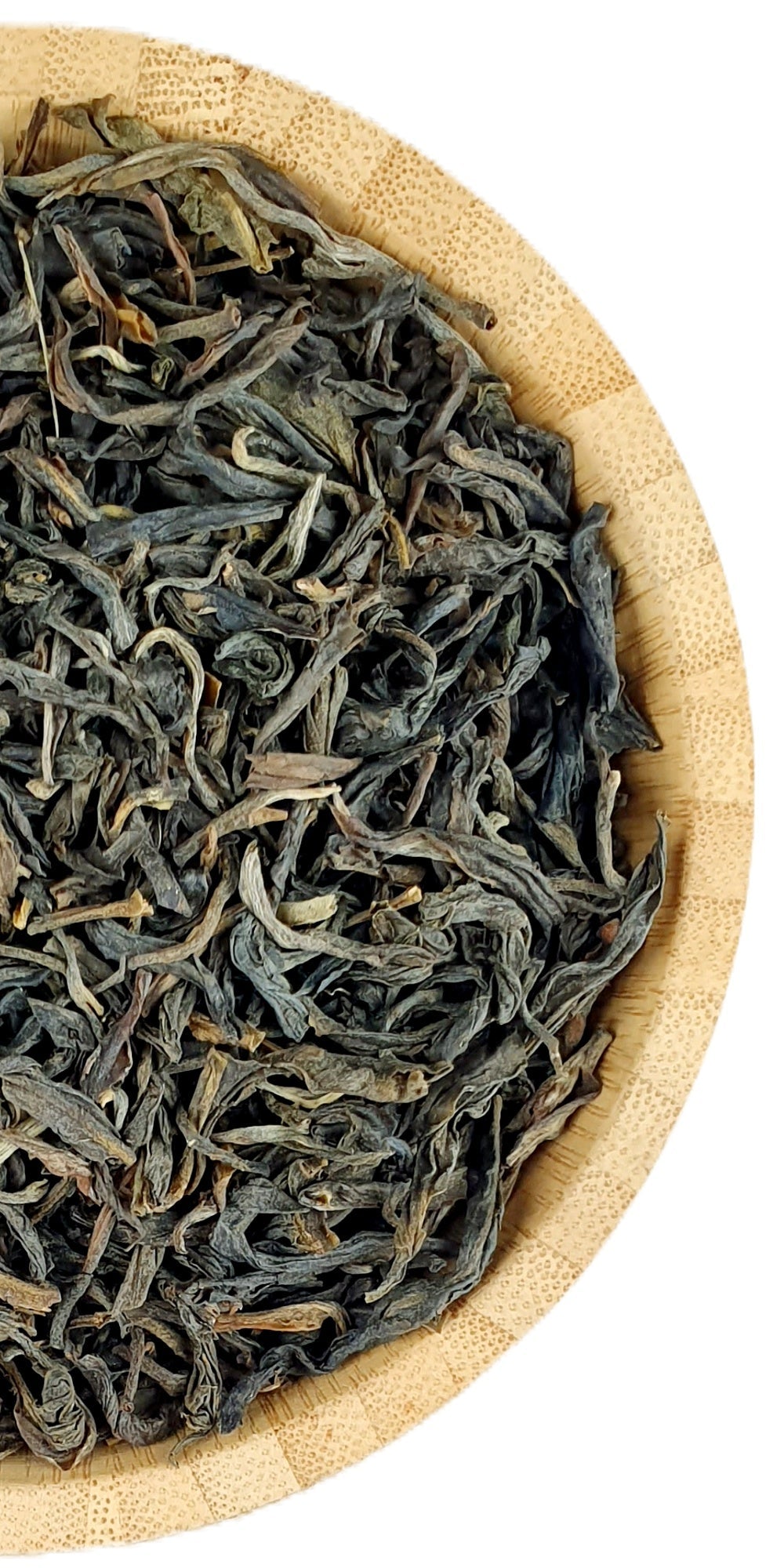
White Monkey, in Chinese Bai Mao Hou, is a white tea made from whole shoots, a bud with young leaves, covered in thick silvery down. The name is an image, “white hairy monkey”, and describes the appearance of the downy shoots. The infusion is pale and sweetish, with a note of hay and peas and a light astringency at the finish. This is a tea for people who like white teas but want more character in them than in buds alone.
Where the White Monkey style began
The Da Bai cultivar
Bai Mao Hou is associated with the Taimu mountains in north-eastern Fujian, near Fuding, one of the centres of white tea, where Gascoyne places the discovery of the Da Bai cultivar.
Green or white
Two teas made from a similar shoot are sold under the name Bai Mao Hou. Some sellers describe White Monkey as a green tea, pan-fired straight after picking, and others as a white tea, only withered and dried. The difference arises straight after picking, because firing stops the changes in the leaf, while withering lets them proceed slowly. In both versions the shoot looks similar, silvery and downy, but the green one is more astringent and vegetal, and the white one sweeter. This description covers the white version.
How White Monkey is made
In spring, a bud with one or two young leaves is picked when the down on the bud is at its thickest. The shoots are spread in a thin layer and wither slowly in the shade for a day or longer. There is no rolling or firing, so the shoots keep their shape and their down. Finally they are dried at a low temperature and sorted so that whole shoots remain in the packet.
How it is used today
- For a cup. Two heaped teaspoons and three minutes.
- Cold with coconut water. A summer drink.
- In rice pudding. The infusion in place of some of the milk.
- Alongside a tea made only from buds. To taste what the young leaves add.
In our White Tea collection you will also find Pai Mu Tan and Yue Guang Bai, and among the black teas Golden Monkey, the second “monkey” in a name.
White Monkey in your tea cupboard
This is a tea for people who like white teas made from whole shoots and want a little more character in them than in buds alone. It also suits those who like to compare processing methods and keep a green tea from a similar harvest in the cupboard.
Frequently asked questions
Where does the name “white monkey” come from?
From its appearance. Bai Mao Hou means “white hairy monkey” and describes shoots covered in thick, pale down. The only link to monkeys is the image.
Is it a green or a white tea?
This description covers the white version, only withered and dried. A green version, pan-fired straight after picking, is also traded under this name.
How does it differ from Golden Monkey?
Golden Monkey is a completely different tea. It is a black tea, fully oxidised, while White Monkey is a white tea with downy shoots.
Does White Monkey contain caffeine?
Yes. Like every tea from the tea plant, it contains caffeine, and the amount in the infusion depends on the quantity of shoots, the water temperature and the brewing time.
Can I drink it during pregnancy or with medication?
It contains caffeine, so in these situations ask a doctor or pharmacist. A product description does not replace their advice.
Sources
- Mary Lou Heiss, Robert J. Heiss, The Story of Tea: A Cultural History and Drinking Guide, Ten Speed Press, Berkeley 2007, chapter “Manufacture: From Fresh Leaves to Distinctive Tea”, section “White Tea” (withering and drying).
- Kevin Gascoyne, François Marchand, Jasmin Desharnais, Hugo Américi, Tea: History, Terroirs, Varieties, Firefly Books, Richmond Hill 2011, section on tea bush cultivars, entry “Fuding Da Bai” (the town of Fuding).
- EFSA, Scientific Opinion on the safety of caffeine, EFSA Journal 2015, 13(5):4102.




