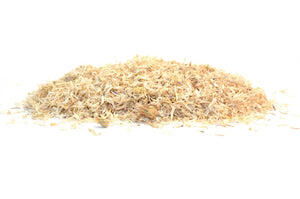
White cornflower petals come from a garden variety of the wild cornflower with creamy-white petals. The dried petals are chosen wherever the colour should be calm: for wedding confetti, for white and green teas, for iced cakes and for soaps. They taste mild, almost neutral, so their job is the way they look. They combine well with petals in other colours, giving them a lighter background.
The cornflower from antiquity to today
Cyanus and the centaurs
The Greeks and Romans knew the cornflower as cyanus, from the word for dark blue. The Latin genus name Centaurea, which Linnaeus used in the 18th century, comes from the centaurs of Greek myth, through the ancient plant name kentaurion. Today it is thought that the cornflower came from the Middle East together with the growing of wheat and barley.
From field to plantation
For centuries the cornflower was an ordinary cornfield weed, whose seeds went back into the field with the seed grain. In the 20th century it disappeared from the fields, pushed out by seed cleaning and herbicides, and moved to plantations, where it is grown for dried petals and flowers. In many countries it is now sown on purpose along field margins and in flower strips for bees.
How white cornflower petals are made
Gardeners collected seeds from rare white plants found in the fields and fixed the colour over successive generations. White petals are picked from these garden varieties and dried in the same way as blue ones, in shade with good airflow, then separated from the flower heads and sifted. The shade of white petals varies between batches more noticeably than in the dark varieties, because white easily turns cream during drying.
How it is used today
- Confetti and wedding decorations. White petals on their own or mixed with pink and blue ones, for scattering and for the table.
- White and green teas. A light addition to delicate teas, in which dark petals would be too strong an accent.
- Baking and desserts. A topping for icing, creams and meringues, and for decorating sugar.
- Crafts. White soaps, bath bombs, cards and potpourri.
Other colours of cornflower petals, including Blue Cornflower Petals and Light Pink Cornflower Petals, as well as Pink Rose Petals, are in our Flowers & Petals collection.
White cornflower in your home cupboard
White cornflower petals are rarely used on their own; more often they give a background to other colours in confetti, in tea or on a cake. They are an addition for people who prepare wedding decorations, put together their own tea blends or make soap at home.
More ways to use it
- Confetti. The petals are ready to use. Mix the white petals with other colours in a large bowl and fill paper cones with a handful per person.
- Desserts. Scatter the petals over desserts just before serving.
- Soap. Add the petals to soap mass at a low temperature, because in hot mass they turn brown.
- Tea blends. A teaspoon of petals is enough for 50 g of tea.
Frequently asked questions
Are white cornflower petals edible?
Yes. They are petals of an edible variety of cornflower, used as an addition to teas, desserts, baking and drinks. They contain no caffeine.
Why are the petals not snow-white?
White varieties of cornflower have creamy-white petals, and drying and light deepen this shade further.
What other cornflower colours do you stock?
We stock cornflower petals in blue, purple, pink and light pink, and whole pink cornflowers separately. They are all in the same collection of the shop.
Where do the petals come from?
The current batch comes from Albania.
Sources
- Riklef Kandeler, Wolfram R. Ullrich, Symbolism of plants: examples from European-Mediterranean culture presented with biology and history of art. September: Cornflower, Journal of Experimental Botany 60(12), 2009, pp. 3297–3299.
- Gyula Pinke, Viktória Kapcsándi, Bálint Czúcz, Iconic Arable Weeds: The Significance of Corn Poppy, Cornflower, and Field Larkspur in Hungarian Ethnobotanical and Cultural Heritage, Plants 12(1), 2023, art. 84.
- Tamaki Mishio, Kosaku Takeda, Tsukasa Iwashina, Anthocyanins and Other Flavonoids as Flower Pigments from Eleven Centaurea Species, Natural Product Communications 10(3), 2015, pp. 447–450.
- Zbigniew Podbielkowski, Barbara Sudnik-Wójcikowska, Słownik roślin użytkowych [Dictionary of useful plants], Warsaw 2003, entry “Chaber bławatek”.
- Alicja Szweykowska, Jerzy Szweykowski (eds.), Słownik botaniczny [Botanical dictionary], Warsaw 2003, entries “Centaurea” and “chaber”.