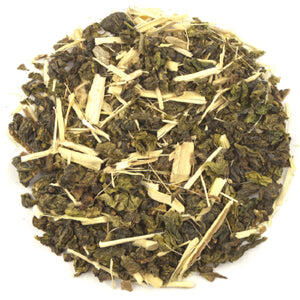
Oolong with Siberian ginseng root is the green oolong Tie Guan Yin, rolled into balls and mixed with pieces of Siberian ginseng root, that is eleuthero (Eleutherococcus senticosus), not Panax ginseng. Once infused, the balls unfurl into whole leaves, and the root gives the infusion a woody, slightly sweetish taste that stays in the background behind the floral note of the oolong. The infusion is yellow, full-bodied and smooth, with no coating and no powder, so it is clear from the first infusion. It is a tea for people who like Tie Guan Yin and want it in a version with the root visible in the pack.
Ginseng in the tea trade
A ship with ginseng sails for tea
The first American ship to China sailed for tea with a cargo of American ginseng. Ukers describes the voyage of the Empress of China, which left New York in 1784, reached Canton and returned the following year with a cargo of tea. For years, then, ginseng was one of the goods with which America bought tea.
Eleuthero is a different plant
The Siberian ginseng in this tea is eleuthero, Eleutherococcus senticosus (Rupr. et Maxim.) Maxim., a different genus from Panax ginseng. It is a thorny shrub from the forests of north-east Asia. Both plants, eleuthero and Panax ginseng, belong to the ivy family, Araliaceae.
How Oolong with Siberian Ginseng Root is made
The base is Tie Guan Yin, a green oolong in the style of Anxi in southern Fujian. The leaves are withered in the sun, then shaken in baskets so that the edges oxidise slightly, and brief pan-firing stops this process. The leaves are then rolled into tight balls in cloth bundles and dried. The finished balls are mixed with cut, dried eleuthero root.
How it is used today
- For the teapot. Balls and root together, for several infusions.
- With jujube dates. A warm infusion made with a sweet jujube decoction.
- Cold with watermelon. A summer jug.
- After dinner. The woody note of the root goes well with meat and sauces.
In our Oolong Tea collection you will find plain Tie Guan Yin and Oolong Ginseng, and among the herbs Siberian Ginseng Root on its own, for your own blends.
Oolong with Siberian ginseng root in your tea cupboard
This is a tea for people who like Tie Guan Yin. It also suits those who enjoy a tea whose taste changes as they drink it.
Frequently asked questions
Which ginseng is in this tea?
Siberian ginseng, that is eleuthero (Eleutherococcus senticosus). It belongs to the same family as Panax ginseng but to a different genus. This tea contains only its root, cut into pieces.
How does it differ from Oolong Ginseng?
They differ in the form of the addition. In Oolong Ginseng, powdered ginseng coats the balls and dissolves in the water; here the root is in the pack in pieces, and the infusion stays clear from the first infusion.
Can the pieces of root be eaten?
There is no need. They are hard and woody and give their flavour to the infusion, and after brewing they are thrown away together with the leaves.
Does oolong with Siberian ginseng root contain caffeine?
Yes. Like every tea from the tea plant, Tie Guan Yin contains caffeine, and the root does not add any. The amount in the infusion depends on the portion, the number of infusions and the water temperature.
Can I drink it during pregnancy or with medication?
It contains caffeine and eleuthero root, so during pregnancy, if you have a health condition or if you take medication regularly, ask a doctor or pharmacist. A product description does not replace their advice.
Sources
- William H. Ukers, All About Tea, The Tea and Coffee Trade Journal Company, New York 1935, vol. II, chapter XV “American Tea Trade History”, pp. 245–247 (voyage of the Empress of China), chronology, pp. 503–504.
- Mary Lou Heiss, Robert J. Heiss, The Story of Tea: A Cultural History and Drinking Guide, Ten Speed Press, Berkeley 2007, chapter “Manufacture: From Fresh Leaves to Distinctive Tea”, section “Oolong Tea” (Anxi, pan-firing).
- EFSA, Scientific Opinion on the safety of caffeine, EFSA Journal 2015, 13(5):4102.