




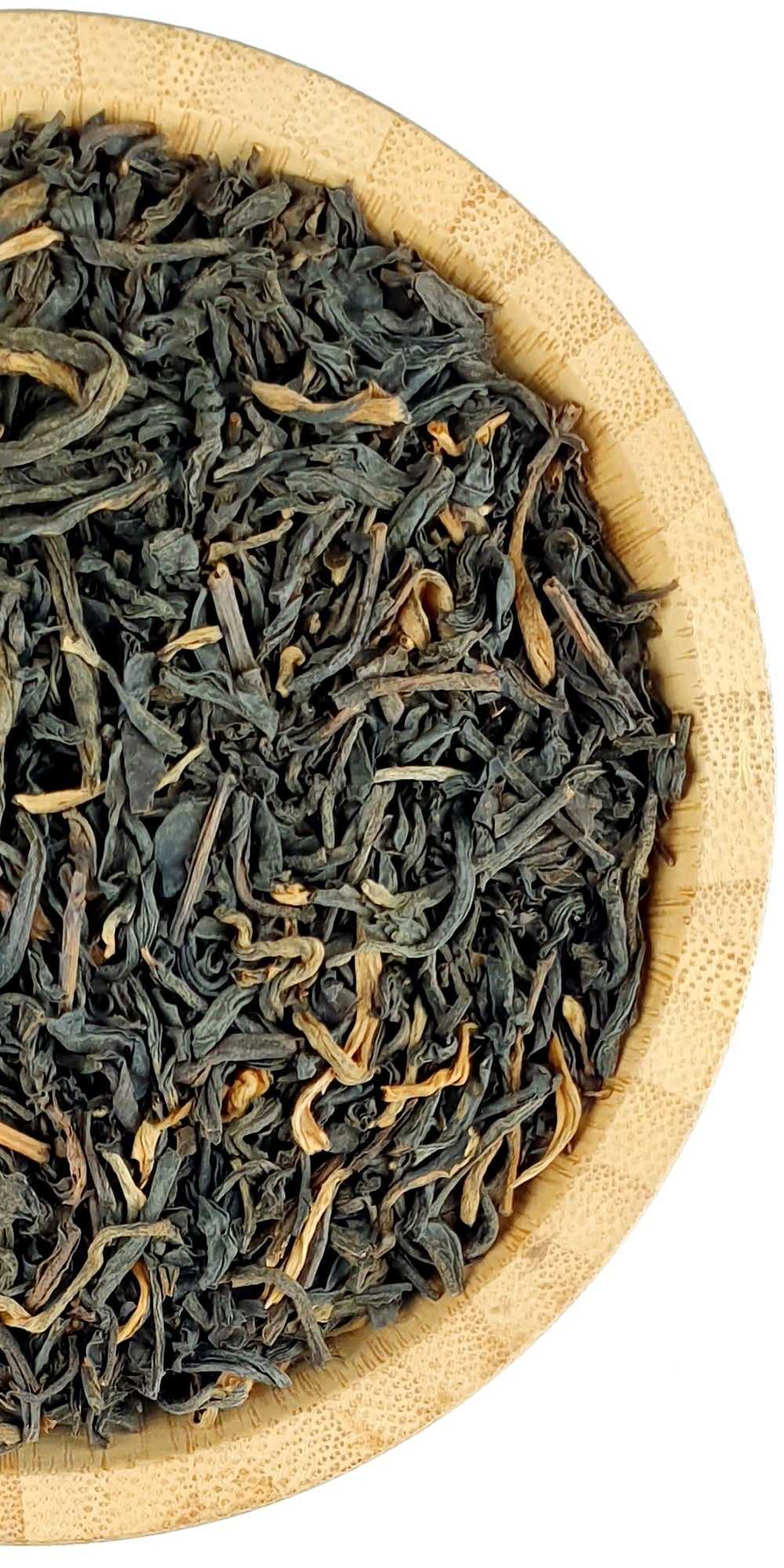
English Breakfast is a blend of loose-leaf black teas with a strong, malty infusion. It is a breakfast tea in the British style, dark and bold.
Breakfast, the English way
Tea blended to order
In London, tea was blended for customers from the very beginning of its sale. Thomas Twining, one of the first London tea merchants, combined teas from several chests in front of the customer and tasted the blend until it suited the customer's taste. His shop on London's Strand has been open since the beginning of the 18th century. The merchant chose the teas so that the infusion would be the same from season to season, regardless of the harvest in any one garden. Blends with fixed names, including breakfast tea, grew out of this practice.
A name that travelled
The name English Breakfast originally referred to Chinese congou black teas from the northern provinces, strong and malty. They were still called that in the trade at the beginning of the 20th century. Stories about who first used the name point to merchants from New York and from Edinburgh, but none of them has a document from the period. Today the name refers to a style, and the composition differs from one blender to another.
How English Breakfast is made
The base is black teas. The leaves are withered, rolled, oxidised and dried.
How it is used today
- Tea for breakfast. A strong infusion with milk, with eggs, sandwiches and porridge. A classic of the British morning.
- Without milk, with lemon. A slice of lemon brightens the malty infusion.
- Homemade chai. Strong tea simmered with milk and spices.
- Iced for summer. A chilled infusion with lemon and honey.
Loose-leaf black teas from a single garden or region include, for example, Assam, Ceylon and Yunnan OP. You will find the others in our Black Tea collection.
English Breakfast in your tea cupboard
It is a strong, straightforward tea, to drink with milk or without.
Frequently asked questions
What is in the blend?
It is a blend of loose-leaf black teas.
How does it differ from Assam?
Assam is a tea from a single region in India. English Breakfast is a blend of black teas.
Is this tea flavoured?
No. It is a blend of black teas with no additions and no flavouring.
Does it contain caffeine?
Yes. The amount of caffeine in the infusion depends on the amount of leaves and the brewing time.
Can I drink it during pregnancy or with medication?
It contains caffeine, so in these situations ask a doctor or pharmacist. A product description does not replace their advice.
Sources
- William H. Ukers, All About Tea, New York 1935, vol. I, chapter XIII “Tea Characteristics”, p. 228 (North China Congou as English Breakfast), and vol. II, chapter VII “History of the British in Tea”, p. 120 (tea blending at Twinings), and chapter XXV “Preparation of the Beverage”, p. 453.
- Jane Pettigrew, A Social History of Tea, London 2001.
- Victor H. Mair, Erling Hoh, The True History of Tea, London 2009.
- Mary Lou Heiss, Robert J. Heiss, The Story of Tea: A Cultural History and Drinking Guide, Berkeley 2007, chapter “Manufacture: From Fresh Leaves to Distinctive Tea”, section “Black Tea”.
- EFSA, Scientific Opinion on the safety of caffeine, EFSA Journal 2015, 13(5):4102.




