




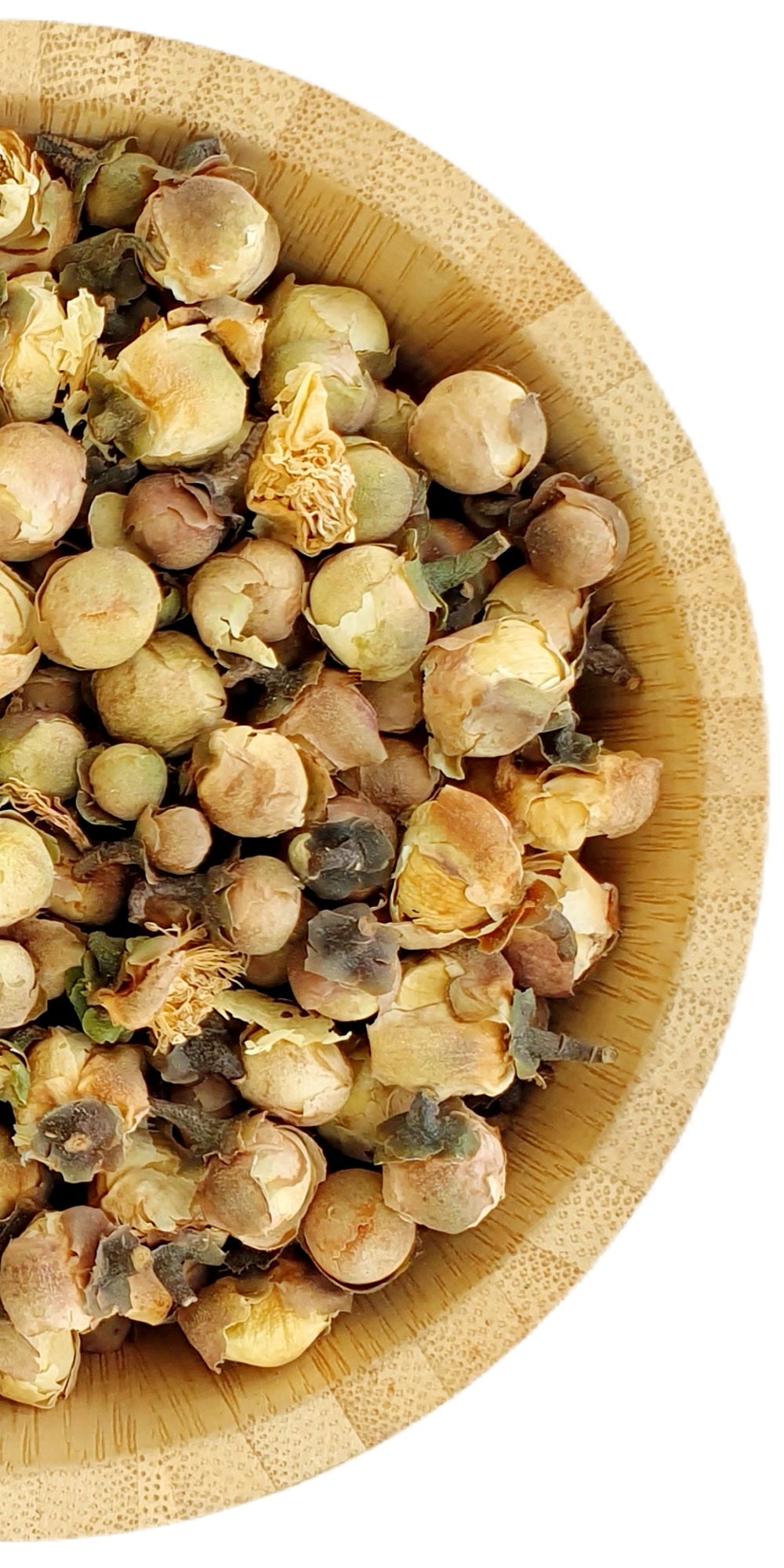
These are dried camellia flower buds from the genus Camellia, the plant group that includes both the Japanese camellia and the tea plant. In China, dried camellia flowers are sold for brewing as a flower tea, and closed buds like these also hold their shape in dried arrangements and craft work. The colour and size of the buds vary between batches.
The camellia genus
Around 120 species
Camellias belong to the family Theaceae. Flora of China counts around 120 species, while other treatments recognise more than 200, and most of them grow in southern China and Indochina. China alone has 97 species, and 76 of them grow nowhere else. Truly yellow camellias, the golden camellia group, are found only in southern China and Vietnam. The same genus holds the Japanese camellia, Camellia japonica, and the tea plant, Camellia sinensis.
A name from Linnaeus
Carl Linnaeus named the genus in 1753 in honour of Georg Joseph Kamel, a Jesuit botanist who worked in the Philippines. Kamel himself never studied camellias. Engelbert Kaempfer saw the camellia in Japan at Dejima in the early 1690s and described it in Amoenitates exoticae in 1712. Camellias reached European gardens in the 18th century.
Camellias in art and literature
In China, camellias appear in painting and on porcelain from the 11th century, and records from the Song period already list 15 varieties. In Yunnan, Camellia reticulata has been grown for centuries and now counts more than 500 cultivars. In Japan the camellia, tsubaki, flowers in early spring and stands for perseverance. In Europe the flower gave its name to a novel: Alexandre Dumas the younger published La Dame aux Camélias in 1848.
How it is used today
- Flower tea. In China, dried camellia flowers are commonly steeped in hot water and sold as a flower tea.
- Crafts and decoration. Whole buds in dried arrangements, wreaths, potpourri and glass jars on display.
Other dried flowers for brewing and craft work, including Globe Amaranth and Jasmine Flowers, are in our Flowers & Petals collection.
Camellia buds in your home cupboard
A jar of camellia buds is for people who like to brew whole flowers, and for those who need small, firm buds for wreaths and arrangements. A few buds are enough for a cup.
Frequently asked questions
What are dried camellia flower buds used for?
In China, dried camellia flowers are sold for brewing as a flower tea. Whole buds are also used in dried arrangements, wreaths and potpourri.
Which camellia are these buds from?
The buds are sold as camellia buds, without a named species, so we describe them at the level of the genus, Camellia. Dried camellia flowers sold for brewing in China come from several species, including the golden camellia, the tea plant and ornamental camellias.
Why is the genus called Camellia?
Linnaeus named it in 1753 after Georg Joseph Kamel, a Jesuit botanist who worked in the Philippines, although Kamel never worked with camellias.
Can I drink it during pregnancy or with medication?
If you are pregnant, breastfeeding, taking medication or have a health condition, ask your doctor before drinking flower infusions.
Where do the buds come from?
The current batch comes from China.
Does it contain caffeine?
We cannot say for this batch. Camellia flowers sold in China come from several species, including the tea plant, Camellia sinensis, whose flowers contain caffeine. Until the species is confirmed, do not treat these buds as caffeine-free.
Sources
- Ming Tienlu, B. Bartholomew, “Camellia”, in Wu Zhengyi, P. H. Raven, Hong Deyuan (eds), Flora of China, vol. 12, Beijing and St. Louis 2007, pp. 366–367.
- International Dendrology Society, “Camellia”, Trees and Shrubs Online.
- Carl Linnaeus, Species Plantarum, vol. 2, Stockholm 1753 (Camellia japonica L.).




