




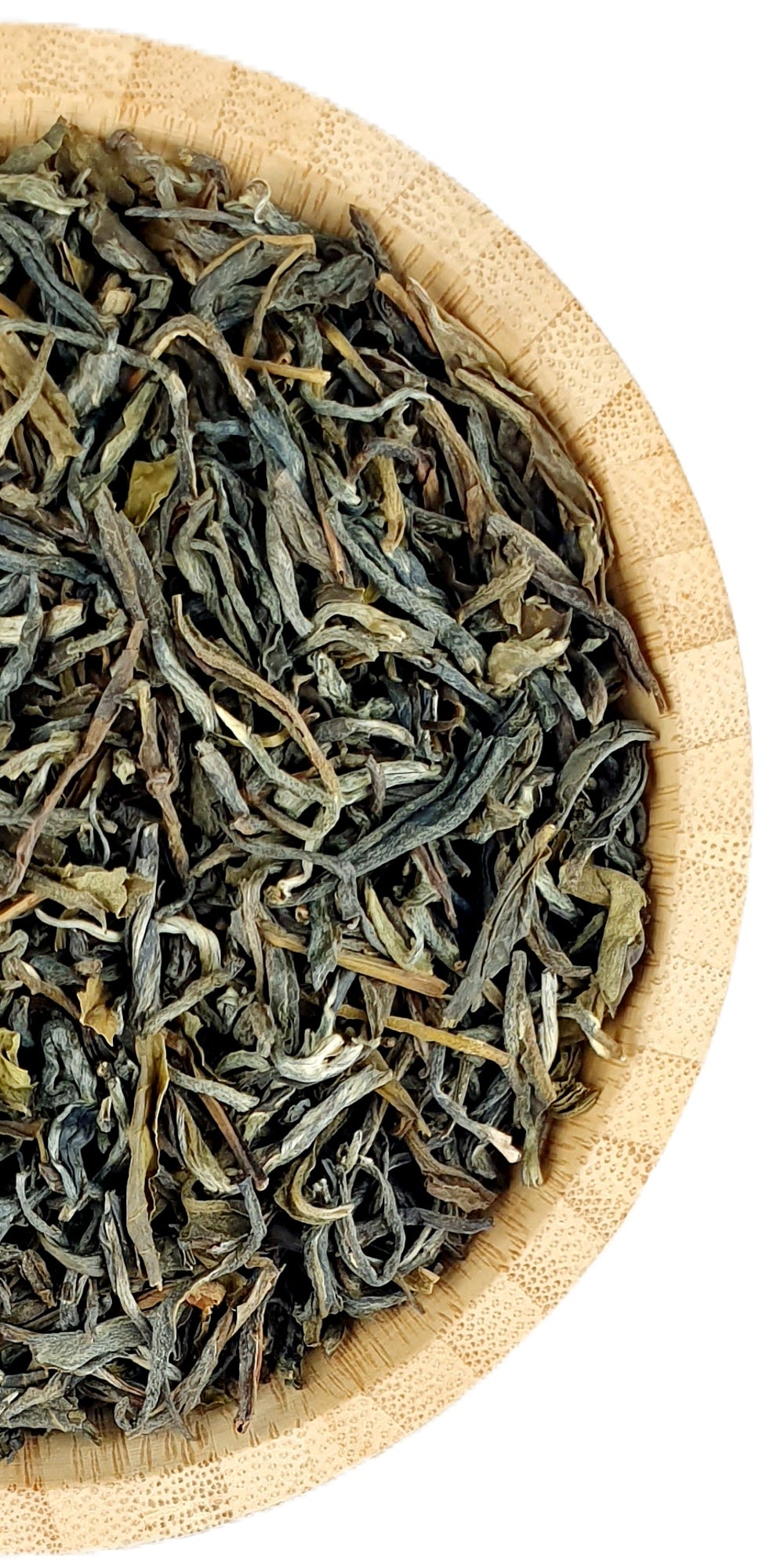
Yunnan Superior green tea is made from large, loosely twisted leaves and gives a full, sweetish infusion with a note of honey and a light earthy background. The flavour develops over several infusions, and the large leaf needs room in the infuser. Yunnan, the province in the tea's name, is associated mainly with pu-erh. It is a tea for people who like stronger green teas and are happy to reach for a gaiwan.
Green tea from south of the clouds
South of the clouds
In Chinese, Yunnan means “south of the clouds”, according to Ukers's glossary. The same author cites the botanist Cohen Stuart, who looked for the answer to the question of where tea came from in the jungles of southern Yunnan, on the borders of Burma and Indochina. In the 1930s the tea season there began in March, and trade was concentrated in Simao, Yibang and Yiwu. From there tea travelled through Sichuan to Tibet and south to Tonkin. At that time Ukers wrote almost exclusively about pressed tea from this province.
The same leaf, a different path
Ukers described how in the prefecture of Pu'er the leaves were fired in a hot pan, dried in the sun, and then steamed and pressed into flat cakes wrapped in bamboo leaves. Green tea begins in the same way, with firing straight after picking. After that the paths diverge, because leaf for green tea is rolled and fully dried, without sun and without pressing. According to the same book, the Chinese method for green tea consisted of firing as soon as possible after picking, rolling and gradual drying.
How Yunnan Superior is made
The leaves are picked together with young tips. Straight after picking, they are heated in a hot, shallow pan to stop oxidation. The soft leaf is rolled lengthwise, so that it dries into long, loose twists. Drying is gradual, until the leaf becomes brittle, and finally the tea is sorted from stalks and dust.
How it is used today
- Several infusions. The large leaf releases its flavour gradually, so one portion is infused three or four times.
- In a gaiwan. Short infusions show how the flavour changes from honey to earth.
- In the kitchen. A strong infusion works as a liquid for cooking fish.
- For pu-erh drinkers. A full-bodied green tea to try alongside it.
We also stock Pu Erh Green and Green Screw separately. You will find our other green teas in the Loose Green Tea collection.
Yunnan Superior in your tea cupboard
This is a green tea for people who like fuller infusions and are happy to infuse the same leaves several times. It also suits those who know pu-erh and want to try a fuller green tea.
Frequently asked questions
Is it the same as sheng pu-erh?
No. Both teas begin with pan-firing, but green tea is fully dried and drunk young, while the leaves for sheng pu-erh are dried in the sun and left to mature.
How many infusions does it take?
Usually three or four when brewed in a cup, and more in a gaiwan. The large leaf releases its flavour gradually, so adjust the time of each infusion to your taste.
Does Yunnan Superior contain caffeine?
Yes. Like every tea from the tea plant, it contains caffeine, and the amount in the infusion depends on the quantity of leaves and the brewing time.
Can I drink it during pregnancy or with medication?
It contains caffeine, so in these situations ask a doctor or pharmacist. A product description does not replace their advice.
Sources
- William H. Ukers, All About Tea, New York 1935, vol. I, chapter I “Tea in the Beginning”, pp. 6–7 (Cohen Stuart and the wild bushes of Yunnan), chapter XIV “Cultivation and Manufacture of Tea”, pp. 267–269 (Chinese method for green tea) and pp. 294–295 (pressed tea from Pu'er), chapter XV “Cultivation and Manufacture in China”, pp. 302–303 (pan-firing) and pp. 307–308 (Pu'er cakes); vol. II, chapter I “Trading in Producing Countries”, pp. 26–27 (trade in Yunnan, season from March) and glossary, pp. 515–516 (“south of the clouds”).
- EFSA, Scientific Opinion on the safety of caffeine, EFSA Journal 2015, 13(5):4102.




