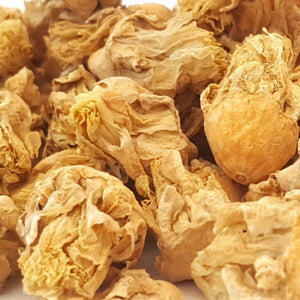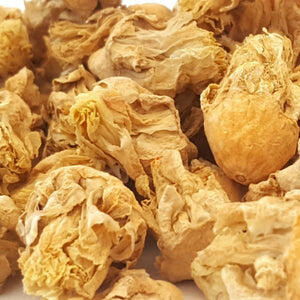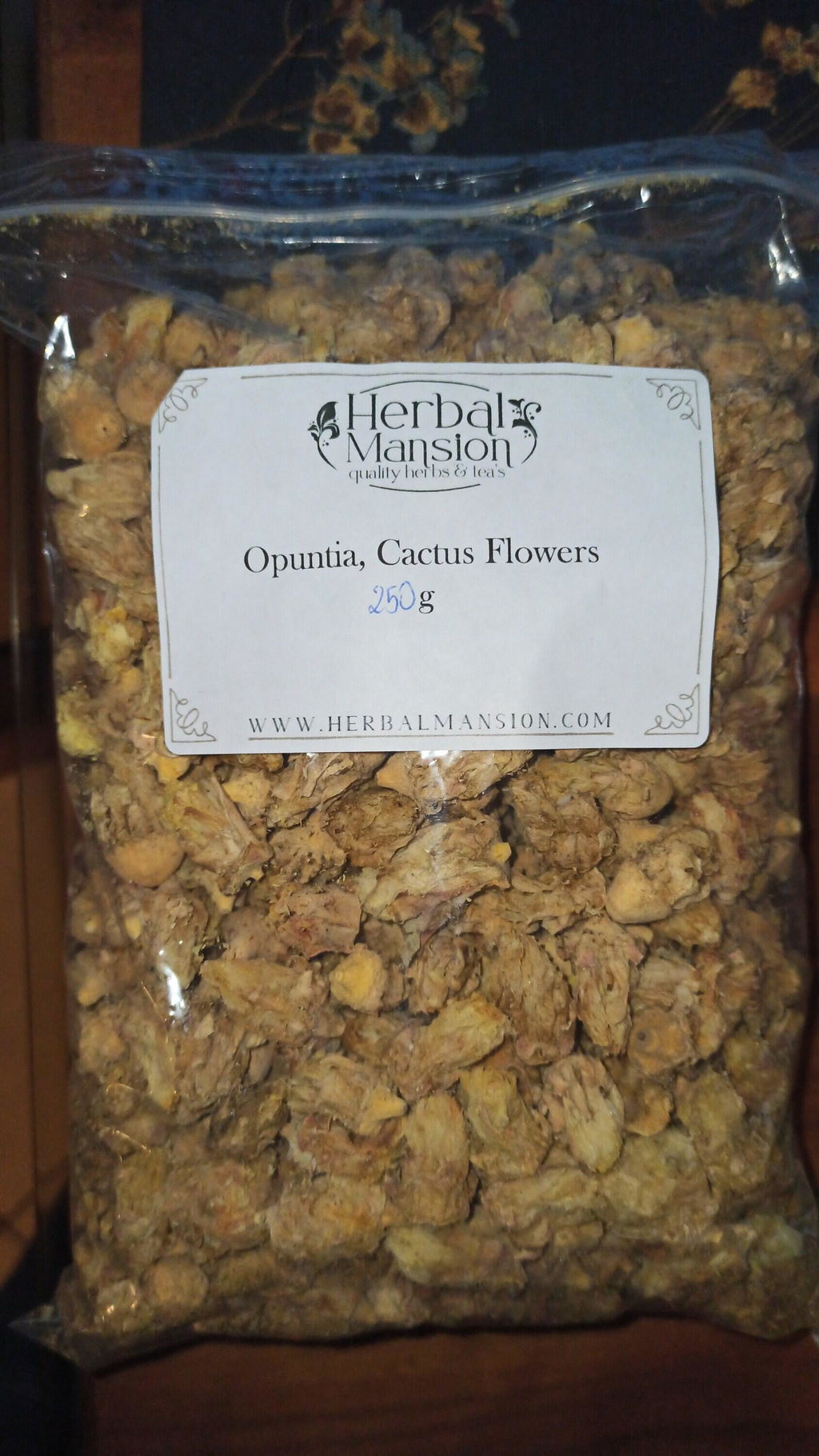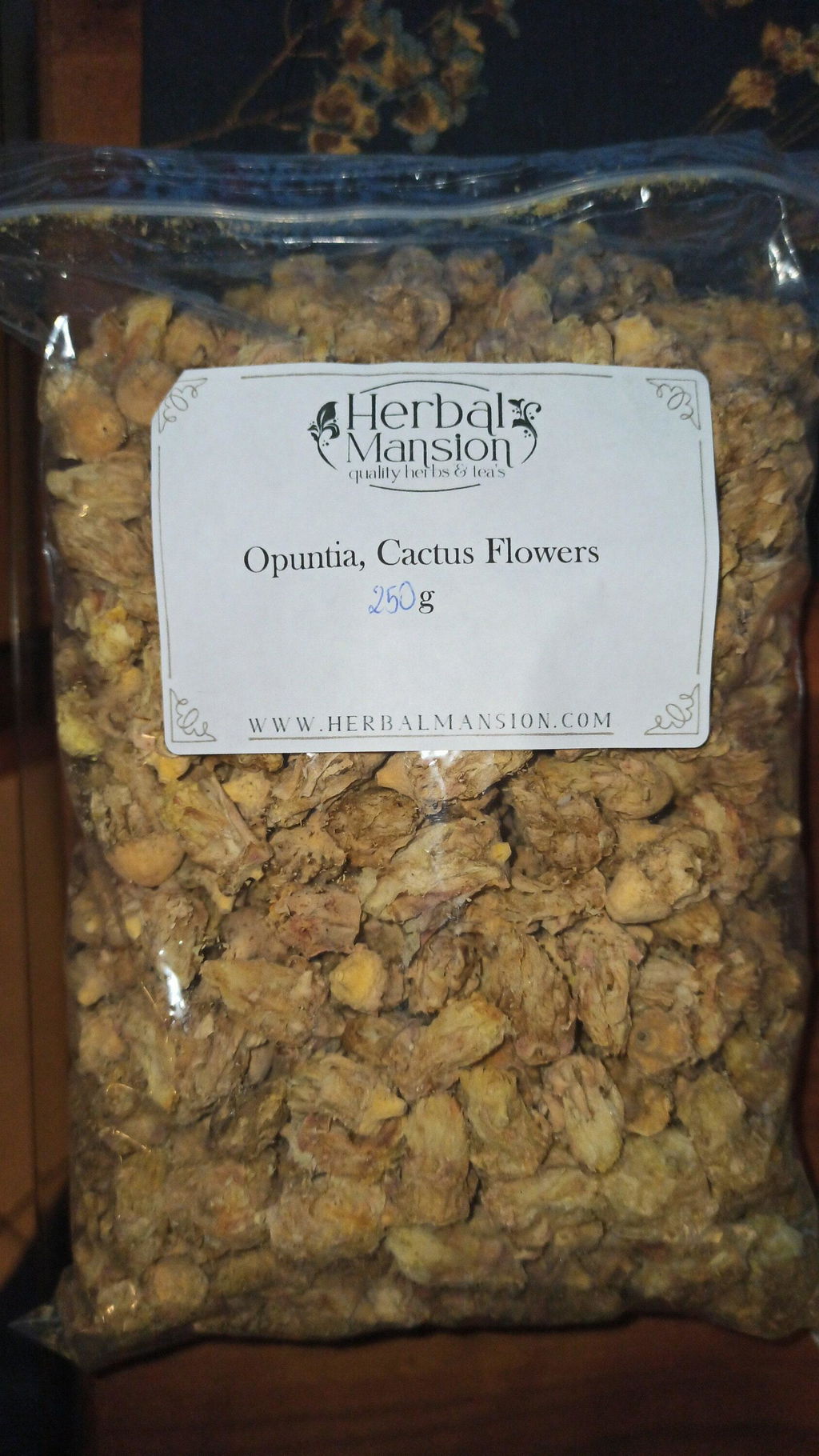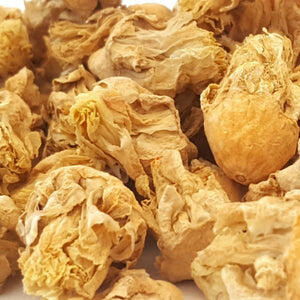


Dried prickly pear flowers are the flowers of the cactus pear, Opuntia ficus-indica. The FAO traces the species to the semi-arid highlands of central Mexico. On the plant these cactus flowers are yellow to orange, and each one stays open for only one or two days.
The cactus and its flower
A shrubby cactus
The cactus pear belongs to the cactus family, Cactaceae. It is a shrubby perennial up to 5 m tall, built from flattened, fleshy stem segments called cladodes. In a Mediterranean climate it flowers in May and June. The flowers grow singly but close together along the upper edge of the segments, each 5 to 8 cm across. The inner petals are yellow to orange and the outer ones yellow with a reddish or green stripe down the middle. The stamens are yellow and the style is bright red.
A plant that crossed the Atlantic
DNA studies place the domestication of the cactus pear in central Mexico. Before Columbus it spread through the Americas, and afterwards around the world. The FAO says it reached Spain around 1500, probably first near Seville or Cádiz, and from Spain it passed to North Africa, where it was called higo de los cristianos, the Christians’ fig. It has since gone wild in many parts of the Mediterranean.
Many names for one plant
In English it is called prickly pear, cactus pear, Barbary fig and Indian fig opuntia. In Spain the fruit is higo chumbo and the plant chumbera. In Mexico the plant is nopal and the fruit tuna, a word probably from the Taíno language. In Greek the fruit is φραγκόσυκο, the Frankish fig.
Fruit and pads in the kitchen
The fruit is eaten raw and made into jams and jellies. The young stem segments, nopalitos, are cooked as a vegetable, with a taste and texture compared to green beans. In Mexico the plant goes into a fermented drink, colonche, and in Sicily and Malta into the liqueurs ficodi and bajtra. The flowers have been studied far less than the fruit and pads. Dried prickly pear flowers have long been infused in Sicily and North Africa.
How it is used today
- Flower infusion. Three to four dried flowers or a heaped teaspoon per cup, steeped covered in water at about 95°C and strained through a fine sieve.
For other whole flowers to steep, try Hibiscus Flowers or Whole Pomegranate Flowers. More dried flowers are in our Flowers & Petals collection, and ingredients for your own blends are in Herbal Tea.
Prickly pear flowers in your home cupboard
Taste varies between batches, so brew your first cup for the shorter time and taste it before adding more flowers or brewing longer. A fine sieve keeps small pieces of the flowers out of the cup. The colour of the dried flowers varies between batches.
Frequently asked questions
Is this dried prickly pear fruit?
No. This product is the dried flowers of the cactus pear. The fruit of the same plant is eaten raw or made into jams and jellies.
Are prickly pear flowers cactus flowers?
Yes. Opuntia ficus-indica is a cactus of the family Cactaceae, and these are its flowers, dried whole.
What is a nopal?
Nopal is the Mexican name for the plant, and its fruit is called tuna. The young stem segments, nopalitos, are cooked as a vegetable.
Can I drink it during pregnancy or with medication?
If you are pregnant, breastfeeding, taking medication or have a health condition, ask your doctor before drinking flower infusions.
Where do the flowers come from?
Tunisia or Morocco, depending on the harvest.
Sources
- Inglese, P., Mondragón, C., Nefzaoui, A. and Sáenz, C. (eds), Crop ecology, cultivation and uses of cactus pear, Food and Agriculture Organization of the United Nations, Rome 2017.
- Flora of North America Editorial Committee, Opuntia ficus-indica, Flora of North America.