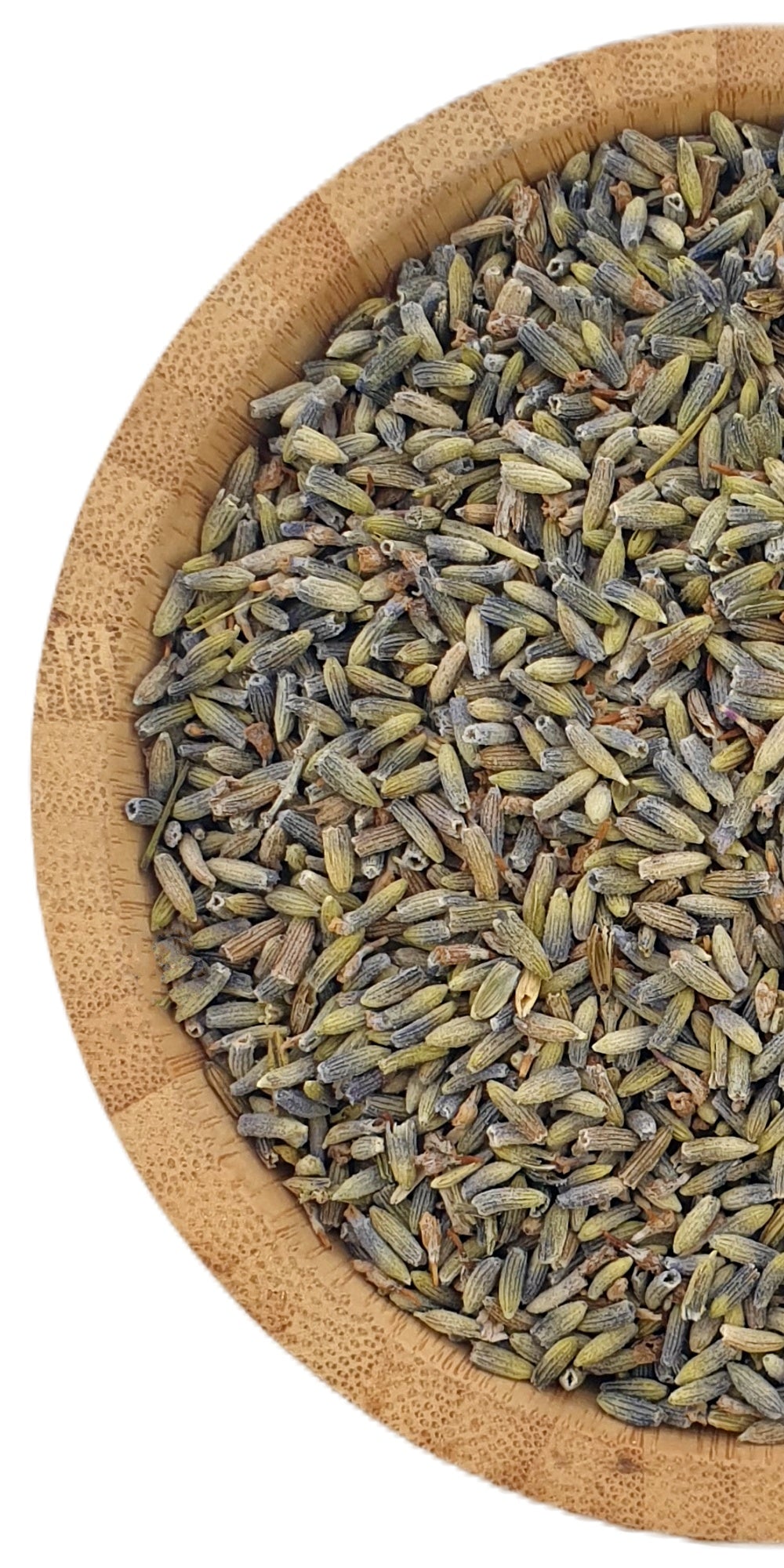
French Lavender is dried lavender, genus Lavandula, and its name tells you the country where it was grown rather than a particular species. That is worth knowing in the UK, where the Royal Horticultural Society uses the name French lavender for one species, Lavandula stoechas. The colour of the flowers varies between batches.
One name, several lavenders
English, French and Spanish
The RHS sorts garden lavenders under three common names. English lavender covers Lavandula angustifolia and the hybrid L. × intermedia. French lavender is L. stoechas. Spanish lavender includes L. latifolia, L. pedunculata and L. viridis. In practice the names are used loosely. French lavender is also a name for L. dentata, and in the United States L. stoechas is usually called Spanish lavender. One account even notes that the French called L. dentata lavande anglaise, English lavender, while the English called the same plant French lavender.
A name for a place
On our shelf, French Lavender refers to where the flowers were grown, not to the species. The lavenders grown as field crops in France are mainly lavande fine, L. angustifolia, and lavandin, a hybrid that gives a higher yield of a less refined oil. The species of this batch is not specified.
Lavender for perfumers
Provence’s lavender has supplied the perfumers of Grasse since the 19th century. Once the railway reached Alpes-de-Haute-Provence, flowers and oil went straight to Grasse, about 100 km away, where perfume making became an industry from the 1850s.
How it is used today
- In the kitchen. Recipe writers say a little goes a long way. Use it sparingly: a pinch is plenty.
- Herbal blends. Lavender is a popular addition to herbes de Provence blends sold outside France, though the Label Rouge recipe of thyme, rosemary, savory and oregano contains none.
- Flower infusion. Sellers suggest a small amount for a cup, steeped under a lid in water just off the boil.
- Decoration and crafts. Whole dried flowers in a glass jar or in dried-flower work.
We also stock Lavender as a separate product with its own description. More plants for the teapot are in Herbal Tea, and other dried flowers are in our Flowers & Petals collection.
A pinch at a time
Lavender is strong, whether it goes into a cake, a syrup or a cup. Start with the smallest amount, taste, and add more next time if you want a stronger note.
Frequently asked questions
What is French lavender?
The name means different things in different places. The RHS uses it for Lavandula stoechas, it is also used for L. dentata, and our French Lavender is named for the country where it was grown.
Does it have the tufted “ears” of Lavandula stoechas?
No. The flower spikes of this batch are slender, without the tufts. The flowers are pale in colour, with a strong scent.
Can I cook with French lavender?
Recipe writers say a little goes a long way. Use it sparingly: a pinch is plenty.
Is lavender a traditional part of herbes de Provence?
Not in the classic recipes. The Label Rouge recipe and the recipes of J.-B. Reboul from 1910 leave it out. Lavender is added mainly to blends made for the North American market.
Can I drink it during pregnancy or with medication?
If you are pregnant, breastfeeding, taking medication or have a health condition, ask your doctor before drinking flower infusions.
Where does the lavender come from?
The current batch comes from France.
Sources
- Royal Horticultural Society, “Lavender: growing guide”, rhs.org.uk.
- INAO, Cahier des charges de l’AOP « Huile essentielle de lavande de Haute-Provence », inao.gouv.fr.
- Ministère de la Culture, Inventaire du patrimoine culturel immatériel, “Les pratiques de culture des lavandes en Haute-Provence”, culture.gouv.fr.
- nature-and-garden.com, “Lavender names”.
- The Daring Gourmet, “Herbes de Provence”, daringgourmet.com.
- Whisked Away Kitchen, “Cooking with Lavender”, whiskedawaykitchen.com.