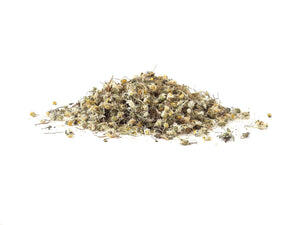
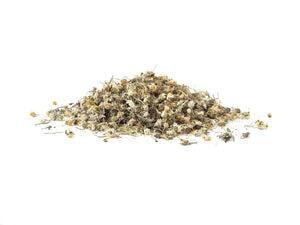
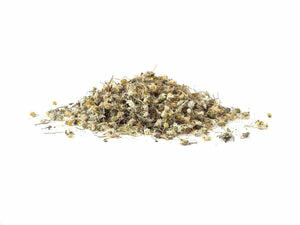
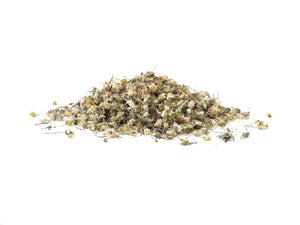
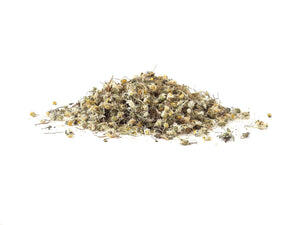
Dried daisy flowers are the flower heads of the daisy, Bellis perennis. Each white “petal” around the yellow centre is in fact a separate flower, and one head holds over a hundred flowers in all.
The daisy and its name
Over a hundred flowers in one head
The yellow centre of a daisy is made of over a hundred tiny flowers, ringed by white ray flowers that look like petals and are sometimes tinged with pink. The plant is a low evergreen perennial, about 20 cm tall, with a rosette of rounded leaves. It grows in lawns and meadows across most of Europe and into western Asia. In Britain it is very common, flowers from March to September and is listed as Least Concern; Plants For A Future notes that it can flower almost all year round. The daisy belongs to the daisy family, Asteraceae.
The day’s eye
The word daisy comes from the Old English dægesēage, “day’s eye”, because the flower opens in the morning and closes at dusk. It was in use before the 12th century. Medieval Latin called the flower solis oculus, eye of the sun, and Chaucer, in the prologue to The Legend of Good Women, writes of the “dayesye” and the “ye of day”.
Daisy chains
Daisy chains are made by slitting the stem of one flower and threading the stem of the next through it, until the chain is long enough for a necklace or a bracelet. Plantlife also records the rhyming slang “daisy roots” for boots.
The daisy at the table
Plants For A Future lists the flower buds and petals as eaten raw in salads, sandwiches and soups.
How it is used today
- Daisy tea. One or two teaspoons of flowers per mug, steeped covered in freshly boiled water.
- In the kitchen. Plants For A Future lists daisy petals and buds as a salad ingredient.
For another member of the daisy family, try Calendula Petals, and for a white flower for the cup, White Chrysanthemum. More dried flowers are in our Flowers & Petals collection, and ingredients for your own blends are in Herbal Tea.
Daisies in your home cupboard
Taste varies between batches, so brew your first cup for the shorter time and taste it before adding more flowers. One seller notes that steeping for too long can make the infusion bitter.
Frequently asked questions
How do I make daisy tea?
Put 1 to 2 teaspoons of dried daisy flowers in a 250 ml mug, pour over freshly boiled water, cover and leave for 5 to 7 minutes, then strain.
Why is it called a daisy?
The name comes from the Old English for “day’s eye”, because the flower opens in the morning and closes at dusk.
Is each white petal really a flower?
Yes. Each white ray is a separate flower, and so is each tiny flower of the yellow centre: over a hundred flowers in one head.
I react to plants in the daisy family. Is this for me?
Daisy belongs to the daisy family, Asteraceae. If you know you react to plants in this family, ask your doctor or pharmacist before use.
Can I drink it during pregnancy or with medication?
If you are pregnant, breastfeeding, taking medication or have a health condition, ask your doctor before drinking flower infusions.
Where do the flowers come from?
The current batch comes from Albania.
Sources
- Plantlife, Daisy (Bellis perennis), plantlife.org.uk, accessed 19 November 2026.
- Plants For A Future, Bellis perennis L., PFAF Plant Database, accessed 19 November 2026.
- Merriam-Webster, Daisy, Merriam-Webster.com Dictionary, accessed 19 November 2026.
- Harper, D., Daisy, Online Etymology Dictionary, accessed 19 November 2026.
- Botanical Society of Britain and Ireland, Bellis perennis L., Daisy, Fermanagh species accounts, accessed 19 November 2026.