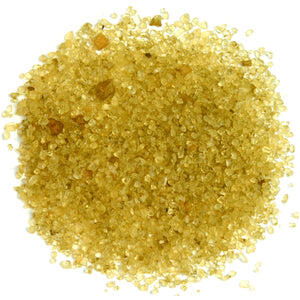
Hawaiian Bamboo Jade Salt, or jade salt, is a green salt: sea salt from the island of Molokaʻi, Hawaii, coloured with bamboo leaf and mineral extracts. This decorative salt, sold as bamboo jade, comes as green granules of 1 to 2 mm.
How it is made
Seawater is let into shallow ponds on Molokaʻi, where the sun and wind evaporate it until the salt crystallises. After drying, the salt is coloured with bamboo leaf and mineral extracts, which give it its green colour. It is then packed as granules of 1 to 2 mm.
About the name
Jade refers to the green colour of the granules, and bamboo to the leaf extract that colours them. The salt is not made in bamboo and is not roasted.
What it contains
Sea salt coloured with bamboo leaf and mineral extracts. Two more salts from Molokaʻi in our range are coloured in other ways: Hawaiian Alaea Red Salt, red with finely milled volcanic clay, and Hawaiian Black Lava Salt, black with activated carbon and a mineral extract.
Storage
Keep the salt tightly closed in a dry, dark place. Salt takes up moisture from the air and clumps when it gets damp.
Frequently asked questions
Is this the same as Korean bamboo salt?
No. Korean bamboo salt, jukyeom, is made by packing solar sea salt into a bamboo tube closed at one end, sealing it with yellow clay and roasting it at a high temperature, nine times over, according to the Standard Korean Language Dictionary. Hawaiian Bamboo Jade Salt is neither roasted nor made in bamboo: it is sea salt coloured with bamboo leaf and mineral extracts.
What makes the salt green?
Bamboo leaf and mineral extracts, added after the salt has dried.
Where does our bamboo jade salt come from?
The current batch was produced on Molokaʻi, Hawaii.
Sources
- National Institute of Korean Language, Standard Korean Language Dictionary, "jukyeom" (죽염), stdict.korean.go.kr, accessed 23 November 2026.
- Verbraucherzentrale Bayern, Was ist Hawaii-Salz?, verbraucherzentrale.bayern, accessed 23 November 2026.