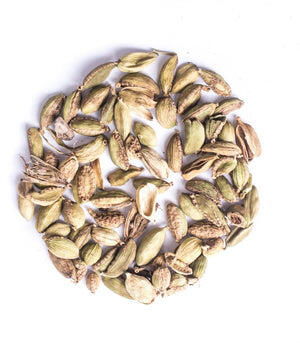
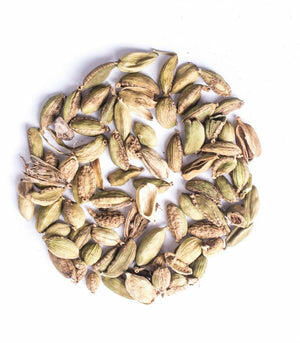
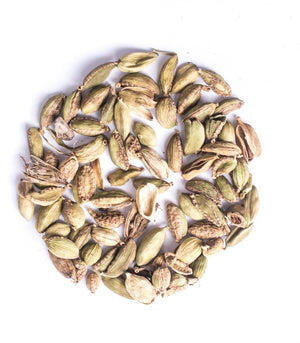
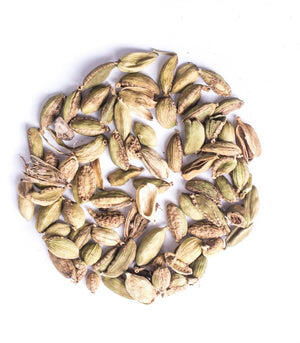
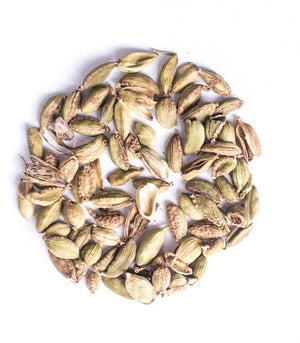
Cardamom pods are the dried fruits of green cardamom, Elettaria cardamomum, a plant of the ginger family native to southern India. Each small, three-sided green pod holds hard, dark seeds with a sweet, citrusy and slightly minty aroma, a spice for Arabic coffee, chai, Scandinavian buns, curries and rice.
The pod and its seeds
The fruit of green cardamom is a three-sided capsule containing small, angular seeds, reddish brown to almost black. The fruits are picked just before they ripen and then dried, either in the sun or in heated kilns. Kiln drying keeps the pods a vivid green, while sun-dried pods tend towards yellow.
Green and black cardamom
Black cardamom is a different plant of the same family, usually Amomum subulatum. Its pods are dried and often smoked, and it has a smoky flavour with notes of menthol, suited mainly to savoury dishes. Green cardamom is milder and sweeter, and it works in both sweet and savoury cooking.
Flavour and name
Spice sellers describe green cardamom as sweet, citrusy and herbal, with minty or eucalyptus-like notes. The word cardamom came into English through Old French and Latin from the Greek kardamōmon, probably a blend of kardamon, "cress", and amōmon, another spice plant. Cardamon is a less common spelling of the same word, listed in English dictionaries.
How it is used today
- Arabic coffee. Ground together with the coffee beans for gahwa, also written qahwa, the light, cardamom-scented coffee of the Gulf.
- Chai. In chai, spiced black tea.
- Scandinavian baking. In Swedish kardemummabullar, cardamom buns, the ground seeds go into both the dough and the filling.
- Curries and spice blends. Whole pods in curries, and ground seeds in blends such as garam masala.
- Rice. Lightly crushed pods in fragrant rice dishes, for example with basmati.
- Desserts. Ground seeds in cakes, shortbread and fruit salads.
For two more spices of garam masala, see Cloves and Coriander Seeds. More are in our Whole Spices and Herbs & Spices collections.
Cardamom pods in your kitchen
For curries and rice, crush the pods lightly so they split, add them whole and take them out before serving. For baking, desserts and coffee, crack the pods, tip out the seeds and grind them just before use: ground cardamom loses its flavour quickly, while whole pods keep it much longer. You can also toast the pods or seeds lightly in a dry pan before grinding. Keep the pods in a tightly closed bag in a cool, dark, dry place and use them within about a year, checking the aroma. Taste varies between batches.
Frequently asked questions
Is it cardamom or cardamon?
Both spellings are correct. Cardamom is the main form in English dictionaries, and cardamon is a less common variant of the same word.
What is the difference between green and black cardamom?
They come from different plants of the ginger family. Green cardamom, this product, is sweet and citrusy. Black cardamom, Amomum subulatum, is dried and often smoked, with a smoky flavour for savoury dishes.
Should I use the whole pod or just the seeds?
Both work. Lightly crushed whole pods suit curries and rice; for baking, desserts and coffee, grind the seeds from inside the pods.
Where do our cardamom pods come from?
The current batch was grown in Honduras.
Sources
- Encyclopaedia Britannica, "cardamom", britannica.com, accessed 23 November 2026.
- The American Heritage Dictionary of the English Language, "cardamom" and "black cardamom", ahdictionary.com, accessed 23 November 2026.
- Dictionary.com, "cardamon", dictionary.com, accessed 23 November 2026.
- The Spice House, Green Cardamom Pods, thespicehouse.com, accessed 23 November 2026.
- Schwartz, Cardamom Pods, schwartz.co.uk, accessed 23 November 2026.
- McCormick, About Cardamom: Uses, Pairings and Recipes, mccormick.com, accessed 23 November 2026.
- Swedish Spoon, Irresistible Swedish cardamom buns, kardemummabullar, swedishspoon.com, accessed 23 November 2026.