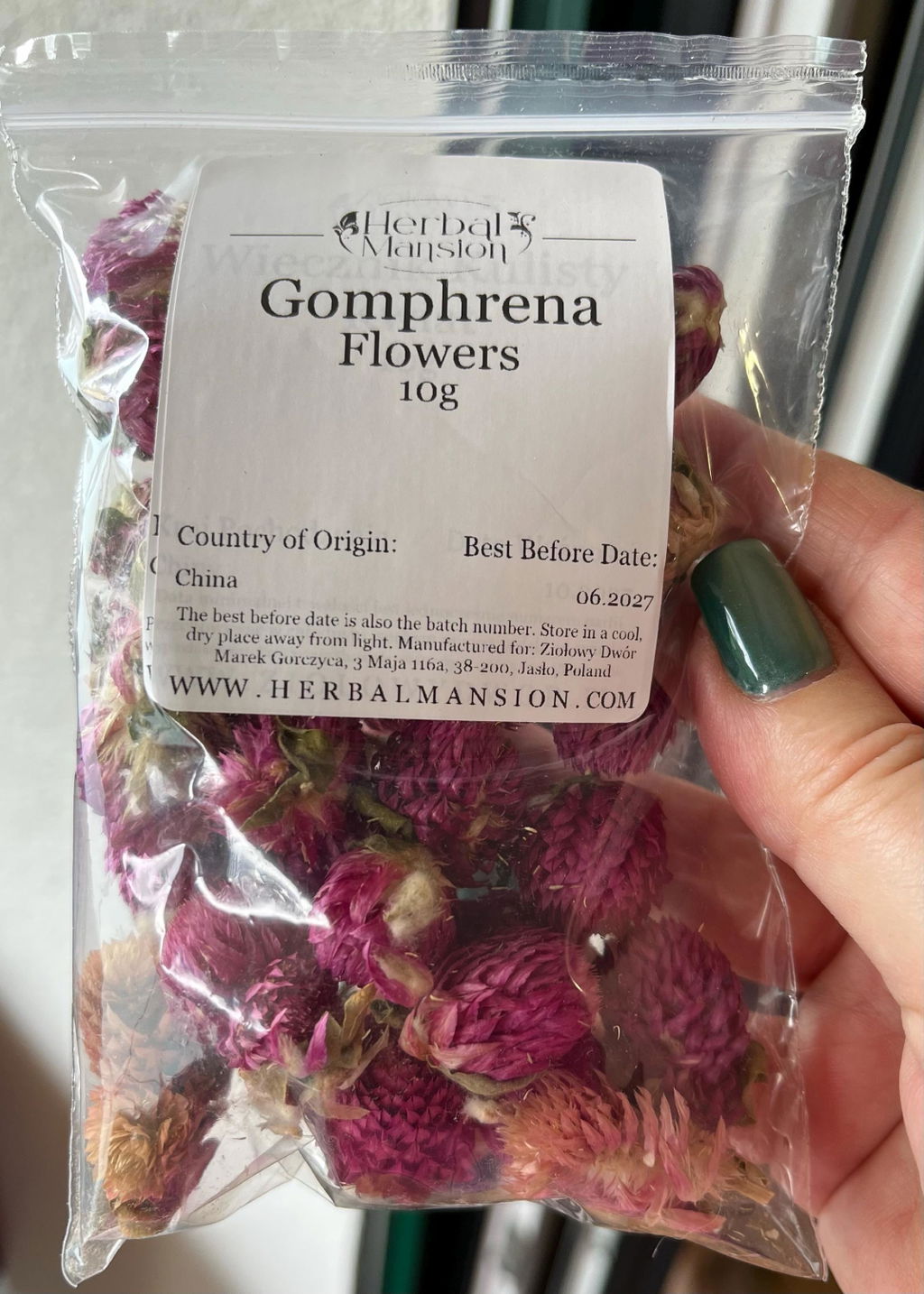
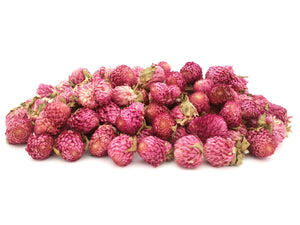
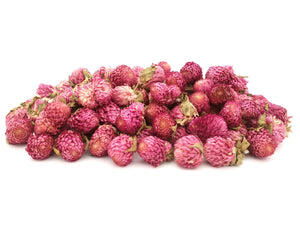
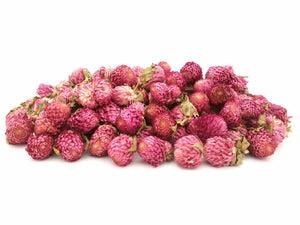
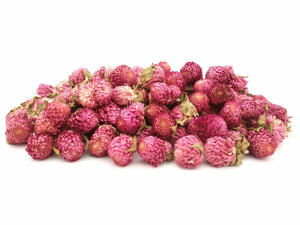
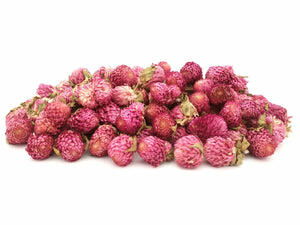
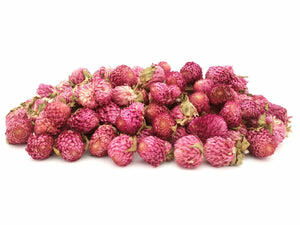
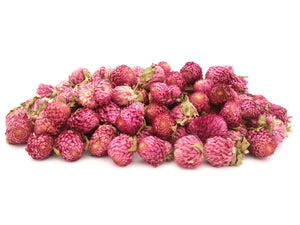
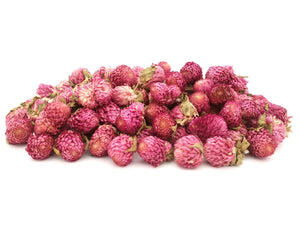
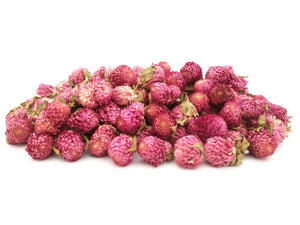
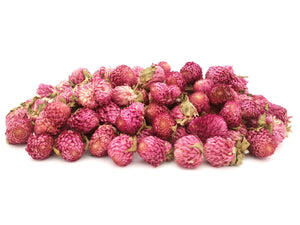
Dried globe amaranth flowers are the round, papery heads of Gomphrena globosa, and they keep their shape and colour after drying. That is why the plant is grown as an “everlasting” for garlands and wreaths. The heads are also steeped in hot water as a flower tea, which sellers describe as pink to purple.
The plant, its bracts and its garlands
An annual from the American tropics
Globe amaranth is an annual of the amaranth family, Amaranthaceae, native to the American tropics, from Mexico to Brazil. Linnaeus described it in Species Plantarum in 1753. It has since been introduced in many places, and China cultivates it widely. The plant grows 20 to 60 cm tall and flowers from June to September. Its heads are 2 to 2.5 cm across, usually purple, sometimes light purple or white.
Bracts, not petals
The real flowers are tiny yellow trumpets hidden among papery bracts. The bracts last, and they hold the shape and colour of the head after drying. In Chinese the plant is called qiānrìhóng, literally “thousand days red”; it also goes by bǎirìhóng and huǒqiúhuā.
Garlands in Hawaii and Nepal
In Hawaii the flower is known as lehua pepa, leihua and lehua mau loa, and it is strung into lei. Andrews, in 1865, described the flowers made into wreaths for the head, and a lei left to dry in the air becomes an “everlasting lei”. In Nepal, garlands of makhamali phul are worn on Bhai Tika, the last day of the Tihar festival; there the slow fading of the flower stands for a long life.
How globe amaranth is used today
- Flower tea. Sold as a caffeine-free flower infusion that sellers describe as mild, slightly sweet and grassy. In India, a pink tea of the same flower is made at home under the name vadamalli.
- Blooming teas. One of the flowers used in flowering, or blooming, teas.
- Decoration and crafts. The colour lasts, so the heads go into potpourri and wreaths and onto cakes as decoration.
Other dried flowers, including Blue Mallow and Camellia Buds, are in our Flowers & Petals collection.
Who globe amaranth is for
People who like a coloured flower tea in a glass cup, and anyone who needs dried flowers that hold their colour in a wreath or a bowl of potpourri.
Frequently asked questions
What colour is globe amaranth tea?
Usually described as pink, bright pink or purple. The flower heads contain betacyanin pigments, which food scientists have studied as a red-violet colouring, for example in ice cream. The exact shade of the infusion varies between batches.
What is globe amaranth used for?
The heads are steeped as a flower tea and used in blooming teas. Because they keep their colour when dried, they also go into potpourri, wreaths, garlands and cake decoration.
Does globe amaranth contain caffeine?
Globe amaranth is not a tea plant, and it is sold as a caffeine-free flower infusion.
Can I drink it during pregnancy or with medication?
If you are pregnant, breastfeeding, taking medication or have a health condition, ask your doctor before drinking flower infusions.
Where do the flowers come from?
The current batch comes from China.
Sources
- Royal Botanic Gardens, Kew, “Gomphrena globosa L.”, Plants of the World Online (accessed 19 November 2026).
- Wu Z. Y., P. H. Raven, Hong D. Y. (eds), Flora of China, vol. 5, Beijing and St. Louis 2003, entry Gomphrena globosa.
- University of Hawaiʻi at Mānoa, College of Tropical Agriculture and Human Resources, Growing Plants for Hawaiian Lei.