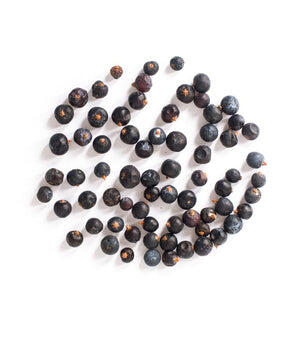
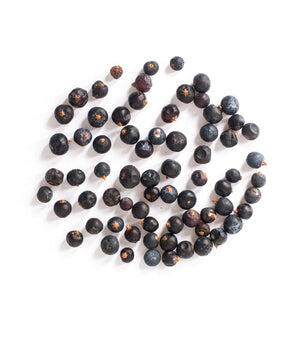
Dried juniper berries are the ripe seed cones of the common juniper, Juniperus communis. Resinous and pine-like, they are the defining flavour of gin and a classic seasoning for game, sauerkraut and Alsatian choucroute.
A cone, not a berry
Juniper is a conifer of the cypress family, the Cupressaceae. Its "berries" are fleshy seed cones: the scales of a small cone fuse together into a round, berry-like structure around the seeds. Botanically they are cones, not true berries. Juniper plants are usually either male or female, and only the female plants bear these cones.
Two or three years to ripen
The cones take two, sometimes three, years to ripen, turning from green to a waxy blue-black. A single shrub can therefore carry green and ripe cones at the same time. Common juniper is native across much of the Northern Hemisphere, from Europe and North Africa through Asia to North America.
Juniper and gin
The word juniper comes from the Latin iuniperus. Gin is named after the plant as well: the word is short for geneva, an alteration of the Dutch genever, literally "juniper", which goes back through Old French to the same Latin word. The spirit took its name from the juniper berries that flavour it, and juniper is still the dominant flavour of gin.
Flavour
One spice seller describes the scent of juniper as clear and sharp, with tannic and citrus notes. In cooking the flavour is often described as resinous and pine-like, with a citrus edge.
How it is used today
- Game and poultry. In marinades for game and poultry, where juniper tempers a strong gamey taste.
- Sauerkraut and cabbage. Cooked with sauerkraut and with braised Savoy cabbage.
- Choucroute garnie. In one Alsatian recipe a few berries go into the pot with the sauerkraut, tied in a cloth bag with garlic and lifted out before serving.
- Marinades and pickles. In marinades for meat and in pickling brines.
For another whole spice used in stews, marinades and pickles, see Allspice Berries. More are in our Whole Spices and Herbs & Spices collections.
Juniper berries in your kitchen
Crush the berries lightly with the flat of a knife or in a mortar just before use, to release their aroma. Juniper is strong: a few berries, around 4 to 6 for a family-sized pot, are usually enough. Add them at the start of braising or marinating, ideally in a small cloth bag, and remove them before serving. Keep the berries whole in a tightly closed bag in a cool, dark, dry place and use them within about a year, checking the aroma. Taste varies between batches.
Frequently asked questions
Are juniper berries really berries?
No. They are fleshy seed cones whose scales have fused into a berry-like shape. Juniper is a conifer, and the cones take two or three years to ripen.
How many juniper berries should I use?
A few are enough: around 4 to 6 lightly crushed berries for a family-sized pot. The Alsace tourist board's recipe for choucroute garnie uses 5 berries for 1.5 kg of sauerkraut.
Is gin named after juniper?
Yes. Gin is short for geneva, from the Dutch genever, "juniper", and juniper berries give gin its main flavour.
Where do our juniper berries come from?
The current batch comes from Germany.
Sources
- Missouri Botanical Garden, Juniperus communis var. depressa, Plant Finder, mobot.org, accessed 23 November 2026.
- Tirmenstein D., Juniperus communis (1999), Fire Effects Information System, USDA Forest Service, fs.usda.gov, accessed 23 November 2026.
- The Spice House, Juniper Berries, thespicehouse.com, accessed 23 November 2026.
- Visit Alsace, Choucroute garnie à l'alsacienne, visit.alsace, accessed 23 November 2026.
- The American Heritage Dictionary of the English Language, "gin", ahdictionary.com, accessed 23 November 2026.
- Dictionary.com, "juniper", dictionary.com, accessed 23 November 2026.