St John's wort takes its English name from the calendar: the plant is often in flower around the feast of St John the Baptist on 24 June. This is the dried herb of Hypericum perforatum, a yellow-flowered perennial native to Europe, Asia and North Africa.
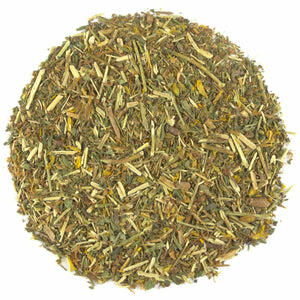
The cut herb includes pieces of pale, straw-coloured stem and green leaf, with yellow flower pieces and some reddish-brown bits.
A flower for St John's Day
St John's wort flowers from June to August, so St John's Day usually finds it in bloom. The genus name Hypericum is said to come from the Greek hyper (above) and eikon (image), after the old custom of hanging the flowers above pictures, icons or windows.
In folklore, the flowers were once gathered and put on display to ward off evil spirits.
What the plant looks like
St John's wort is an upright, branching perennial, 30 to 90 cm tall, that grows from a woody rootstock and spreads by runners.
Its star-shaped flowers are about 4 cm across, with five yellow petals marked with black dots and a tuft of stamens in the centre.
The oval to oblong leaves, up to about 3 cm long, clasp the stem. They are covered in translucent dots that make them look pierced, which is where the species name perforatum comes from, and black dots run along their edges.
Where it grows
The plant is native across Europe, including Poland, Germany, France, Britain, Ireland and Scandinavia, east through Asia as far as China, and in North Africa.
Settlers brought it to North America in 1696. There it became known as Klamath weed, after the Klamath River in California, where it was found growing wild. A single plant can produce up to 100,000 seeds, and today it is regarded as a weed in several US states.
Across Europe it goes by many names: Johanniskraut in German, millepertuis in French, hipérico in Spanish, erba di San Giovanni in Italian, sint-janskruid in Dutch and dziurawiec in Polish.
Storage
Keep the herb in a closed container in a cool, dry place, away from direct light.
Frequently asked questions
Why is it called St John's wort?
Because the plant is often in flower around the feast of St John the Baptist on 24 June.
What does perforatum mean?
The leaves are covered in tiny translucent dots that make them look perforated, and the species is named after them.
Where does St John's wort grow?
It is native to Europe, Asia as far as China, and North Africa. It has been introduced to North America, Chile, Argentina, New Zealand, Japan and Korea.
Sources
- Plants of the World Online, Royal Botanic Gardens, Kew, Hypericum perforatum L., accessed 25 November 2026.
- Missouri Botanical Garden, Plant Finder, Hypericum perforatum, accessed 25 November 2026.