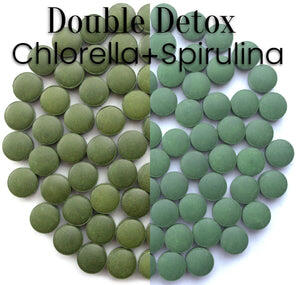
Chlorella and spirulina tablets, sometimes listed as spirulina & chlorella, are tablets made from pressed chlorella and spirulina powder. They bring together two very different microorganisms: chlorella, a single-celled green alga, and spirulina, the cyanobacterium Arthrospira platensis. Both come from China.
Two different microorganisms
Chlorella and spirulina are often mentioned in the same breath, yet biologists place them in different kingdoms.
- Chlorella is a true alga, a green alga whose cell has a nucleus. Each organism is a single round cell, 2 to 12 thousandths of a millimetre long, coloured green by chlorophyll.
- Spirulina is a cyanobacterium, whose cells have no nucleus. It grows as threads of cells coiled into a spiral, 50 to 500 thousandths of a millimetre long, coloured blue-green by phycocyanin together with chlorophyll.
Grown in different ways
Chlorella is cultivated in aerated cultures, and in Japan and Korea widely by fermentation; commercial chlorella production began in Japan around 1960. Spirulina needs strong sunshine and highly alkaline water and is grown in open or covered ponds or in bioreactors. Its use as food is far older: Spanish chroniclers recorded the Aztecs gathering it from the lakes around Tenochtitlan, and people living by Lake Chad have long dried it into cakes.
Why tablets
Two fine, strongly coloured powders are exactly the kind of thing that ends up on the worktop. Pressed into tablets, both stay firm: no spoon, no blender, and no green or blue-green dust. A closed pack slips into a bag or a drawer without mess.
To try each one on its own, see Chlorella Tablets and Spirulina Tablets. For cooking, Chlorella Powder and Spirulina Powder mix straight into smoothies and doughs.
Ingredients
Chlorella tablets: chlorella 99%, anti-caking agent: silicon dioxide 1%. Spirulina tablets: spirulina 98%, anti-caking agents 2% (silicon dioxide, magnesium salts of fatty acids).
Storage
Spirulina in particular draws moisture from the air. Keep the pack tightly closed, in a cool, dry place out of the light, and reseal it as soon as you have taken tablets out.
Frequently asked questions
What is the difference between chlorella and spirulina?
Chlorella is a green alga made of single round cells; spirulina is a cyanobacterium that grows in spiral threads. Chlorella is green and spirulina blue-green, and they grow in different conditions: chlorella in aerated cultures or by fermentation, spirulina in sunny, alkaline ponds.
Is either of them a seaweed?
No. Both are microscopic. Chlorella is a single-celled alga and spirulina a cyanobacterium, so neither is a seaweed.
Where do the chlorella and spirulina come from?
Both come from China.
Can I buy chlorella or spirulina on their own?
Yes. Each is also sold separately, as tablets and as a powder.
Sources
- Encyclopaedia Britannica, Chlorella, accessed 24 November 2026.
- Pl@ntUse, Plant Resources of South-East Asia (PROSEA), Chlorella, accessed 24 November 2026.
- Habib M.A.B., Parvin M., Huntington T.C., Hasan M.R., A review on culture, production and use of spirulina as food for humans and feeds for domestic animals and fish, FAO Fisheries and Aquaculture Circular No. 1034, FAO (2008), accessed 24 November 2026.
- GBIF Backbone Taxonomy, Global Biodiversity Information Facility, genus Chlorella and Arthrospira platensis, accessed 24 November 2026.