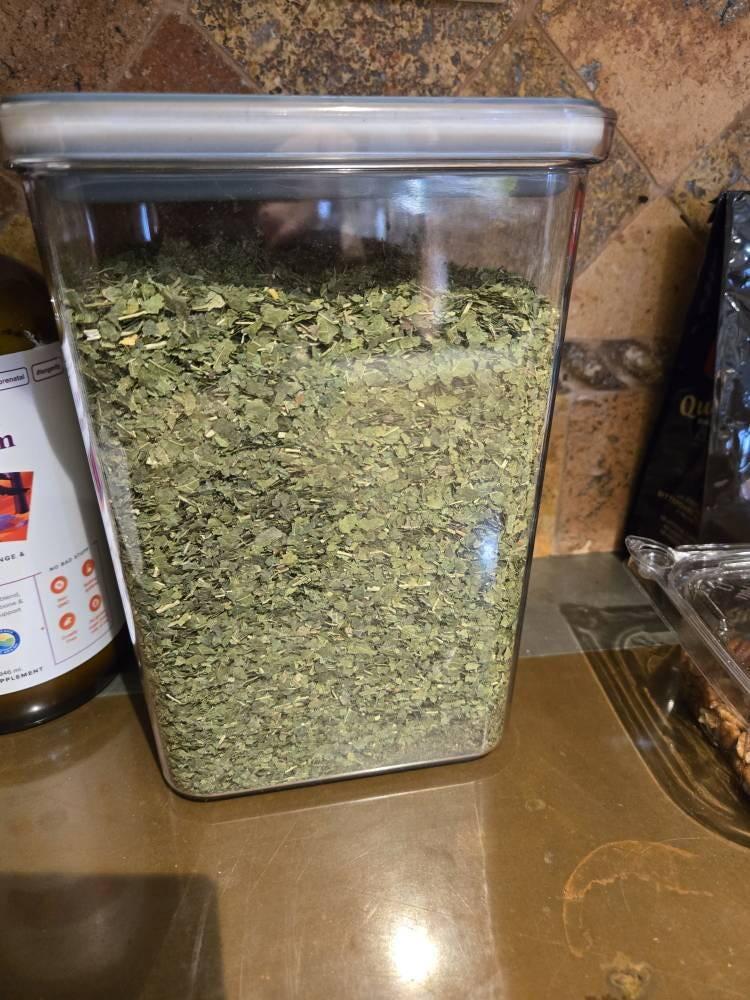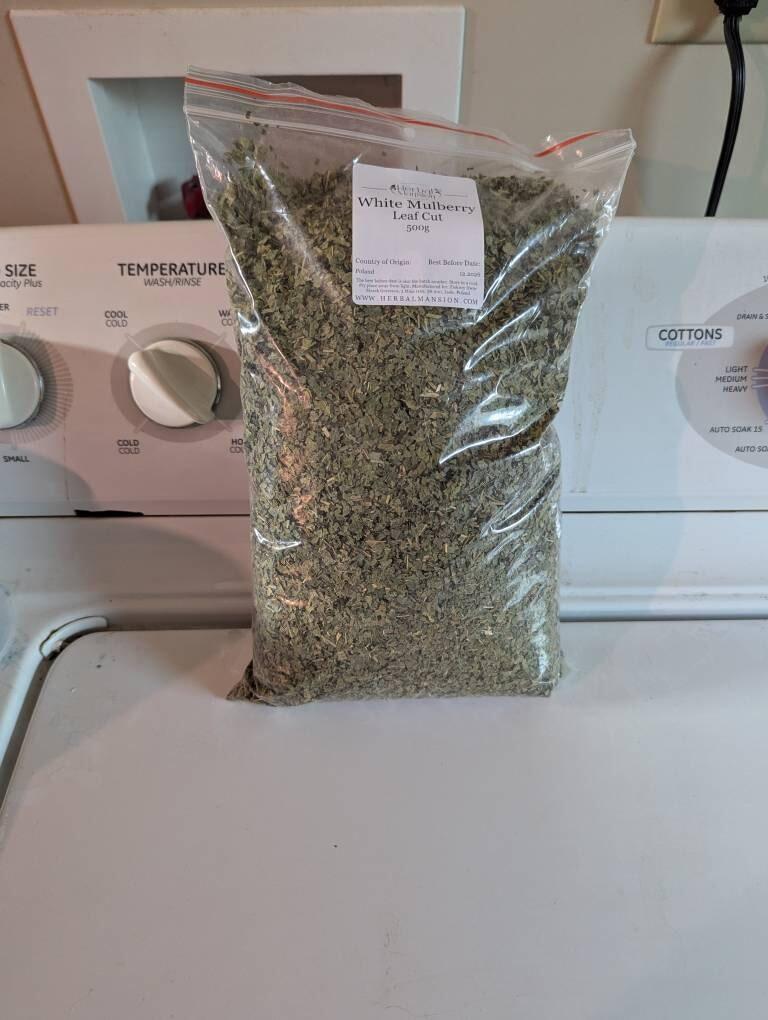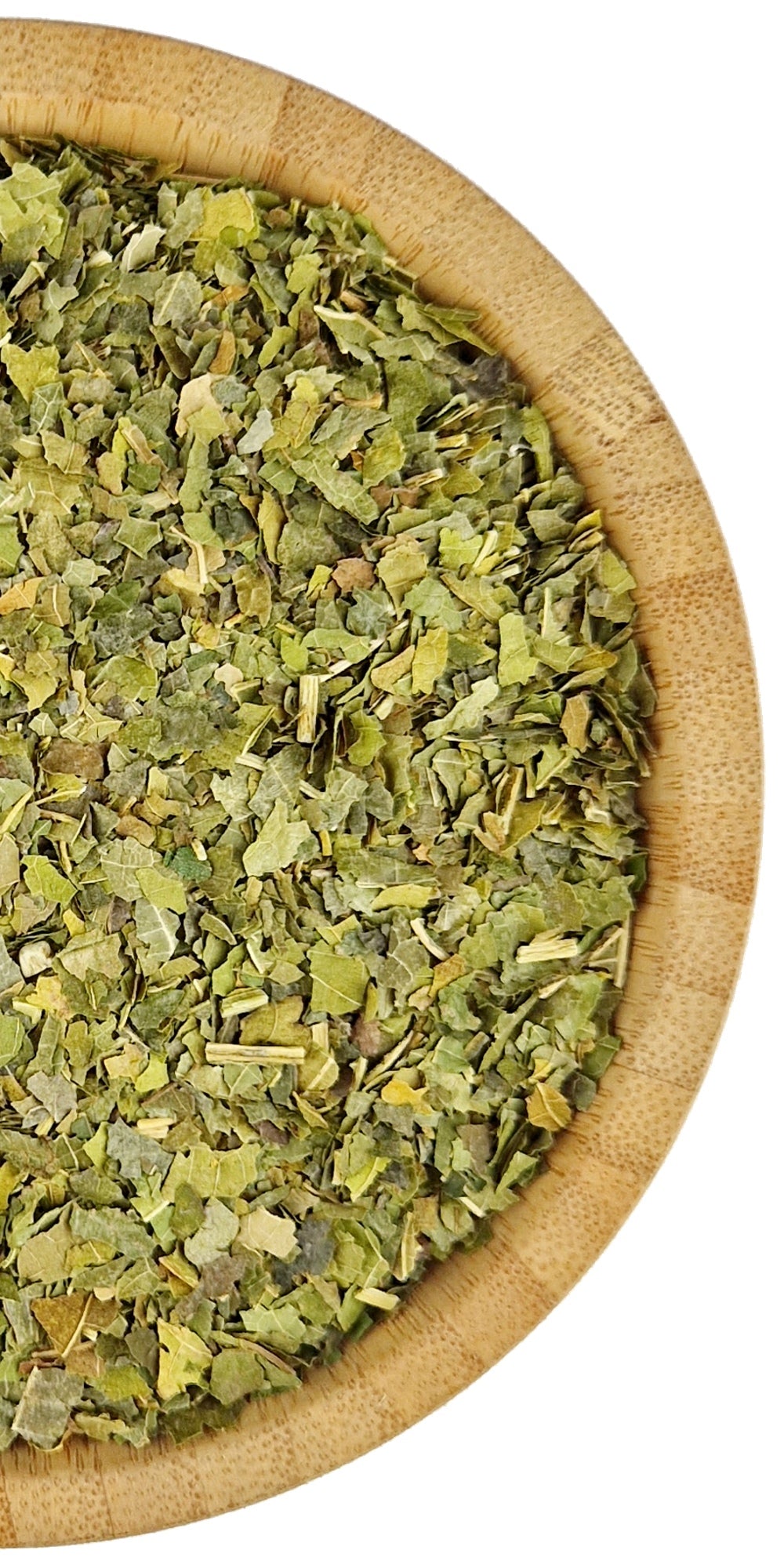
Dried white mulberry leaf is the leaf of Morus alba, the tree whose leaves have fed silkworms for thousands of years, and it is brewed as mulberry leaf tea. That tea is made from mulberry leaves alone, not from the tea plant.
The silkworm’s tree
One tree, many leaf shapes
White mulberry belongs to the mulberry family, Moraceae. Native to China, it has been cultivated for so long that its original wild range is hard to pin down. Its leaves are famously variable: on the same tree you can find lobed leaves on young shoots and broad, oval, unlobed leaves with rounded teeth on mature growth. On the tree they are glossy and bright pale green, anywhere from 5 to 30 cm long. Despite the name, the fruit usually ripens from red to dark purple-black and only sometimes stays white.
Food for silkworms
White mulberry leaves are the favoured food of the silkworm, the caterpillar of the domestic silk moth, Bombyx mori. After five moults, a silkworm spins its cocoon from 300 to 900 metres of silk fibre. The tree is also known as common mulberry or silkworm mulberry.
From the Silk Road to a king’s garden
Monks with hollow canes
Legend has it that in the mid-6th century two monks smuggled silkworms, or their eggs, to Constantinople hidden in hollow canes, on behalf of Emperor Justinian I; the Byzantine historian Procopius tells the story. White mulberry travelled west along the Silk Road around that time to supply silk-making in the Byzantine Empire.
Black or white?
In 1608 King James I set out to build an English silk industry and planted a mulberry garden of about four acres, on land that is now part of Buckingham Palace and Green Park. It is often said that the plan failed because the king’s gardeners planted black mulberry instead of white. Yet the story may be too neat: silkworms will also feed on black mulberry, which copes better with Britain’s cool, damp weather.
Mulberry leaf in the cup
Kuwacha and ppongnip-cha
In Japan, mulberry leaf (kuwa) is made into kuwacha, sold as rolled loose leaf processed much like sencha, or as a fine powder. In Korea, mulberry leaf tea is known as ppongnip-cha. Traditionally the leaves were gathered in autumn and dried in the sun, and some modern versions are roasted.
How it is used today
- Infusion. Steeped covered in hot water, just below the boil.
- Iced tea. Brewed strong in a little hot water, then poured over ice.
Another tree leaf for the cup is Birch Leaf, and for a green tea, see Gunpowder Green Tea. More single herbs are in our Single Herbs collection, and other plants for the cup are in Herbal Tea.
Mulberry leaf in your home cupboard
Sellers describe a green to golden cup with a fresh, vegetal flavour, very little bitterness and a faint sweetness; roasted versions taste gently nutty. The leaf stays mellow even with a longer steep, so start at 5 minutes and adjust. Taste varies between batches.
Frequently asked questions
What is mulberry leaf tea?
It is an infusion of dried mulberry leaves. In Japan it is called kuwacha and in Korea ppongnip-cha.
How do I make white mulberry tea?
Use 1 to 2 teaspoons of dried leaf per 250 ml cup. Pour over water at 90 to 95 °C, cover and steep for 5 minutes, or 3 to 7 minutes to taste.
Can I drink it during pregnancy or with medication?
If you are pregnant, breastfeeding, taking medication or have a health condition, ask your doctor before drinking herbal infusions.
Where does white mulberry leaf come from?
The current batch comes from Poland.
Sources
- Gabriel Hemery, Morus alba (White Mulberry), gabrielhemery.com, accessed 20 November 2026.
- Country Life, The best places to find magnificent mulberries in London, countrylife.co.uk, accessed 20 November 2026.
- Shakespeare Birthplace Trust, The Gardens of Shakespeare’s New Place: July, shakespeare.org.uk.
- Encyclopaedia Britannica, Silk, britannica.com.
- My Japanese Green Tea, Kuwacha, myjapanesegreentea.com, accessed 20 November 2026.
- Kimchimari, 20 Traditional Korean Teas beyond Barley and Corn Tea, kimchimari.com.
- Wikipedia, Morus alba, en.wikipedia.org.