




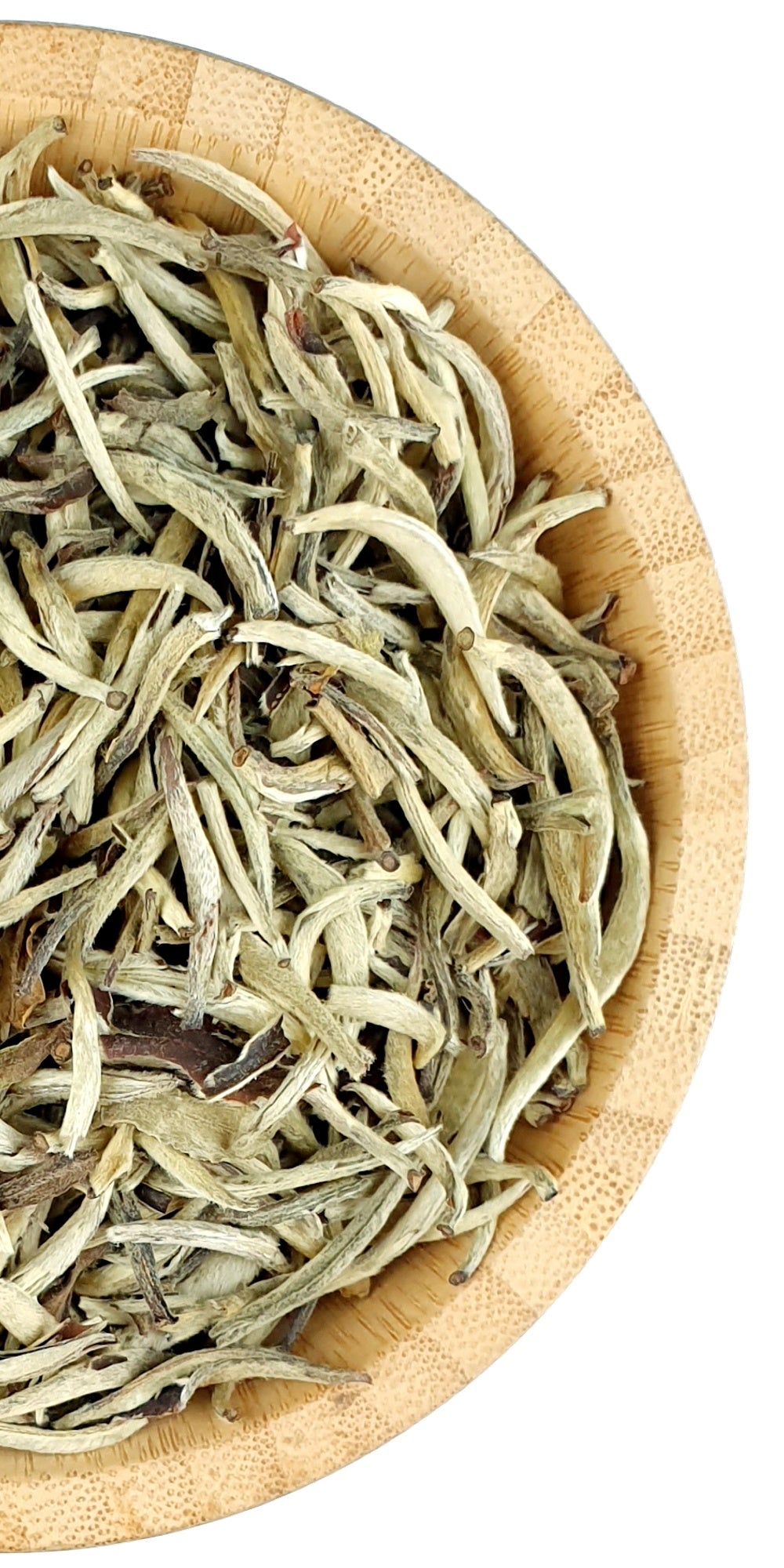
Silver Needle tea, in Chinese Bai Hao Yinzhen, is a white tea made solely from unopened buds covered in silvery down. After picking, the buds are only withered and dried, with no rolling or firing, which is why the infusion is pale, light and sweetish, with a note of melon, hay and honey, and no astringency. The buds are light and bulky, so a cup needs more of them than of other teas. This is a tea to drink without additions and to brew slowly in cooler water.
White tea from Fuding
White tea at the Song court
The name white tea already appears under the Song dynasty. Emperor Huizong, himself a connoisseur of tea, described white tea in his treatise Daguan chalun of 1107 as a rarity, the most highly prized at court. By white tea, however, he meant a pale green tea, pressed and whisked. It shares only its name with today's white tea.
Fuding and Zhenghe
Modern Silver Needle originated in Fujian province, in the counties of Fuding and Zhenghe. In the middle of the 19th century a wild bush with large, downy buds was found in Fuding and named Fuding Da Bai, and the related Zhenghe Da Bai cultivar is grown in the neighbouring county. Around 1885 people began making tea from their buds alone. Exports of Silver Needle to Europe and South-East Asia began in the 1890s, and for a long time it was an expensive, rare tea.
How Silver Needle is made
The buds are picked in early spring, over a few days, before they open. They are then spread in a thin layer to wither, in shade or in weak sunlight, and finished at a low temperature, with no rolling or firing. For most of the 20th century white tea was drunk mainly in China and among the Chinese diaspora, and it only properly reached European shops in the 2000s. Today Silver Needle is also made in Yunnan and outside China, but Fujian remains the benchmark.
How it is used today
- A tea for slow drinking. Brewed in cooler water, without additions, because the infusion is light.
- Multiple infusions. The buds last for 3 to 4 infusions, each one sweeter.
- Cold brew. An infusion from a jug in the fridge is sweet and floral.
- In the kitchen. The infusion as a base for light jellies and sorbets that a strong tea would not suit.
Other white teas, including Pai Mu Tan, made from buds and leaves, and White Mao Feng, are in our White Tea collection.
Silver Needle in your tea cupboard
Silver Needle is not a tea to drink in a hurry, because its taste is quiet and sweet and brewing takes longer than usual. It is a choice for people who like delicate infusions without additions, and for those who think tea has to be bitter, because this one will change their mind.
Frequently asked questions
How does white tea differ from green tea?
White tea is only withered and dried, with no rolling or firing, which is why it is paler, sweeter and less astringent. Green tea is steamed or pan-fired, which gives it a grassier, more pronounced taste.
How does Silver Needle differ from Pai Mu Tan?
Silver Needle is buds only; Pai Mu Tan is buds with the first two leaves.
Does Silver Needle contain caffeine?
Yes, like every tea from the tea plant. The amount depends on the quantity of buds, the water temperature and the brewing time.
Can I drink Silver Needle during pregnancy or with medication?
It contains caffeine, so in these situations ask a doctor or pharmacist. A product description does not replace their advice.
Sources
- Zhao Ji (Emperor Huizong), Daguan chalun (Treatise on Tea of the Daguan Era), 1107, chapter on white tea.
- Mary Lou Heiss, Robert J. Heiss, The Story of Tea: A Cultural History and Drinking Guide, Berkeley 2007, chapter “White Tea”.
- Victor H. Mair, Erling Hoh, The True History of Tea, London 2009, chapter on tea in Song-dynasty China.
- EFSA, Scientific Opinion on the safety of caffeine, EFSA Journal 2015, 13(5):4102.




