


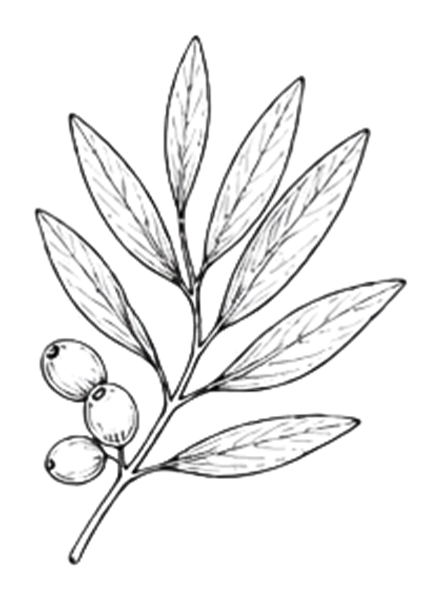


Rooibos Redbush tea is made from the red bush, a shrub from the Cederberg mountains. It contains no caffeine and does not turn bitter even after long brewing. The infusion is red-amber, mild and slightly sweet, with a note of honey and wood, and it tastes good both on its own and with milk, lemon or honey. It is a herbal tea for people who want to cut down on caffeine without giving up tea.
A shrub from the Cederberg mountains
The Khoikhoi and the first settlers
Rooibos, Afrikaans for red bush, grows wild only in the Cederberg region north of Cape Town and its surroundings, and nowhere else in the world has it been possible to grow it on a larger scale. The Khoikhoi peoples gathered its twigs, chopped them, bruised them and dried them in the sun long before the Europeans arrived. The Dutch settlers, for whom imported tea was expensive, learned this from them.
Benjamin Ginsberg, 1904
The commercial career of rooibos began in 1904 with Benjamin Ginsberg, a merchant from the small town of Clanwilliam who came from a family of tea traders. He started buying rooibos from local gatherers and selling it as mountain tea. In the 1930s Pieter le Fras Nortier, a doctor from Clanwilliam, worked out a way of growing the shrub from seed, whose hard coat first had to be scarified. Since then rooibos has been planted on farms, though still only in the Cederberg. Until the end of the 20th century it was drunk mainly in South Africa, and in the 1990s it began to be exported on a larger scale to Germany, the Netherlands, Japan and the United States.
How rooibos is made
The twigs and leaves of the shrub are cut in summer, chopped into small, needle-like pieces, moistened and bruised, then laid in heaps in the sun, where they oxidise and turn red. Rooibos is then dried and sifted. The same shrub without the oxidation stage gives green rooibos, with a grassier taste. In 2021 the European Union added rooibos to its register of protected designations of origin, the first product from Africa to be included.
How it is used today
- Caffeine-free tea. For drinking at any time of day.
- With milk. Rooibos with milk and honey, or as a latte with frothed milk, in the style of the South African red latte.
- Cold. Iced rooibos with lemon and mint, because it does not turn bitter or cloudy when chilled.
- In the kitchen. A strong infusion for meat sauces, marinades and dried-fruit compotes.
Other versions of the red bush, including the unoxidised Green Rooibos, are in our Rooibos collection.
Rooibos in your tea cupboard
Rooibos is a herbal tea that replaces black tea in many homes, because with milk it tastes similar and has no caffeine. It is a choice for people who want to drink tea at any time of day and like a sweetish infusion without bitterness.
Frequently asked questions
Does rooibos contain caffeine?
No. Rooibos comes from the shrub Aspalathus linearis, which does not produce caffeine, so it can be drunk at any time of day.
How does red rooibos differ from green rooibos?
Red rooibos, like this one, has been oxidised in the sun, which gives it its red colour and sweet, honeyed taste. Green rooibos is dried straight after harvesting and is lighter and grassier.
Is rooibos a tea?
Not in the strict sense, because it does not come from the tea plant but from a South African shrub of the legume family. It is brewed and drunk like tea, which is why it is commonly called tea.
Can rooibos be given to children or drunk during pregnancy?
Before giving rooibos to a small child, and also during pregnancy, while breastfeeding or when taking medication, ask a doctor or pharmacist. A product description does not replace their advice.
Sources
- Mary Lou Heiss, Robert J. Heiss, The Story of Tea: A Cultural History and Drinking Guide, Berkeley 2007, chapter on herbal infusions.
- Commission Implementing Regulation (EU) 2021/865 of 28 May 2021 entering the name “Rooibos / Red Bush” in the register of protected designations of origin.




