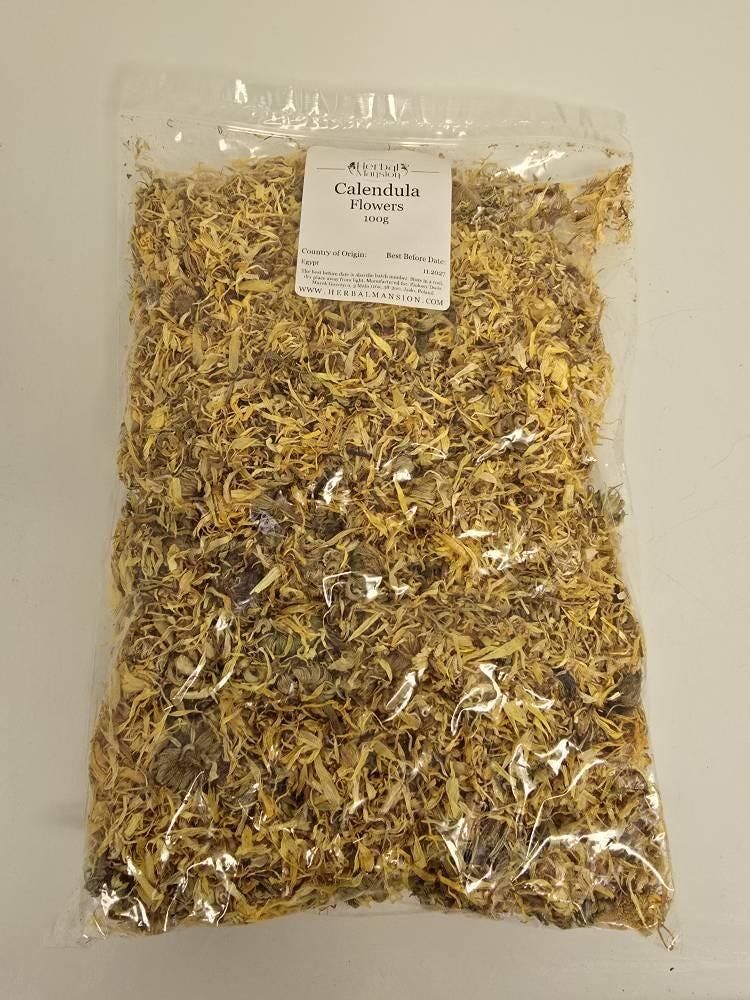
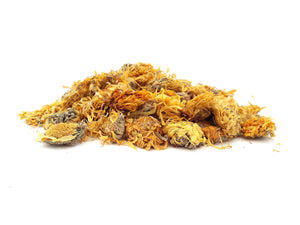
Dried whole marigold flower heads are brewed like a herbal tea, added to blends for colour, macerated in oil for homemade cosmetics and used in decorations. Pot marigold (Calendula officinalis) flowers from June until the first frosts and gives orange and yellow flowers all summer long, which have been gathered for drying since the Middle Ages. An infusion of whole flower heads is golden, smells lightly herbal and tastes gently bitterish, with a floral note. Whole flowers are easy to strain after brewing or macerating.
A flower named after the calendar
Antiquity and the early Middle Ages
The name calendula comes from the Latin calends, the first day of the month. The Romans noticed that in a warm climate the plant flowers almost without a break and seems to open new flowers at the start of every month. Pot marigold comes from the Mediterranean basin, but it has been grown for so long and so widely that its exact homeland is unknown today.
The Middle Ages and the Renaissance
It was grown commonly in monastery gardens. In the kitchen it served as the poor man's saffron, because the dried petals were used to colour soups, rice, butter and cheese, as well as fabrics and hair. In his herbal of 1597, John Gerard wrote that in Holland dried marigold flowers were sold by the barrel, because no proper soup could do without them. In the mid-17th century Nicholas Culpeper placed marigold among the herbs of the sun.
How dried marigold is made
The flower heads are picked in full bloom, on a dry, sunny day, once the dew has dried. They are dried spread out in a thin layer in shade with good airflow, then sifted to remove the crumbling parts.
How it is used today
- Infusions and blends. Whole flowers are brewed on their own or added to herbal blends and teas for colour and a mild, floral background.
- Oil macerate. Dried flowers covered with vegetable oil are a traditional base for homemade creams, balms and soaps.
- Baths and rinses. An infusion of whole flowers is added to bath water, to foot baths and to hair rinses.
- Decoration. Whole flowers decorate tea blends, bath salts and potpourri.
In blends, marigold looks good next to chamomile and cornflower petals. Other flowers for infusions and blends are in our Flowers & Petals collection.
Marigold in your herb cupboard
Whole flower heads are simple to use, because all you need to do is brew them or cover them with oil, and they are easy to strain afterwards. This is a flower for people who make their own macerates at home and like colour in their tea blends.
More ways to use it
- Bath. For a bath, brew 2 handfuls of flowers, about 20 g, in a litre of water that has just boiled, leave covered for a quarter of an hour and pour the strained infusion into the bath. A smaller amount of cooled infusion is enough for a foot bath.
- Crafts. For a macerate, pour 250 ml of oil over 30 g of dried flowers so that they are covered, and leave in a warm, bright place for 3 to 4 weeks. Use dried flowers, because the water from a fresh flower spoils the oil.
Frequently asked questions
How do whole flowers differ from marigold petals?
Whole flowers are flower heads with the receptacle and the small bracts around it. We also stock marigold petals on their own.
Is pot marigold the same as Tagetes?
No. Tagetes is a different plant with a stronger, spicy scent, used mainly in blends and decorations. Pot marigold (Calendula) has a gentler, herbal scent.
Do the flower heads need to be crushed before brewing?
No. Whole flower heads are covered with water and strained after brewing. Crushing them releases the colour faster, but makes straining harder.
Where do these flowers come from?
The current batch comes from Egypt.
Sources
- Macer Floridus, De viribus herbarum, 11th/12th century, entry “Calendula”.
- William Coles, Adam in Eden, London 1657, entry on marigold (explanation of the name from the calends).
- John Gerard, The Herball, or Generall Historie of Plantes, London 1597, chapter “Of Marigolds”.
- Nicholas Culpeper, The English Physitian, London 1652, entry “Marigolds”.
- Maud Grieve, A Modern Herbal, London 1931, entry “Marigold”.