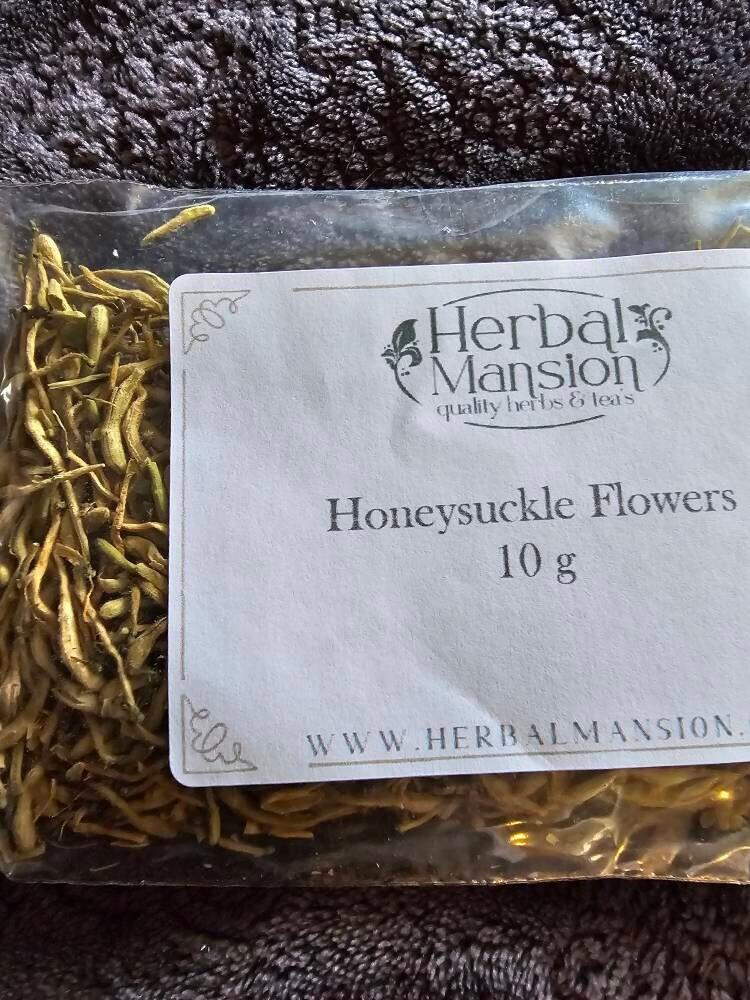
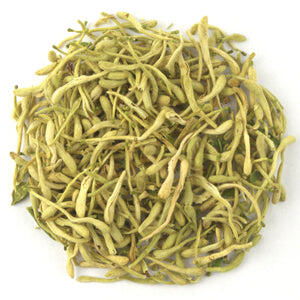
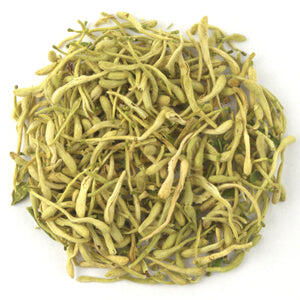
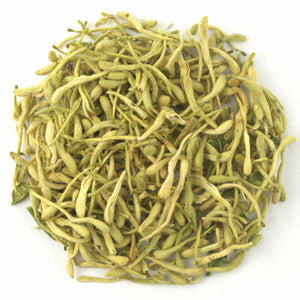
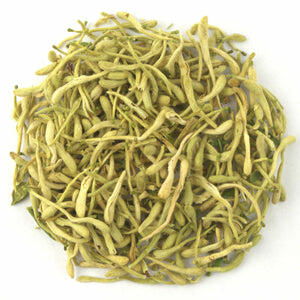
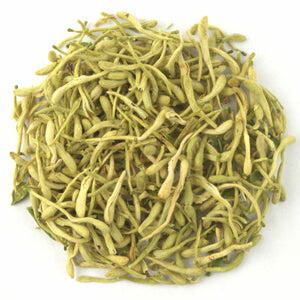
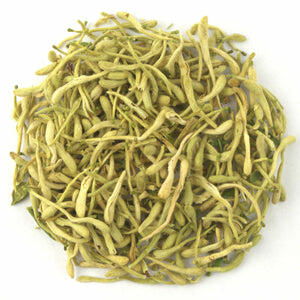
Dried honeysuckle flowers are the tubular, two-lipped flowers of Japanese honeysuckle, Lonicera japonica, a woody climber native to China and temperate East Asia. On the plant they open white and turn yellow with age, which is why the Chinese name 金银花 (jīnyínhuā) means the gold and silver flower.
The gold and silver flower
A climber from East Asia
Japanese honeysuckle belongs to the honeysuckle family, Caprifoliaceae. Its native range runs from China across temperate East Asia and takes in Japan, Korea, Manchuria and Taiwan. The fragrant flowers grow in pairs on short stalks where the leaves meet the stem, and each corolla is 3 to 4 cm long and hairy on the outside.
Two Chinese names
Besides jīnyínhuā, the plant is called 忍冬 (rěndōng), the one that endures winter, because its leaves stay on through the cold months. English speakers have also called it the gold-and-silver flower. The English name honeysuckle comes from the sweet nectar inside the tubular flowers.
From Long Island to the wider world
Japanese honeysuckle reached the United States in 1806, when it was planted on Long Island, New York, as an ornamental and to hold soil against erosion. By 1898 it was recorded growing wild, and by the early 20th century it had spread widely across the east of the country. Today it is an introduced plant in much of the United States and Europe, Britain included.
How it is used today
- Flower infusion. In China honeysuckle is a popular summer drink. Tea sellers steep the dried flowers covered in water at about 90°C, and the infusion can also be drunk cold.
- Scented tea. In China honeysuckle flowers were used to scent tea in the same way as jasmine, a custom that spread in the Qing dynasty.
- Syrups and cordials. In Western kitchens, cooks make syrups and cordials from the fresh flowers, using the flowers alone without any green parts.
Our Jasmine Flowers are dried for brewing too. More dried flowers are in our Flowers & Petals collection, and ingredients for your own blends are in Herbal Tea.
Honeysuckle in your home cupboard
Taste varies between batches, so brew your first cup for the shorter time and taste it before adding more flowers. If you make a larger pot, let some of it cool and try it cold.
Frequently asked questions
Does this product contain honeysuckle berries?
No. This product contains the dried flowers only. The berries are not part of it.
Why is it called the gold and silver flower?
Each flower opens white and turns yellow as it ages, so a flowering plant carries white and yellow flowers at the same time. The Chinese name 金银花 means gold and silver flower.
Can I drink honeysuckle infusion cold?
Yes. Tea sellers suggest it both hot and cold. Brew it as usual, strain it and let it cool.
Can I drink it during pregnancy or with medication?
If you are pregnant, breastfeeding, taking medication or have a health condition, ask your doctor before drinking flower infusions.
Where do the flowers come from?
The current batch comes from China.
Sources
- Royal Botanic Gardens, Kew, Lonicera japonica Thunb., Plants of the World Online, accessed 19 November 2026.
- National Parks Board Singapore, Lonicera japonica Thunb. ex Murray, Flora & Fauna Web.
- USDA Forest Service, Lonicera japonica, Japanese honeysuckle, Fire Effects Information System.