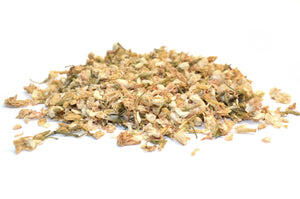
These dried jasmine flowers are whole flowers of common jasmine, Jasminum officinale, each a slender white tube that opens into five lobes. Drop a few into a pot of green or white tea, brew them on their own, or keep them for blends and decoration. Size and colour vary between batches.
Common jasmine, from Persia to English gardens
Shrub, leaves and flowers
Common jasmine belongs to the olive family, Oleaceae. It is a scrambling shrub that can climb to about 5 metres, and each leaf is divided into three to nine leaflets. The flowers grow in small clusters of one to ten. Each is white, sometimes reddish outside, with a tube 1 to 1.5 cm long ending in five lobes. In China it flowers from May to August.
Where it grows
Kew's Plants of the World Online gives its native range as the Transcaucasus to south-central China, including Iran, Afghanistan, Pakistan, Nepal and the Himalaya. In Europe it was brought in as a garden plant and has become naturalised in countries including France, Italy, Portugal and Great Britain.
A Persian name in English gardens
The word jasmine reached English through French jasmin and Arabic yāsamīn, from the Persian yāsaman, and the genus name Jasminum has the same root. Older English spellings include jessamine. By the end of the 16th century it was a familiar garden climber in England.
How jasmine flowers are used today
- With tea. A few flowers added to green or white tea, such as Sencha, in the pot or in a jar of loose tea.
- On their own. Brewed as a flower infusion, covered while they steep.
- In blends. Whole flowers stirred into a homemade tea or herbal blend.
- Decoration. Flowers placed on cakes and desserts.
Chinese jasmine tea is traditionally scented with a different species, Arabian jasmine (Jasminum sambac). Common jasmine is the white garden jasmine of Persia and Europe. For ready-made jasmine teas, see Jasmine Flower Tea and Jasmine Phoenix Pearls in our Jasmine Tea collection. Loose petals of the same jasmine are sold as Jasmine Petals, and more dried flowers are in our Flowers & Petals collection.
Jasmine by your own measure
With a jar of whole flowers you decide how much jasmine goes into each pot, and the flowers stay in view in a glass cup.
Frequently asked questions
How do I add dried jasmine flowers to tea?
Put a few flowers in the pot with green or white tea and brew the tea as usual. Next time, use more or fewer flowers to suit your taste.
Is this jasmine tea?
No. These are jasmine flowers on their own, without tea. For a ready-made jasmine tea, see Jasmine Flower Tea.
Are jasmine flowers edible?
The Plants For A Future database lists the flowers of common jasmine as edible and as used to flavour or scent tea. We sell them for tea, blends and decoration.
Is this the same as yellow jessamine?
No. Yellow or Carolina jessamine, Gelsemium sempervirens, is an unrelated plant from a different family, Gelsemiaceae. The English names sound alike, but it is not a jasmine.
Can I drink it during pregnancy or with medication?
If you are pregnant, breastfeeding, taking medication or have a health condition, ask your doctor before drinking flower infusions.
Where do the flowers come from?
The current batch comes from China.
Sources
- Royal Botanic Gardens, Kew, “Jasminum officinale L.”, Plants of the World Online (accessed 19 November 2026).
- Wu Z. Y., P. H. Raven, Hong D. Y. (eds), Flora of China, vol. 15, Beijing and St. Louis, entry Jasminum officinale.
- John Gerard, The Herball or Generall Historie of Plantes, London 1597.
- Plants For A Future, Jasminum officinale: Common Jasmine, Jessamine, pfaf.org, accessed 19 November 2026.