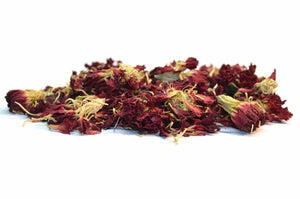
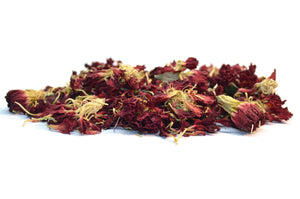
Dried carnations are the flowers of the garden carnation, Dianthus caryophyllus, a plant whose botanical name comes from the clove. In 16th- and 17th-century England the petals flavoured wine and ale in place of the costlier imported clove. Today the dried flowers are steeped as a flower infusion, and cooks candy the petals and add them to fruit.
Names and history of the carnation
A name taken from the clove
The epithet caryophyllus is the old name for the clove, given to the carnation for its scent. Through medieval French girofle and English gilofre, the same word became the old English name “gillyflower”, and Chaucer wrote of the “clow-gelofre”. For Chaucer, Spenser and Shakespeare, a gillyflower was the carnation. Only later did the name pass to another garden flower, stock.
Sops in wine: petals in wine and ale
Spenser called carnations “sops in wine”, because in the 16th and 17th centuries the petals flavoured wine and ale. The scent of the flower also flavoured vinegar, beer and sauces, and the petals went into salads.
The genus name and the plant
Theophrastus coined the genus name Dianthus from the Greek dios, divine, and anthos, flower. The origin of “carnation” is less certain: it may come from the Latin corona, a garland, or from caro, flesh, after the colour. The plant is a Mediterranean perennial up to 80 cm tall, with fragrant flowers 3 to 5 cm across. Around 2,000 years of cultivation have blurred where it first grew wild.
Mother’s Day, Freedom Day and Ohio
Anna Jarvis chose the carnation for Mother’s Day in 1907, because it had been her mother’s favourite flower. On 25 April 1974 Celeste Caeiro handed carnations to Portuguese soldiers, who put them in the barrels of their rifles. The day is still celebrated as Freedom Day, the Carnation Revolution. The scarlet carnation is the state flower of Ohio.
How dried carnations are used
- Flower infusion. Three or four flowers per cup. Chinese tea sources describe the infusion as delicately floral, slightly sweet and slightly bitter, and it is often brewed with rose.
- In the kitchen. The petals are candied, added to fruit and used in place of rose petals in syrup.
To brew carnations with rose, try Red Rose Petals or Pink Rose Petals. You will find both, with other dried flowers, in our Flowers & Petals collection.
How much to use
A few flowers make a cup, and the petals can go into a syrup or a fruit salad. They suit people who like to brew flowers together and cook with them.
Frequently asked questions
Can you eat carnation petals?
Yes. They are candied, added to fruit and used in syrups.
What does carnation infusion taste like?
Chinese tea sources call it delicately floral, slightly sweet and slightly bitter. Cooler water and a shorter brew keep the bitterness down.
Why are they called carnations?
Nobody is sure. The word may come from the Latin corona, a garland, or from caro, flesh, after the colour of the flower.
Can I drink it during pregnancy or with medication?
If you are pregnant, breastfeeding, taking medication or have a health condition, ask your doctor before drinking flower infusions.
Where do the carnations come from?
The current batch comes from China.
Sources
- Plants For A Future, Dianthus caryophyllus: Carnation, Clove Pink, pfaf.org, accessed 19 November 2026.
- NC State Extension, Dianthus caryophyllus, North Carolina Extension Gardener Plant Toolbox.
- “Gillyflower”, encyclopedia entry after R. C. A. Prior, On the Popular Names of British Plants.