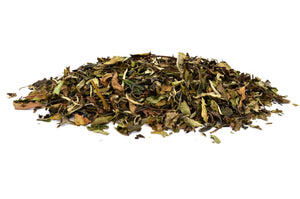


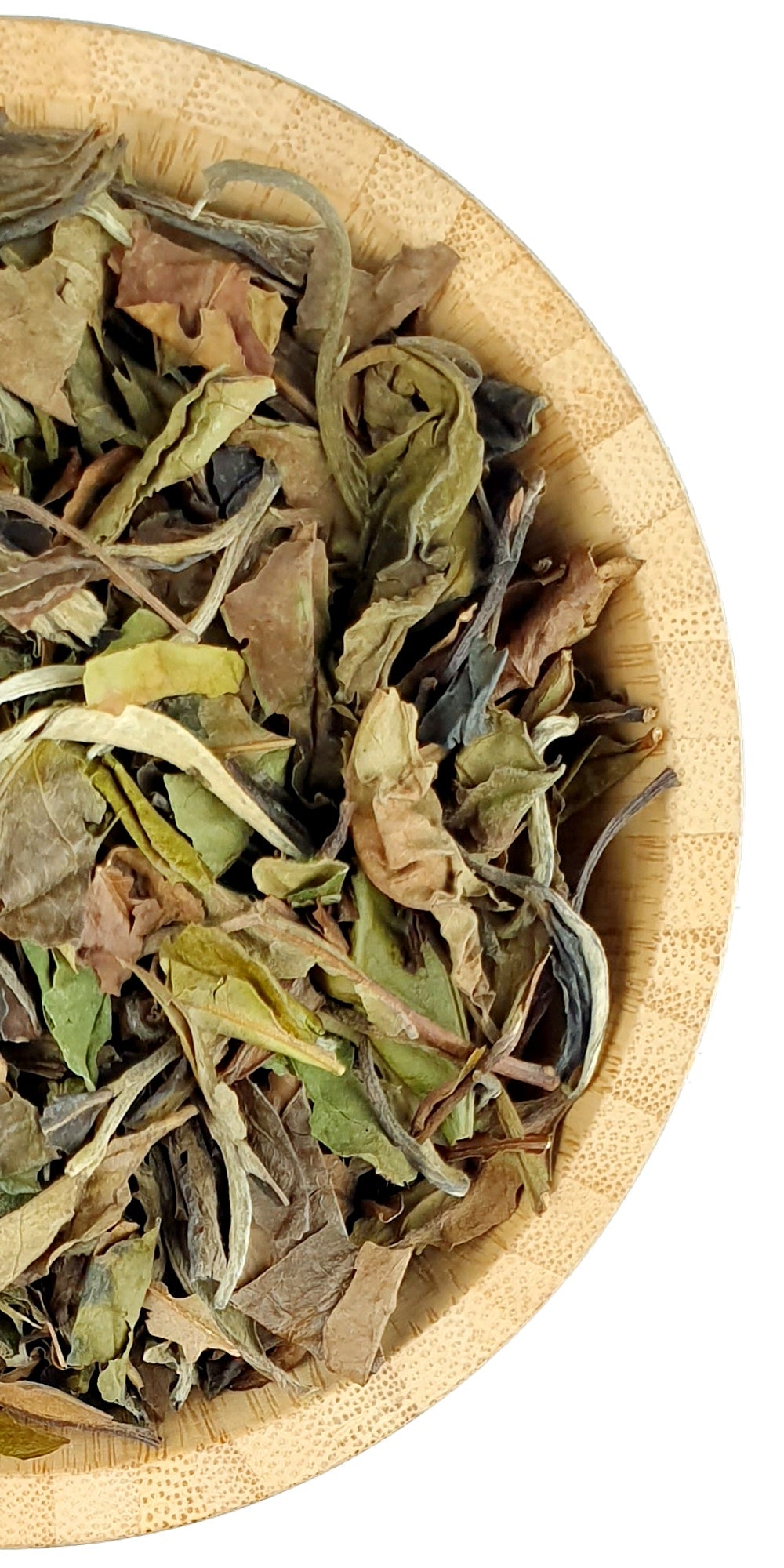
Pai Mu Tan white tea, in Chinese Bai Mu Dan, meaning “White Peony”, is a white tea made from a bud and two young leaves that are only withered and dried. The infusion is pale golden, smooth and sweetish, with a note of hay and dried fruit and little astringency. It is a simple way into white teas, for the cup, the gaiwan and the cold-brew jug.
White Peony
The bud and the leaves
White teas are divided by what goes into the picking. The Heisses write that white tea in its original form consisted of buds alone, and that adding young leaves gave an infusion with a stronger taste. Gascoyne lists Bai Mu Dan alongside Shou Mei among the white teas made from a mix of buds and leaves. The classic Bai Mu Dan picking is a bud with two leaves.
Pekoe means “white hair”
The word pekoe, familiar from black tea grades, comes from Chinese and means “white hair”. Ukers explains in his glossary that this was the name given to the earliest pickings, because the young buds and leaves are covered with white down. The same down can be seen on the buds of Pai Mu Tan. Ukers also recorded that a bud in tea was called a tip, and teas with white or golden tips were called tippy. In white tea the down stays intact, because the leaf is neither rolled nor pan-fired.
How Pai Mu Tan is made
A bud with two young leaves is picked in spring. Gascoyne names Da Bai, with its large, downy buds, as a cultivar grown for white tea. The leaves are spread in a thin layer and wither slowly, in the shade or in weak sunlight, until they have lost most of their water. There is no rolling or pan-firing, so the leaf stays loose and the buds stay whole. Finally the tea is dried further at a low temperature and sorted, separating out broken leaves.
How it is used today
- In a gaiwan. Short infusions, several from one portion.
- Cold with blueberries. A summer jug over fruit.
- For a large cup. A mild infusion that forgives a longer brew.
- A first white tea. A simple start before teas made from buds alone.
In our White Tea collection you will also find White Monkey, Silver Screw and Long Zhu White. Each of them has a different leaf shape and a different picking.
Pai Mu Tan in your tea cupboard
This is a tea for people who want to start with white teas from a mild infusion that forgives mistakes in brewing. It also suits those who like a gaiwan and watching the buds unfurl in the water.
Frequently asked questions
How does it differ from Silver Needle?
In the picking. Silver Needle is buds alone, while Pai Mu Tan is a bud with two leaves, so the infusion is fuller in taste and has more of a hay note.
Why are the leaves two colours?
Because the buds and the leaves dry differently. The downy bud stays silvery, while the opened leaf darkens to greenish brown during the long withering.
Can I brew it with boiling water?
It is better not to. At 85°C the infusion is sweet and smooth, while boiling water draws astringency out of the young leaves. If you only have boiling water, wait a few minutes for it to cool.
Does Pai Mu Tan white tea contain caffeine?
Yes. Like every tea from the tea plant, it contains caffeine, and the amount in the infusion depends on the quantity of leaves, the water temperature and the brewing time.
Can I drink it during pregnancy or with medication?
It contains caffeine, so in these situations ask a doctor or pharmacist. A product description does not replace their advice.
Sources
- Mary Lou Heiss, Robert J. Heiss, The Story of Tea: A Cultural History and Drinking Guide, Ten Speed Press, Berkeley 2007, chapter “Manufacture: From Fresh Leaves to Distinctive Tea”, section “White Tea” (buds alone, the addition of leaves).
- Kevin Gascoyne, François Marchand, Jasmin Desharnais, Hugo Américi, Tea: History, Terroirs, Varieties, Firefly Books, Richmond Hill 2011, chapter on China (Bai Mu Dan and Shou Mei, the Da Bai cultivar).
- William H. Ukers, All About Tea, The Tea and Coffee Trade Journal Company, New York 1935, vol. II, glossary, pp. 512–516 (Pekoe, tip, tippy teas).
- EFSA, Scientific Opinion on the safety of caffeine, EFSA Journal 2015, 13(5):4102.