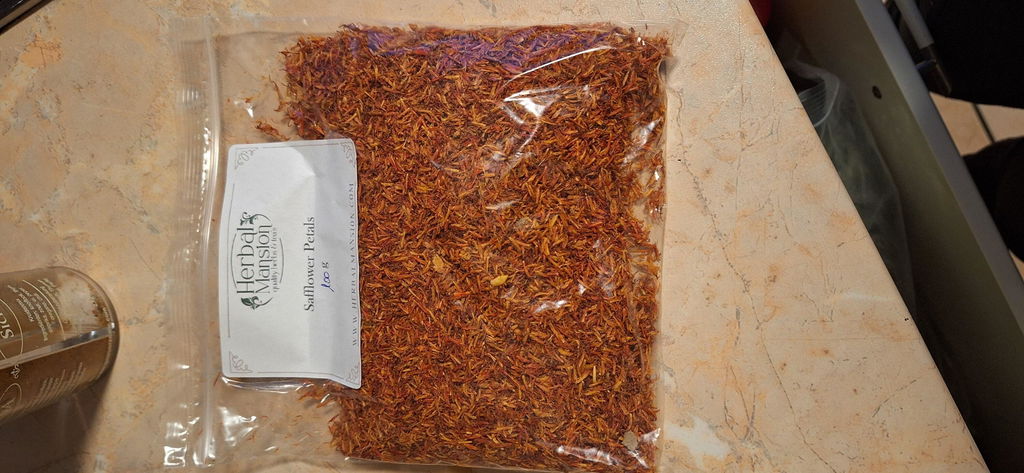
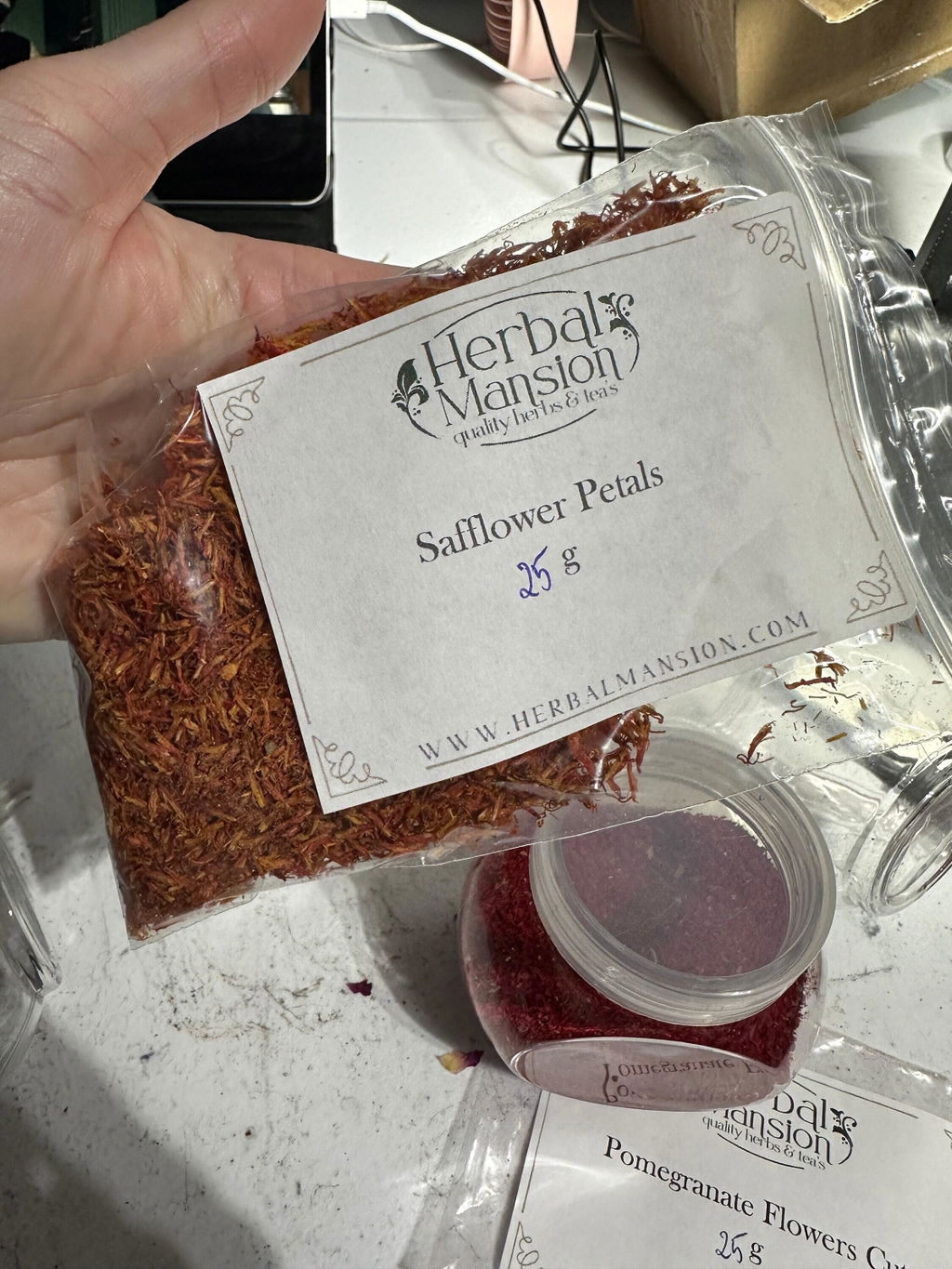
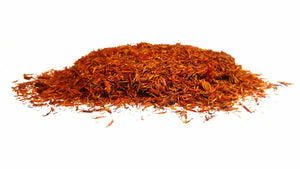
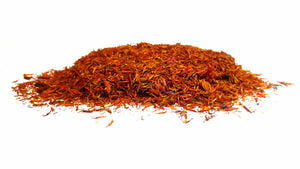
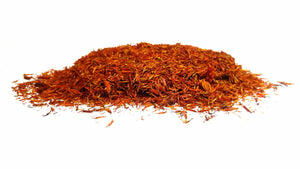
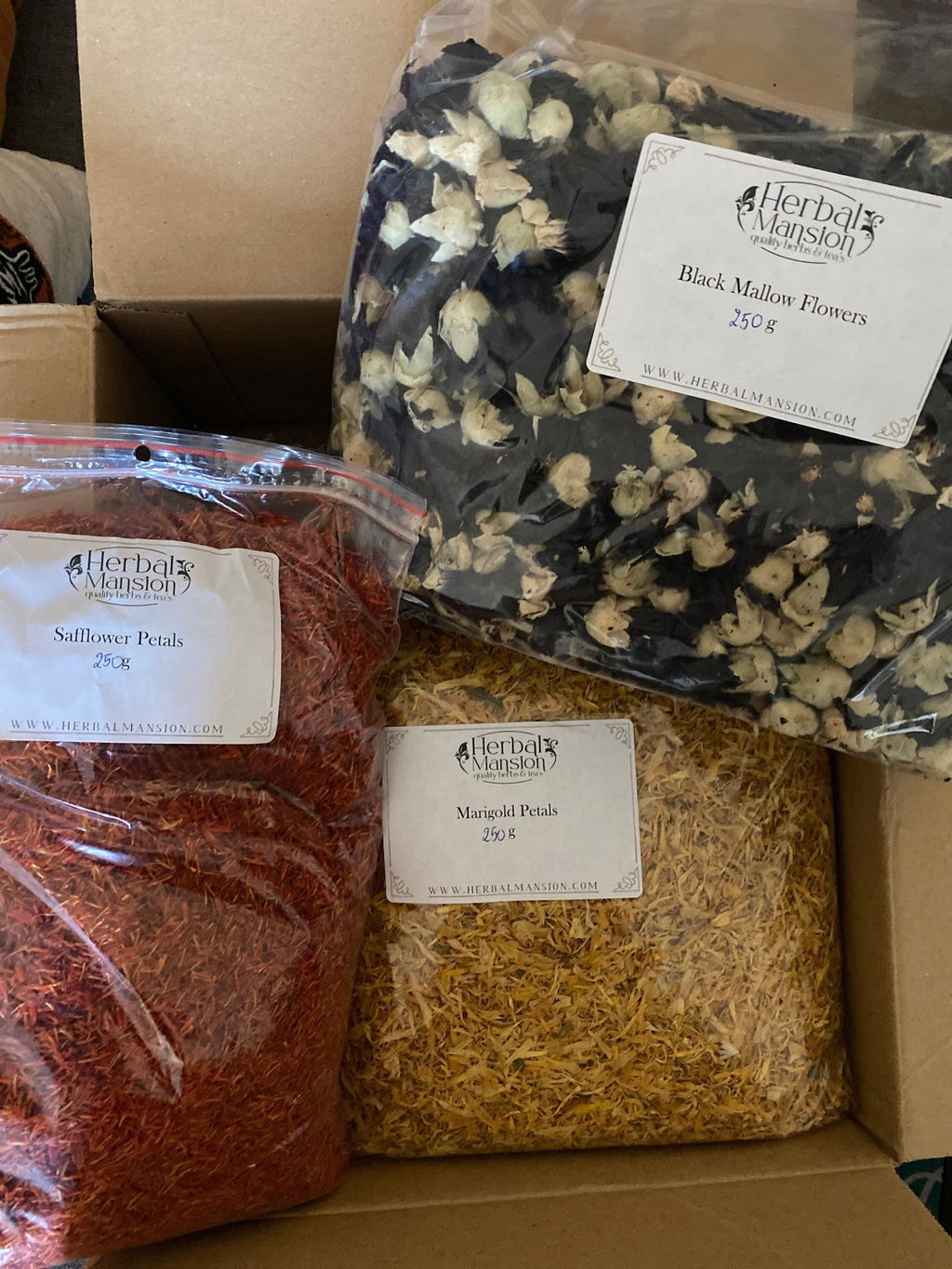
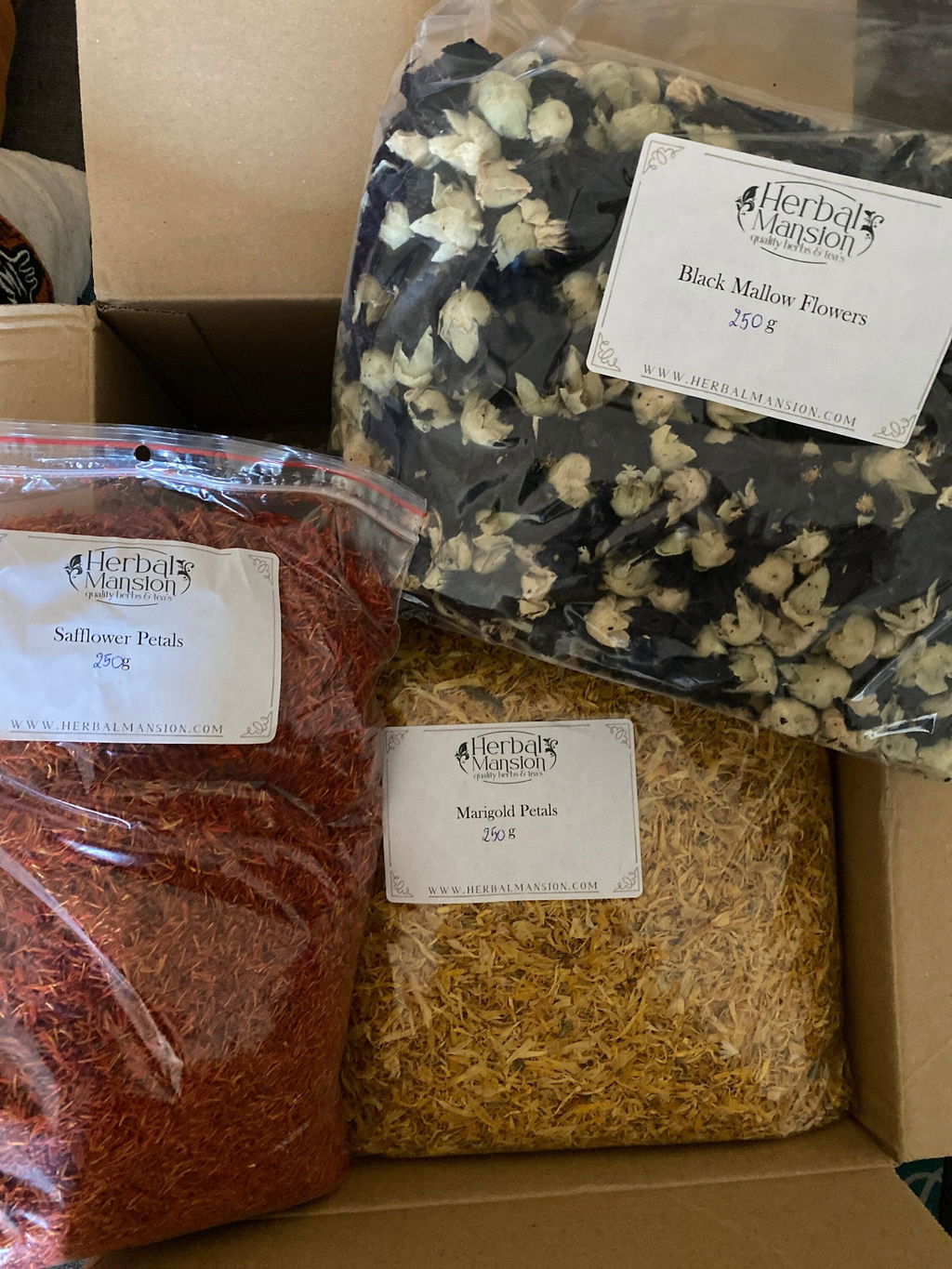
Dried safflower petals are the florets of Carthamus tinctorius, a thistle-like annual of the daisy family, Asteraceae, that grows to about 1 m and flowers from August to October. Its florets were a common textile dye until the 19th century, and a single flower holds both a yellow and a red dye. The shade of the petals varies between batches.
A flower grown for its colour
Two dyes in one flower
Safflower florets carry two colours. A yellow dye washes out in plain water. Once the yellow has gone, a weak alkaline solution draws out the red, called carthamin. The 1911 Encyclopædia Britannica described it as “a brilliant but fugitive scarlet dye for silk”. Cheaper aniline dyes took its place in the 19th century.
An old dye plant
Packets of safflower seed and garlands of its florets have been found with Egyptian mummies about 4,000 years old, and Pliny mentions the plant in his Natural History. Across the Middle East, Turkey and India it was important in carpet weaving, and in Persia it was used mainly to colour food and textiles. In the 18th century dye from Egyptian safflower coloured cheese in Italy, France and Britain.
Bastard saffron and other names
Older English names for the plant include bastard saffron, dyer’s saffron, fake saffron, saffron thistle and American saffron. According to the 1911 Britannica, the word safflower comes ultimately from the Arabic safra, yellow. The genus name Carthamus goes back to an Arabic word for dye, and tinctorius means “of dyers”. Many European languages call the plant a false saffron. In Persian it is known as gul rang, in Arabic as usfur, in Japanese as benibana and in Hindi as kusum.
How it is used today
- Colour in the kitchen. Ekin (2005) records the petals as used to colour rice, soups, sauces, bread and pickles, in shades from yellow to bright orange. Gernot Katzer notes that in Azerbaijan they colour broths and stews such as Şəki pitisi.
- Flower infusion. Sellers suggest about a teaspoon of petals for a cup of freshly boiled water.
- Natural dyeing. The florets give the yellow and red dyes described above.
- Decoration and crafts. Dried petals in glass jars and in dried-flower work.
For other yellow and orange flowers, see Calendula Petals, Sunflower Petals and Tagetes Marigold Flowers. More plants for the teapot are in Herbal Tea, and other dried flowers are in our Flowers & Petals collection.
Colour, not saffron
Safflower is bought for its colour. Gernot Katzer describes its taste as very weak and herbaceous: the flowers have no essential oil, and the colour they give is rather pale. Even so, safflower is still sometimes sold to tourists as saffron in the eastern Mediterranean, Hungary and North Africa, so the two are worth telling apart.
Frequently asked questions
What are dried safflower petals?
They are the dried florets of safflower, Carthamus tinctorius, a thistle-like annual of the daisy family.
Is safflower the same as saffron?
No. Safflower is a different plant. Its old names, such as bastard saffron and dyer’s saffron, come from its use as a colour. Gernot Katzer describes its taste as very weak and herbaceous, and notes that the flowers have no essential oil.
Can safflower petals be used in cooking?
Ekin (2005) records the petals as used to colour rice, soups, sauces, bread and pickles, from yellow to bright orange.
Is safflower in the daisy family?
Safflower belongs to the daisy family (Asteraceae). If you know you react to plants in this family, ask your doctor or pharmacist before use.
Can I drink it during pregnancy or with medication?
If you are pregnant, breastfeeding, taking medication or have a health condition, ask your doctor before drinking flower infusions.
Where do the petals come from?
The current batch comes from Iran.
Sources
- Plants For A Future, “Carthamus tinctorius”, PFAF Plant Database, accessed 19 November 2026.
- Royal Horticultural Society, “Carthamus tinctorius”, RHS Plants, rhs.org.uk.
- Katzer, G., “Safflower (Carthamus tinctorius)”, Gernot Katzer’s Spice Pages, accessed 19 November 2026.
- Ekin, Z. (2005), “Resurgence of Safflower (Carthamus tinctorius L.) Utilization: A Global View”, Journal of Agronomy 4(2): 83-87.
- “Safflower”, Encyclopædia Britannica, 11th edition (1911), Wikisource.