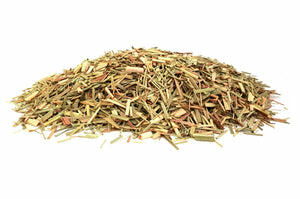


Dried lemongrass comes from Cymbopogon citratus, a tropical grass whose lemon scent comes mainly from citral. Steeped on its own it makes lemongrass tea, and in South-East Asian cooking it flavours curry pastes, soups and satay.
A grass that smells of lemon
Boats and beards
Lemongrass belongs to the grass family, Poaceae. Its genus, Cymbopogon, has around 55 species, mostly from South and South-East Asia and Australia, and lemongrass itself is now grown throughout tropical Asia. The genus name joins the Greek words for ‘boat’ and ‘beard’, after the boat-shaped sheaths of the flower heads, and citratus refers to the lemon scent. One spice reference describes the aroma as fresh and lemon-like, with a hint of rose.
West Indian, East Indian and citronella
In the spice trade, Cymbopogon citratus is known as West Indian lemongrass, as distinct from East Indian lemongrass, Cymbopogon flexuosus. Citronella grass is a different species again, Cymbopogon winterianus, and its oil is dominated by citronellal rather than citral.
Camel’s hay and squinant
The old Dutch name kamelhewe, ‘camel’s hay’, recalls the caravans that carried the dried grass from Asia to Europe, and medieval English knew it as squinant. Dried lemongrass was once added to beer brewing and to spiced wine.
In the kitchen: curry pastes, soups and satay
Takrai, sả and sereh
In Thailand lemongrass is called takrai, in Vietnam sả and in Indonesia sereh or serai. It flavours Thai curry pastes and dishes of chicken, fish and seafood, Vietnamese curries and bò nhúng dấm, beef dipped in a vinegar broth, and the bumbu spice pastes, soto ayam soups, laksa and satay of Indonesia and Malaysia.
Tom yum
Lemongrass is a core ingredient of Thai tom yum, alongside kaffir lime leaves, galangal, lime juice, fish sauce and chilli. The tough stalks flavour the broth and are not eaten.
How it is used today
- Infusion. About 1 heaped teaspoon per 250 ml, steeped covered in water just off the boil.
- In the kitchen. A lemon note for soups, broths and curries.
- Herbal blends. A citrus scent in your own blends.
For other lemon-scented herbs for the cup, try Lemon Verbena and Lemon Balm. More herbs for cooking are in our Culinary Herbs collection, and other herbs for tea are in Herbal Tea.
Lemongrass in your home cupboard
One seller advises weighing lemongrass rather than measuring it with a spoon. Another notes that after about 10 minutes the cup stays smooth but loses its fresh top notes, so taste it at five.
Frequently asked questions
How do I make lemongrass tea?
Put 1.5 to 2 g of dried lemongrass, about 1 heaped teaspoon, in a 250 ml cup, pour over water just off the boil, cover and leave for 5 to 7 minutes, then strain.
Is lemongrass the same as citronella?
No. Citronella grass is a related but different species, Cymbopogon winterianus. Its scent is led by citronellal, while the lemon scent of lemongrass comes mainly from citral.
What is West Indian lemongrass?
It is the spice trade name for Cymbopogon citratus, the species sold here. East Indian lemongrass is Cymbopogon flexuosus.
Can I drink it during pregnancy or with medication?
If you are pregnant, breastfeeding, taking medication or have a health condition, ask your doctor before drinking herbal infusions.
Where does the lemongrass come from?
The current batch comes from Egypt.
Sources
- Gernot Katzer’s Spice Pages, Lemon Grass (Cymbopogon citratus/flexuosus), gernot-katzers-spice-pages.com, accessed 20 November 2026.
- ScienceDirect Topics (Elsevier), Cymbopogon citratus, sciencedirect.com.
- Wikipedia, Tom yum, en.wikipedia.org.