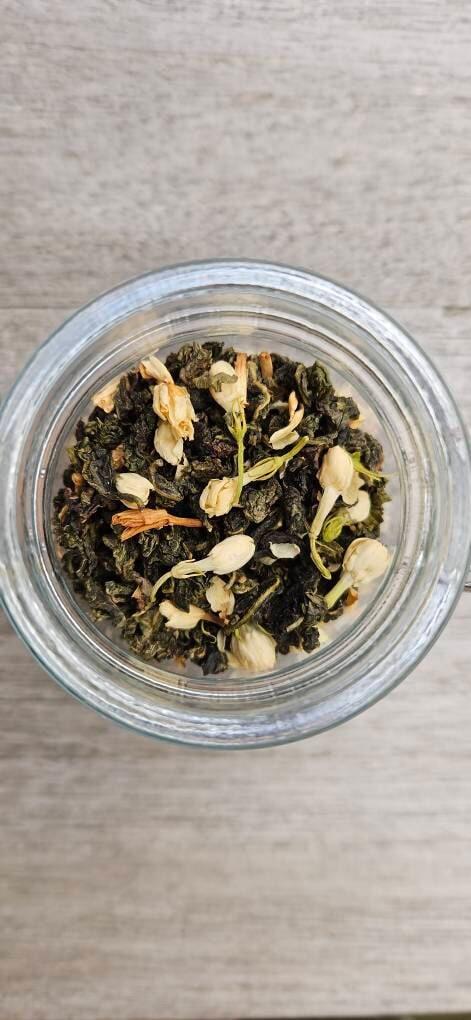
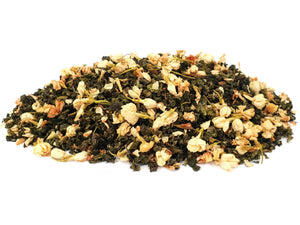
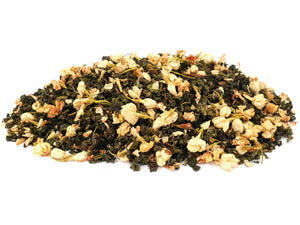
King of Jasmine is a lightly oxidised Tie Guan Yin oolong with whole jasmine buds and added jasmine flavouring. The infusion is golden, full-bodied and floral, with the creamy note that Tie Guan Yin has by nature and a distinct jasmine scent on top. One portion gives several infusions. It is a tea to drink without sugar or milk.
An oolong that smells of flowers
The Iron Goddess from Anxi
Tie Guan Yin comes from Anxi county in southern Fujian. The name means “Iron Goddess of Mercy” and refers to the Buddhist goddess Guanyin. In 1935 Ukers listed oolongs from Anxi among the teas of Fujian. The Heisses describe it as a tea made from local varieties of the tea bush from Anxi.
Flowers in oolong
Scenting oolong with flowers has its own tradition. Ukers describes Pouchong tea from Taiwan, which before the final drying was layered with jasmine, gardenia or yulan magnolia flowers and sold to South-East Asia. The flowers were removed after scenting. According to the Heisses, the jasmine used for tea is mainly Jasminum sambac, a species with small white flowers. In King of Jasmine, the jasmine scent comes from added jasmine flavouring, and the dried buds stay in the blend.
How King of Jasmine is made
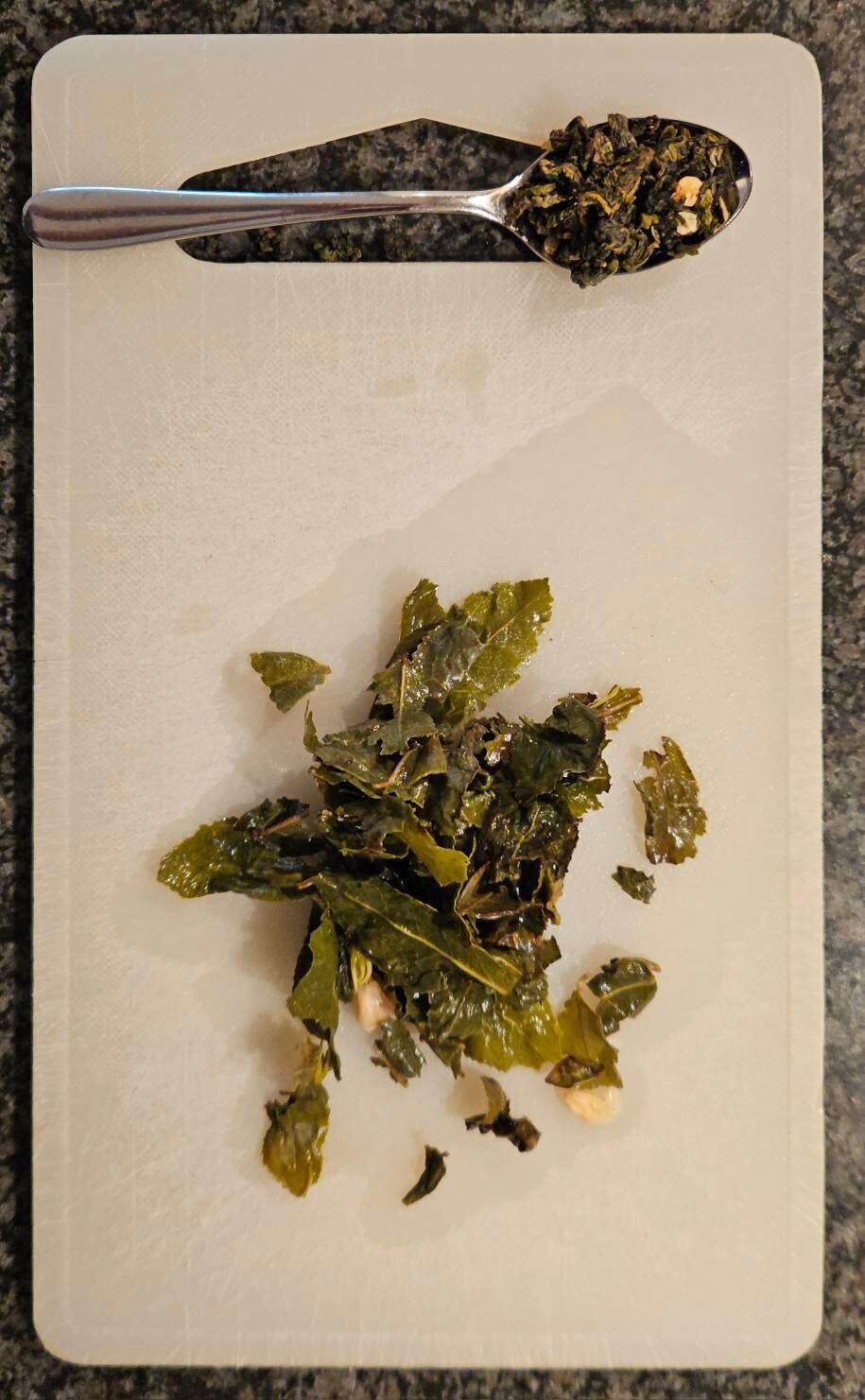
Tie Guan Yin leaves are withered in the sun and then indoors, where they are shaken in baskets so that their edges oxidise slightly. When oxidation reaches the intended degree, the leaves are heated to stop it and rolled in many passes. Finally, the tea is dried. Whole dried jasmine buds and jasmine flavouring are added to the finished oolong; the buds stay in the blend and float in the infusion.
How it is used today
- A cup on its own. The creamy note of the oolong and the jasmine need no sugar.
- Several infusions from one portion. Each infusion tastes a little different.
- Iced with fruit. The cooled infusion with lychee or peach.
- After a meal. A full-bodied, floral infusion to finish a meal.
We also stock plain Tie Guan Yin, Oolong Milk and Jasmine Phoenix Pearls separately. You will find our other oolongs in the Oolong Tea collection.
King of Jasmine in your tea cupboard
This is a tea for people who drink oolongs and like jasmine. Here the jasmine gets the creamy background of Tie Guan Yin.
Frequently asked questions
Is this tea flavoured?
Yes, this tea has added jasmine flavouring.
How does it differ from Tie Guan Yin oolong?
It differs in the addition of jasmine buds and jasmine flavouring. We also stock plain Tie Guan Yin oolong.
Is this a green tea?
No. It is an oolong, that is, a partly oxidised tea, in this case lightly. The leaves stay green and the infusion is golden.
Does King of Jasmine contain caffeine?
Yes. The amount of caffeine in the infusion depends on the quantity of leaves and the brewing time.
Can I drink it during pregnancy or with medication?
It contains caffeine, so in these situations ask a doctor or pharmacist. A product description does not replace their advice.
Sources
- William H. Ukers, All About Tea, New York 1935, vol. I, chapter XII, pp. 220–221, and chapter XIII “Tea Characteristics”, pp. 235–236 (Pouchong scented with jasmine, gardenia and yulan), pp. 229–230 and 257 (oolongs from Anxi), and chapter XVII, pp. 338–339 (proportions of flowers to tea).
- Mary Lou Heiss, Robert J. Heiss, The Story of Tea: A Cultural History and Drinking Guide, Berkeley 2007, chapter “An Encyclopedia of Tea”, entries “Tieguanyin” and “Scented Tea”.
- EFSA, Scientific Opinion on the safety of caffeine, EFSA Journal 2015, 13(5):4102.