





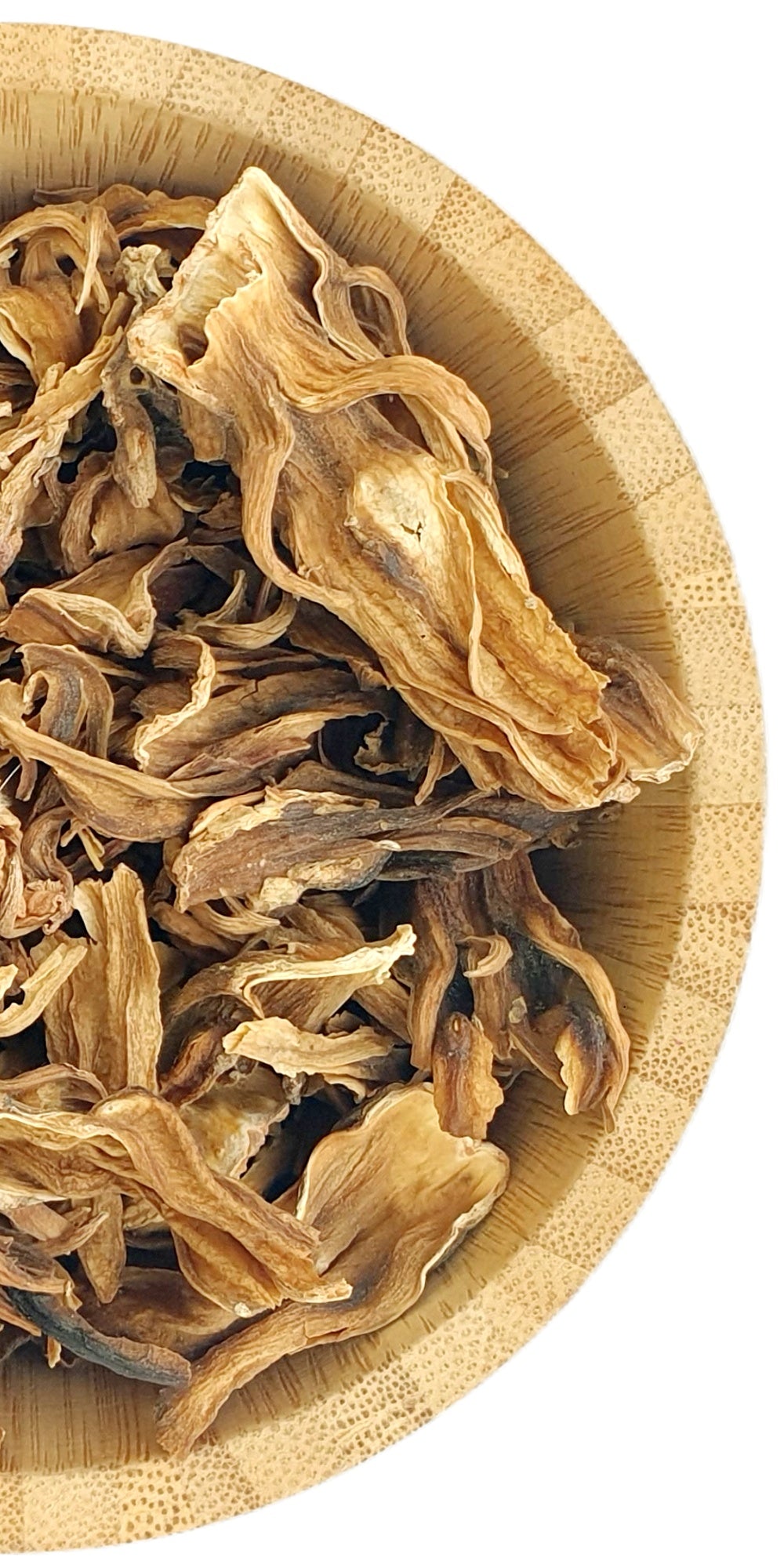
Sellers describe white hibiscus, known in Senegal as bissap blanc, as the pale form of roselle, Hibiscus sabdariffa, which in Senegalese cooking goes mainly into sauces, especially for thiéboudienne. It is the same species as red hibiscus but less common, and like the red form it is sold as dried calyces.
The pale roselle
Same species, paler calyx
Roselle is an annual or biennial of the seasonally dry tropics, in the mallow family, Malvaceae, and Kew gives its native range as west tropical Africa to Sudan. When the petals fall, the calyx at the base of the flower stays on the stem, enlarges and becomes fleshy. In white bissap this calyx is pale instead of crimson. The pale calyces are dried and sold as white hibiscus flowers, although botanically they are not petals.
Why it is not red
The red of roselle comes from anthocyanins, natural plant pigments. Sellers explain that white hibiscus carries far fewer of them, so its infusion comes out pale gold to amber rather than crimson. Sellers generally describe it as gentler and less sharply tart than red hibiscus. The colour of both the calyces and the infusion varies between batches.
A seasoning for sauces
In Senegal red bissap is the drink, served hot or cold, while bissap blanc is used mainly as an addition to certain sauces, especially for thiéboudienne. Roselle has uses beyond the calyx too. Its stem gives a bast fibre used in place of jute, and in some West African kitchens the leaves are cooked in soups.
How it is used today
- Pale infusion. One or two teaspoons per cup in water just off the boil, for a lighter cup than red hibiscus gives.
- In the pot. Added to sauces, as cooks in Senegal do for thiéboudienne.
For the crimson form of the same plant, choose Hibiscus Flowers. Another pale flower for the cup is White Chrysanthemum, and more are in our Flowers & Petals collection.
White hibiscus in your home cupboard
Taste varies between batches, so brew your first cup for the shorter time and taste it before adding more calyces or brewing longer. If the cup is lighter than you like, use a few more calyces next time.
Frequently asked questions
Is white hibiscus a different plant from red hibiscus?
No. Both are roselle, Hibiscus sabdariffa. White hibiscus comes from a form with pale calyces, and it is less common than the red.
Is this a flower or a calyx?
A calyx. It is the part that stays on the stem and grows fleshy once roselle’s petals have fallen, and the trade sells it as hibiscus flowers. It is not the petals of the ornamental hibiscus, Hibiscus rosa-sinensis.
What colour is white hibiscus infusion?
Sellers describe it as pale gold to amber, not crimson, because the calyces carry far fewer red pigments. The shade varies between batches.
What is bissap blanc used for?
In Senegal it goes mainly into sauces, especially for thiéboudienne. It can also be steeped as a pale infusion.
Can I drink it during pregnancy or with medication?
If you are pregnant, breastfeeding, taking medication or have a health condition, ask your doctor before drinking flower infusions.
Where do the calyces come from?
The current batch comes from Nigeria.
Sources
- Royal Botanic Gardens, Kew, Sabdariffa gossypiifolia (Mill.) M.M.Hanes & R.L.Barrett (syn. Hibiscus sabdariffa L.), Plants of the World Online, accessed 19 November 2026.




