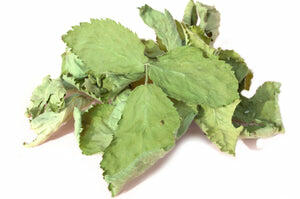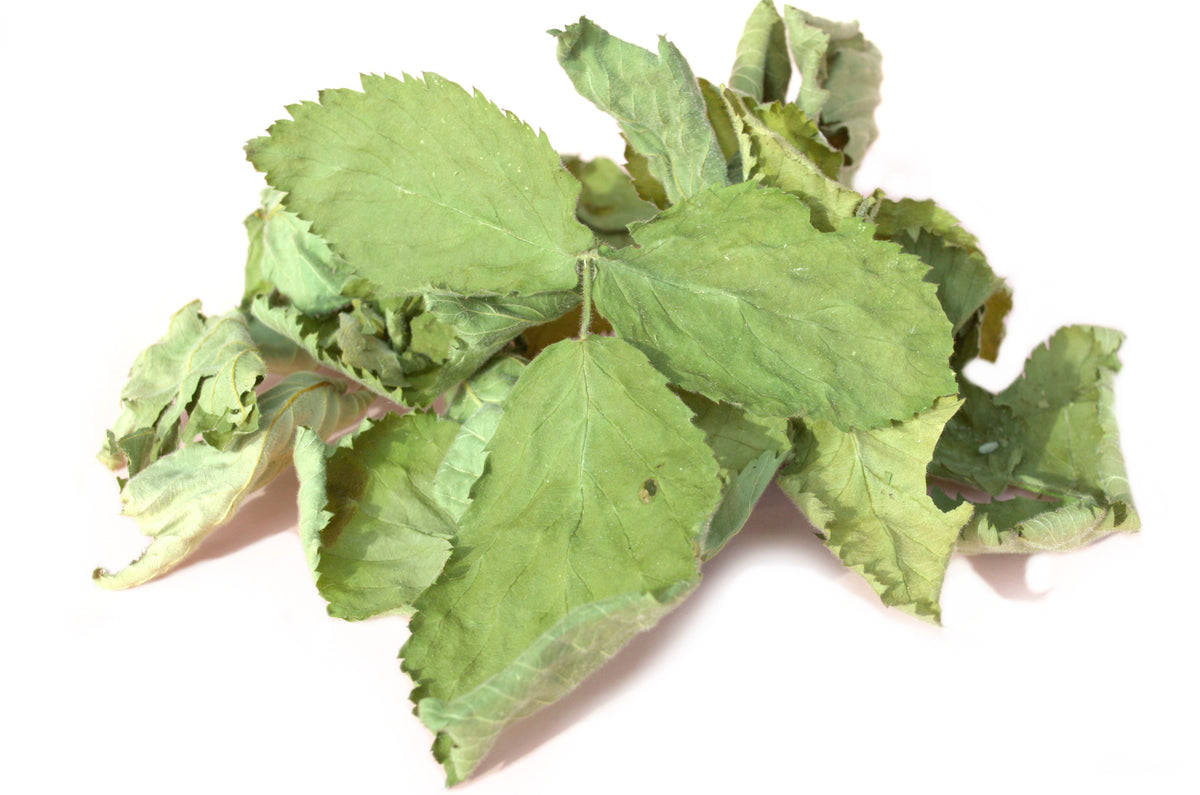
Dried blackberry leaf for blackberry leaf tea, sold as complete leaves of the bramble, Rubus fruticosus agg. The agg. stands for aggregate, because the bramble is not one species but hundreds.
Hundreds of brambles under one name
An aggregate, not a species
Botanists recognise more than 320 bramble microspecies in Britain and Ireland alone, and most of them set seed without fertilisation. Bramble is a plant of woods, scrub, hedges, banks and heaths, and grows most vigorously on acidic soils.
Leaf, stem and flower
A member of the rose family, Rosaceae, it has arching, prickly stems and white or pink five-petalled flowers. On the plant, each leaf is made of three or five toothed, oval leaflets, dark green above and paler beneath, with prickly stalks.
Hedges, graves and string
Blackberries have been found in the stomach of a Neolithic man. Ancient Britons used the thorny stems as boundaries, a kind of early barbed wire, and brambles were once planted on graves to keep sheep from grazing. Fibres from the stems have been made into string. Another name for the plant is black heg.
The Devil and Michaelmas
English folklore says the Devil, cast out of heaven by St Michael, fell into a bramble bush, and each year at Michaelmas, 29 September, he spoils the blackberries. None should be picked after that day. Accounts differ on how: he spits on the berries, treads on them, throws his club over them or, in one Romani telling, blows on them. The earliest record, from 1727, has him casting his club over them, and even its author called it a tale. In some counties the cut-off was Old Michaelmas Day in October, left over from the calendar change of 1752, and in Ireland the spoiling was also blamed on the púca, with Samhain, 1 November, as the cut-off.
Blackberry leaf in the teapot
In 1915 a Vienna daily, the Neues Wiener Tagblatt, wrote about blackberry leaves as a substitute for tea. During the First World War, Austrian schools and municipalities collected blackberry and strawberry leaves to be dried as a tea substitute for soldiers, and a notice of 1916 advised that spring leaves made the better tea. Together with raspberry leaves, blackberry leaves were also the base of the German-speaking Haustee, or house tea, often brewed half and half.
How it is used today
- A hot cup. About 2 to 3 whole leaves, crumbled and steeped covered in water just off the boil.
- A house tea. Half blackberry leaf and half raspberry leaf, brewed together.
For the other half of a house tea, try Whole Raspberry Leaf or the cut Raspberry Leaf. Another leaf sold whole is Whole Nettle Leaf, and more plants for the cup are in our Herbal Tea collection.
Blackberry leaf in your home cupboard
Start with a 5-minute steep and taste before you go longer. Taste varies between batches.
Frequently asked questions
How do I brew whole blackberry leaves?
Crumble about 2 to 3 whole leaves per 250 ml. Pour over water just off the boil, cover and steep for 5 to 10 minutes, then strain.
Who should ask a doctor first?
If you are pregnant, breastfeeding, taking medication or have a health condition, ask your doctor before drinking herbal infusions.
Why is it a limited quantity?
These leaves come from our own small harvest, so stock is limited.
Where does this blackberry leaf come from?
The current batch comes from our own harvest in Poland.
Sources
- Botanical Society of Britain and Ireland, Rubus fruticosus agg. (Plant Atlas 2020), bsbi.org, accessed 20 November 2026.
- Woodland Trust, Bramble (Rubus fruticosus), woodlandtrust.org.uk, accessed 20 November 2026.
- Folklore Thursday, Michaelmas: The Day the Devil Spits on the Blackberries?, folklorethursday.com, accessed 20 November 2026.
- Historic UK, Michaelmas, historic-uk.com.
- Society of Genealogists, Why did our ancestors celebrate Michaelmas?, sog.org.uk.
- Europeana and Österreichische Nationalbibliothek, Einsammeln von Brombeer- und Erdbeerblättern als Tee-Ersatz für Soldaten (1916), europeana.eu, accessed 20 November 2026.
- Wienbibliothek digital, Brombeerblätter und Lindenblüten als Ersatzmittel für Tee (Neues Wiener Tagblatt, 1915), digital.wienbibliothek.at.
- garten-haus.at, Heimische Alternativen zu Schwarztee, garten-haus.at.