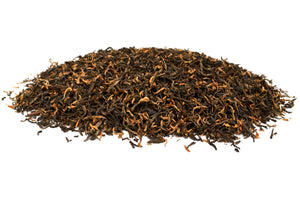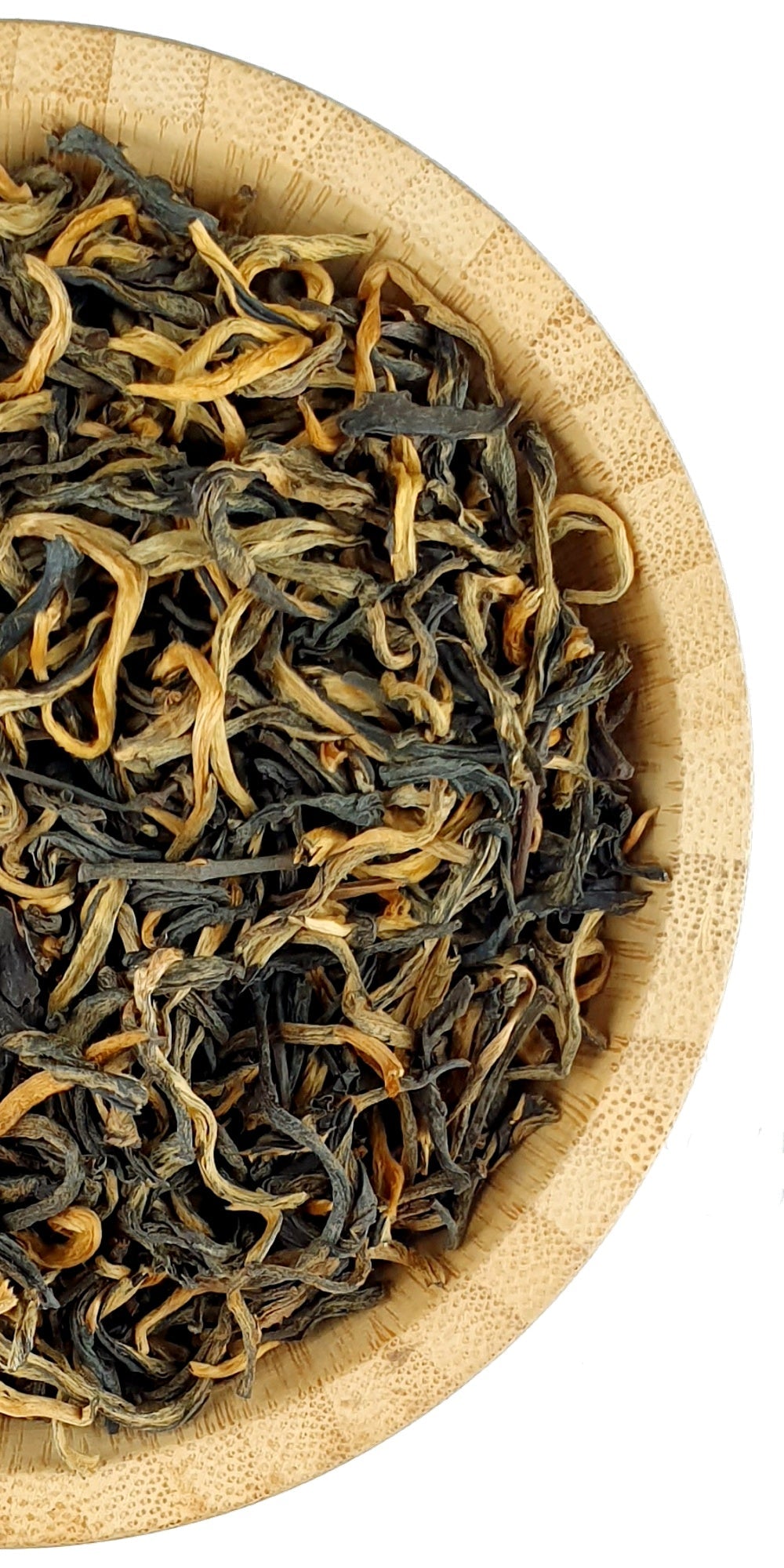
Golden Monkey black tea, in Chinese Jin Mao Hou, is a loose-leaf black tea made from dark, twisted leaves and buds. The infusion is red-brown, thick and sweet, with a note of cocoa, malt and dried fruit, and little astringency. In this style, the downy buds take on an orange-gold colour during oxidation. This is a tea for people who like black teas drunk without milk, although it also takes milk and sugar.
Golden Monkey in history
Panyong, the red wine of China
In 1935 Ukers called the black teas of southern China, shipped through the port of Fuzhou, the red wines of China, because the soil and climate gave them a taste different from teas from the north. Among them he listed Panyong, a large-leaf tea useful for blending, whose better lots gave a thick, full infusion. He described the summer pickings, called Thorny or Assam Panyong, as fragrant, brisk and pungent, and advised brewing them for four minutes, with milk or cream. The Golden Monkey style belongs to this Fujian family, and the index of the Heisses' handbook refers from the name Golden Monkey straight to Panyang Congou.
Tips in the tea trade
Ukers explains in his glossary that a golden tip is an orange-coloured bud in black tea, and that teas with white or golden tips were called tippy and priced separately.
How Golden Monkey is made
A bud with one or two leaves is picked in spring. The leaves wither for a dozen or so hours until they soften, then they are rolled to release the sap and left in a warm, humid room to oxidise fully. During this time the leaf darkens; in this style, the downy buds take on a golden colour during oxidation. Finally the tea is dried with hot air and sorted.
How it is used today
- A cup without milk. A sweet infusion with little astringency.
- For hot chocolate. The infusion in place of some of the milk.
- Cold with cherries. A summer jug over fruit.
- With milk at breakfast. As Ukers advised drinking Panyongs.
In our Black Tea collection you will also find Yunnan OP, and among the white teas White Monkey, the second “monkey” in a name.
Golden Monkey in your tea cupboard
This is a tea for people who like sweet, thick black teas drunk without additions. It also suits those who want one black tea for the cup, for hot chocolate and for a cold jug.
Frequently asked questions
Where does the name “golden monkey” come from?
From its appearance. Jin Mao Hou means “golden hairy monkey” and describes the twisted leaves and golden, downy buds of this style.
How does it differ from Yunnan OP?
In the leaf and the taste. Golden Monkey has a smaller, twisted leaf and a note of cocoa, while Yunnan OP is a large leaf with a malty taste.
Does it turn bitter when brewed for longer?
With a longer brewing time, astringency and bitterness can appear. Start with 3 minutes and shorten the time with the next cup if the infusion is too strong for you.
Does Golden Monkey black tea contain caffeine?
Yes. Like every tea from the tea plant, it contains caffeine, and the amount in the infusion depends on the quantity of leaves, the water temperature and the brewing time.
Can I drink it during pregnancy or with medication?
It contains caffeine, so in these situations ask a doctor or pharmacist. A product description does not replace their advice.
Sources
- William H. Ukers, All About Tea, The Tea and Coffee Trade Journal Company, New York 1935, vol. I, chapter XII “Commercial Teas of the World”, pp. 220–221 (Panyong districts), chapter XIII “Tea Characteristics”, pp. 229–230 (the red wines of China, Panyongs) and pp. 257–258 (glossary, Panyong); vol. II, chapter XXV “Preparation of the Beverage”, pp. 454–455 (four minutes, with milk), glossary, pp. 512–516 (golden tip, tippy teas).
- Mary Lou Heiss, Robert J. Heiss, The Story of Tea: A Cultural History and Drinking Guide, Ten Speed Press, Berkeley 2007, chapter “Manufacture: From Fresh Leaves to Distinctive Tea”, section “Black Tea” (withering, rolling, oxidation).
- Mary Lou Heiss, Robert J. Heiss, The Tea Enthusiast's Handbook: A Guide to the World's Best Teas, Ten Speed Press, Berkeley 2010, index, entry “Golden Monkey” (cross-reference to Panyang Congou).
- EFSA, Scientific Opinion on the safety of caffeine, EFSA Journal 2015, 13(5):4102.