




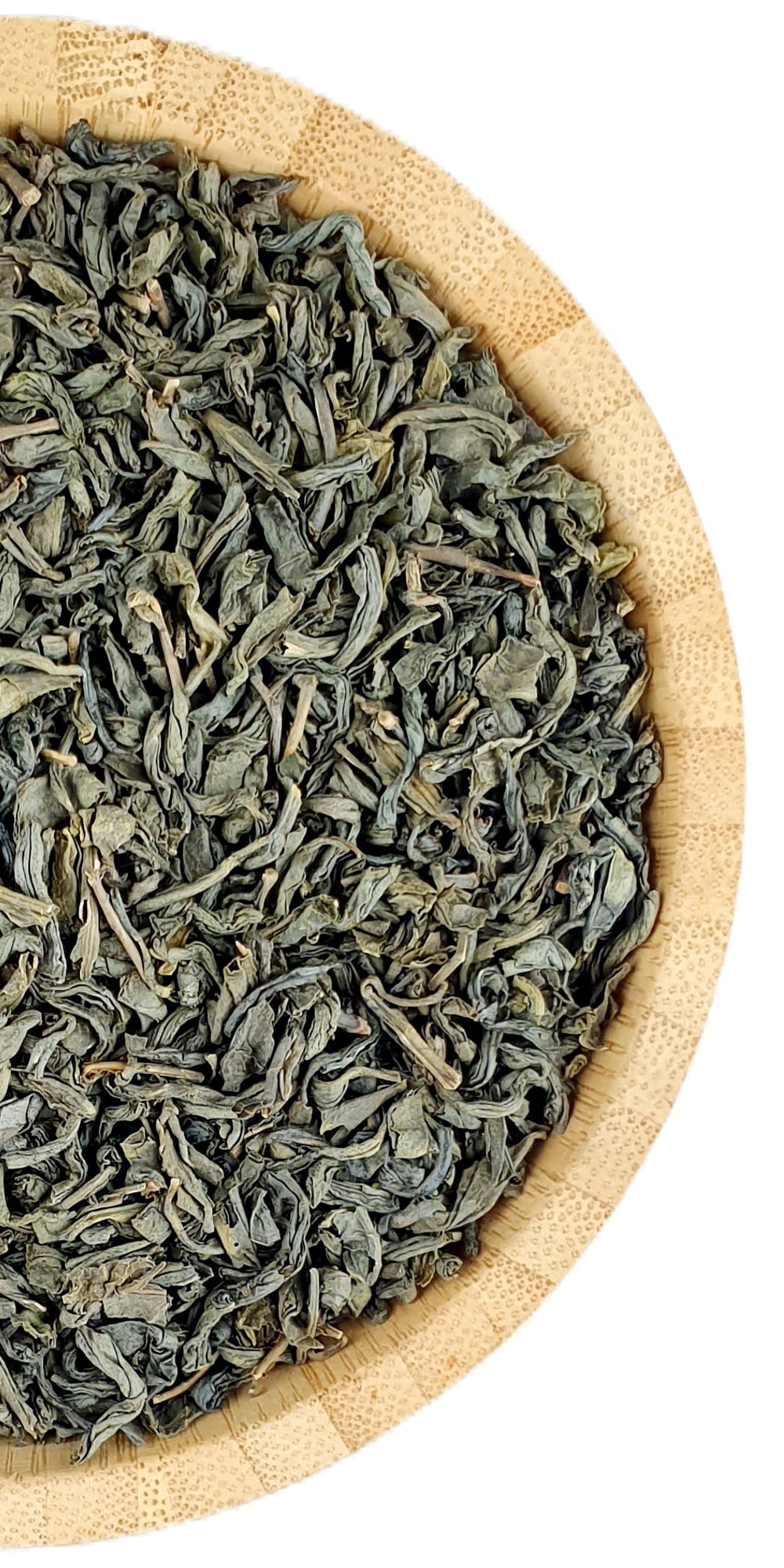
Chun Mee is a green tea with small, curved leaves whose shape gave it its Chinese name, “precious eyebrows”. The infusion is yellow and distinct, slightly astringent, with a tart note of plum and a sweet aftertaste. It takes everyday brewing in a teapot well, for two infusions, and needs no ceremony. It is a tea for work, for meals and for baking.
Eyebrows in the list of grades
Grades named after the leaf
Describing Chinese green teas in 1935, Ukers divided them into styles according to the leaf. Alongside the round-rolled Gunpowder and Imperial, he listed Young Hyson with a long, twisted leaf, Hyson with a fine, curly leaf and Sowmee with a small leaf. He also noted that in the trade each style was divided into grades by the size and evenness of the leaf. Chun Mee, zhen mei in Chinese, belongs to the same family of fine, twisted green teas, and the name describes the curved shape of the leaf.
Before the rains
The name Young Hyson, Ukers's glossary explains, means “before the rains”, because the tea was picked early, before the spring rains. Ukers also noted that green tea was the national drink of Morocco.
How Chun Mee is made
The leaves are picked in spring and summer, a bud with several leaves. Straight after picking they are pan-fired on a hot pan to stop oxidation. The leaf is then rolled and dried in the same pan with a movement that curves it into the shape of an eyebrow. Finally, the tea is sorted by leaf size and the stems are sifted out.
How it is used today
- For the everyday teapot. Two infusions, no ceremony.
- With lemon and honey. A simple warm drink.
- For baking. Ground leaves in shortbread biscuits.
- With meals. The slight astringency suits richer dishes.
In our Loose Green Tea collection you will also find Gunpowder Temple of Heaven, Dragon Well and Mao Jian. Together they show three different shapes that can be given to a pan-fired leaf.
Chun Mee in your tea cupboard
This is a tea for people who want a distinct green tea for the everyday teapot, without ceremony and without watching a timer. It also suits those who like baking and are looking for a tea for cakes.
Frequently asked questions
Why “eyebrows”?
Because of the shape of the leaves, which are thin and curved after rolling. The Chinese name zhen mei means “precious eyebrows”, and Chun Mee is the spelling used in the tea trade.
How does it differ from Gunpowder?
They differ in the shape of the leaf. Gunpowder is rolled into pellets, Chun Mee into curved leaves. Both are pan-fired green teas from China.
Does Chun Mee contain caffeine?
Yes. Like every tea from the tea plant it contains caffeine, and the amount in the infusion depends on the quantity of leaves and the brewing time.
Can I drink it during pregnancy or with medication?
It contains caffeine, so in these situations ask a doctor or pharmacist. A product description does not replace their advice.
Sources
- William H. Ukers, All About Tea, The Tea and Coffee Trade Journal Company, New York 1935, vol. I, chapter XIII “Tea Characteristics”, pp. 253–254 (styles and grades of Chinese green teas) and chapter XIV “Cultivation and Manufacture of Tea”, pp. 267–269 (the Chinese green tea method); vol. II, chapter XIV “Tea Trade in Other Lands”, pp. 241–242 (green tea in Morocco) and glossary, pp. 515–516 (Young Hyson).
- EFSA, Scientific Opinion on the safety of caffeine, EFSA Journal 2015, 13(5):4102.




