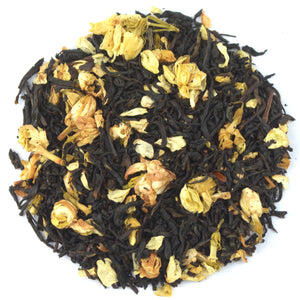


Earl Grey Jasmine is Earl Grey with added dried jasmine buds. It is made on a base of loose-leaf black tea from Yunnan with added bergamot flavouring, and the jasmine adds the sweet, floral note known from green jasmine teas. Here the flowers stand against the dark, full background of black tea. It is a version for people who like both scents and do not want to choose.
The two best-known scents in tea
The earl who did not trade in tea
Charles Grey, 2nd Earl Grey, led the government of Great Britain in the 1830s. His cabinet abolished the East India Company's monopoly on trade with China. From then on, any merchant could import tea from China. Apart from that, the only thing linking the earl to tea is his name. The story of a Chinese mandarin who is said to have given him tea with bergamot remains a legend. The oldest known mention of a tea bearing his name comes from an advertisement from the second half of the 19th century.
Jasmine from Fuzhou
Scenting tea with jasmine is most closely associated with Fuzhou in Fujian province. The flowers were picked in summer and combined with the finished tea overnight, when jasmine opens and smells strongest. In the morning the flowers were sifted out. In this blend the jasmine buds are an addition alongside the bergamot.
How Earl Grey Jasmine is made
The base is black tea. The leaves are withered, rolled, oxidised and dried. The finished tea is combined with bergamot flavouring. Finally, dried jasmine buds are added. The buds are picked before they open and dried at a low temperature so that they keep their shape and scent. In the infusion they give a floral note that does not cover the bergamot.
How it is used today
- An afternoon cup. Without milk, so that you can taste both scents.
- A tea with dessert. Jasmine and bergamot go well with fruit cakes and butter biscuits.
- Cold infusion. Cold brew brings out the sweetness of the jasmine and softens the astringency.
- A version with coconut milk. The floral infusion with a little coconut milk and honey.
The classic version, with no added flowers, is our Earl Grey, and another floral version is Earl Grey Rose. Jasmine Buds are also available on their own. You will find the other versions in our Earl Grey collection.
Earl Grey Jasmine in your tea cupboard
It is an Earl Grey for people who like jasmine teas. The jasmine gives it sweetness, and the black base a dark background.
Frequently asked questions
Is this tea flavoured?
Yes. It contains added bergamot flavouring.
Does it contain caffeine?
Yes, the base of the blend is black tea. The amount of caffeine in the infusion depends on the portion of leaves and the brewing time.
Can I drink it during pregnancy or with medication?
It contains caffeine, so in these situations ask a doctor or pharmacist. A product description does not replace their advice.
How does it differ from classic Earl Grey?
It differs in the added jasmine buds.
Is it a jasmine tea?
It is Earl Grey with added jasmine buds. Jasmine teas are usually green or white teas.
Sources
- William H. Ukers, All About Tea, New York 1935, vol. I, chapter XIII “Tea Characteristics”, pp. 232–233 and 258 (teas scented with jasmine from Foochow) and vol. II, chapter IX, pp. 156–157.
- E. A. Smith, Lord Grey 1764–1845, Oxford 1990.
- Oxford English Dictionary, entry “Earl Grey”.
- Mary Lou Heiss, Robert J. Heiss, The Story of Tea: A Cultural History and Drinking Guide, Berkeley 2007, chapter “Manufacture: From Fresh Leaves to Distinctive Tea”, section “Scented and Flavored Teas”, pp. 159–161.
- EFSA, Scientific Opinion on the safety of caffeine, EFSA Journal 2015, 13(5):4102.