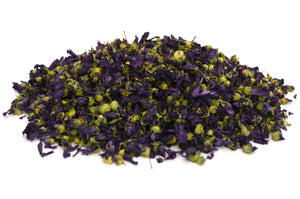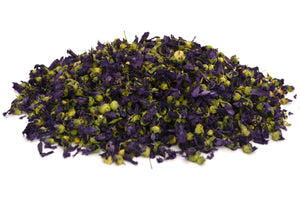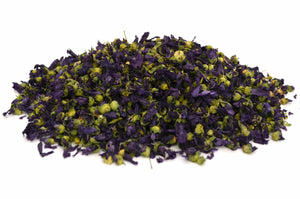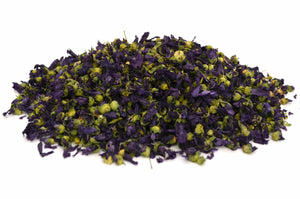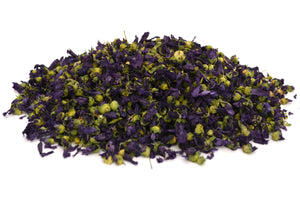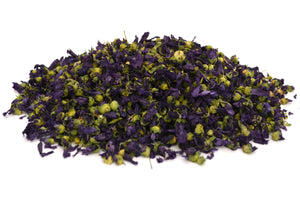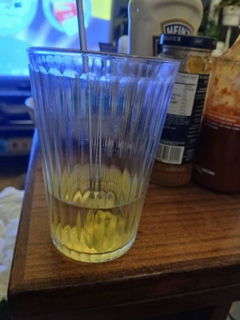


Blue mallow is the dried flower of the common mallow, Malva sylvestris, and it makes an infusion that is blue in the cup and turns pink with a squeeze of lemon. The change is a natural pH effect of the flower's anthocyanin pigments. Steep the flowers hot or cold, pour the infusion into a glass and add the lemon at the table, where everyone can see the colour shift.
A plant eaten since antiquity
Where common mallow grows
Malva sylvestris belongs to the mallow family, Malvaceae, and is a biennial or perennial plant. Kew's Plants of the World Online gives its native range as Macaronesia, Europe to Central Asia and the western Himalaya, which takes in North Africa and Western Asia. “Blue mallow” is the trade name for the dried flowers, after the colour of the infusion they give.
Mallow in Hesiod and Horace
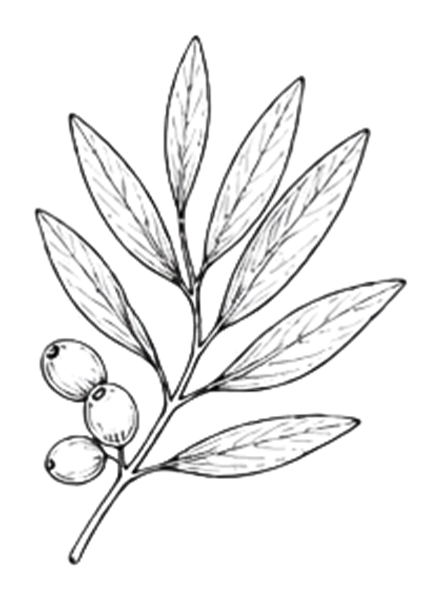
In ancient Greek and Roman writing, mallow was plain food. In Works and Days (lines 40–41), Hesiod speaks of “what great advantage there is in mallow and asphodel”, the fare of the poor; his Greek word for mallow was malache. In Odes 1.31, a prayer to Apollo, Horace writes “me pascunt olivae, / me cichorea levesque malvae”: olives, chicory and light mallows feed me. Pliny the Elder noted that both the cultivated and the wild mallow were “in magnis laudibus”, highly praised. A 19th-century note to Pliny by Bostock and Riley adds that the ancients commonly ate mallows as a vegetable, as people still did in China and the south of France.
Leaves in the pot, flowers in the cup
The mallow plant has been eaten as a leafy green since antiquity, and today it is the leaves, not the flowers, that go into the pot. In Morocco mallow leaves are cooked as bakoula or khobiza, with parsley, olive oil and lemon, and finished with olives and preserved lemon. In Lebanon they become khobbeizeh bi zeit, and the Arabic name is sometimes explained as “little piece of bread”. Mallow is not molokhia, which is a different plant, Corchorus olitorius. The flowers have a use of their own: in Iran they go into sharbat-e panirak, a drink that, left unstirred, stays pink at the bottom and blue at the top.
How it is used today
- Hot infusion. Blue to blue-violet in a glass cup. In hot water the blue fades fairly quickly, so it is at its brightest just after brewing.
- Cold infusion. Steeped in cold water, the infusion keeps its blue.
- With lemon. A squeeze of lemon juice turns the blue infusion pink.
- Layered drinks. Poured without stirring, in the manner of sharbat-e panirak, pink below and blue above.
Other flowers for colourful infusions, among them Blue Cornflower Petals and Poppy Flowers, are in our Flowers & Petals collection. More plants for the cup are in Herbal Tea.
Blue mallow in your tea cupboard
It is a flower for people who like to watch a drink change colour, and for anyone who wants a blue cold infusion in a glass jug.
Frequently asked questions
Why does the infusion change colour?
Mallow flowers contain anthocyanin pigments, which change colour with acidity. In plain water the infusion is blue to blue-violet. Lemon juice makes it more acidic, and it turns pink.
Why does the blue fade?
In hot water the blue fades fairly quickly. If you want the blue to last, steep the flowers in cold water.
Is blue mallow the same as molokhia?
No. Blue mallow is Malva sylvestris. Molokhia is a different plant, Corchorus olitorius.
Where do the flowers come from?
The batch comes from Poland or Iran, depending on the harvest.
Can I drink it during pregnancy or with medication?
If you are pregnant, breastfeeding, taking medication or have a health condition, ask your doctor before drinking flower infusions.
Sources
- Royal Botanic Gardens, Kew, Plants of the World Online, entry “Malva sylvestris L.” (accessed 19 November 2026).
- Horace, Odes 1.31, in Q. Horati Flacci Carmina, ed. P. Shorey and G. J. Laing, 1919, Perseus Digital Library, Tufts University.
- Hesiod, Works and Days, trans. H. G. Evelyn-White, Loeb Classical Library, London: Heinemann 1914.