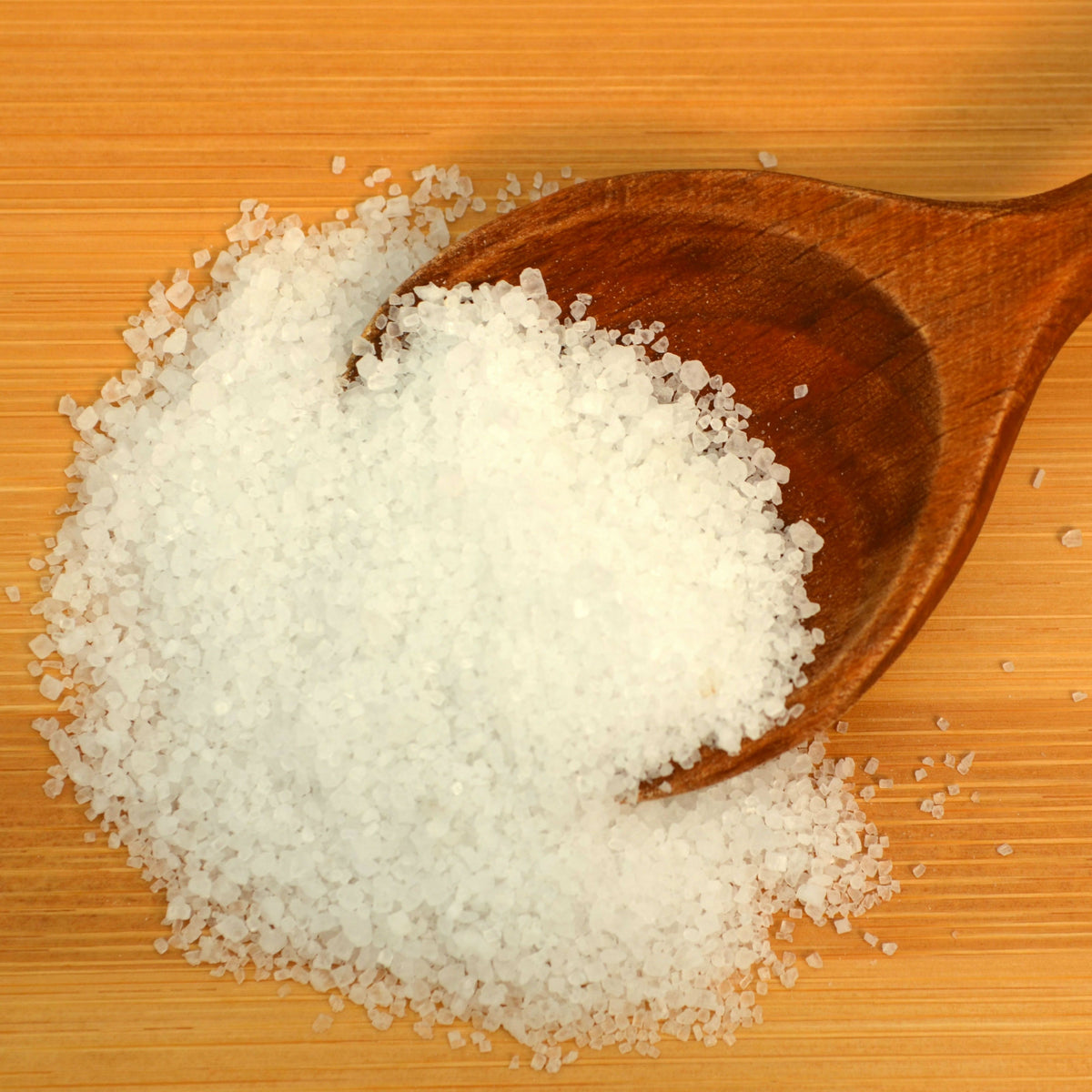
Dead Sea salt is salt from the Dead Sea, generally obtained from the lake's water by evaporation in large ponds at its southern end. This coarse-grained Dead Sea salt comes from Israel or Jordan, depending on the lot. The name tells you where the salt comes from, not a single fixed composition.
How it is made
Extensive evaporation ponds line the southern end of the Dead Sea, on both the Israeli and the Jordanian side. NASA's Jet Propulsion Laboratory notes that these ponds have in effect diked off the whole southern end of the lake. Lake water is let into the ponds, and the sun slowly evaporates it. From the brine, the operators produce potash, bromine, magnesium metal and sodium chloride, among other products.
What it contains
Much of the salt sold as Dead Sea salt differs from ordinary table salt, which is almost entirely sodium chloride. NASA's Jet Propulsion Laboratory gives salt from the Dead Sea as mostly magnesium chloride and potassium chloride, with only a small share of sodium chloride. Composition varies between producers and lots, so we give no figures for our lot. This salt comes as coarse crystals.
Storage
Keep it tightly closed in a dry place.
Frequently asked questions
Is Dead Sea salt the same as Epsom salt?
No. Epsom salt is a single compound, magnesium sulphate. Much of the salt sold as Dead Sea salt is mainly magnesium and potassium chlorides. See Epsom Salt.
How is Dead Sea salt obtained?
Water from the Dead Sea is let into large ponds at the southern end of the lake, on both the Israeli and the Jordanian side, and the sun evaporates it until the salts are left behind.
Where does our Dead Sea salt come from?
Our Dead Sea salt comes from Israel or Jordan, depending on the lot.
Sources
- NASA Jet Propulsion Laboratory, The Dead Sea (PIA01916), jpl.nasa.gov, accessed 23 November 2026.