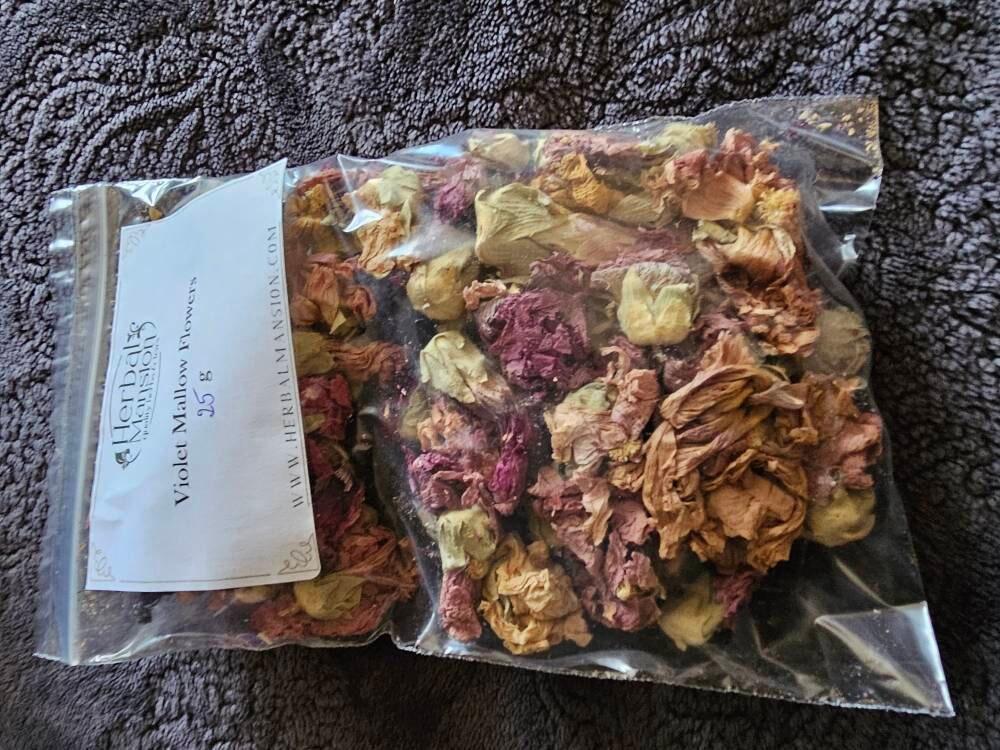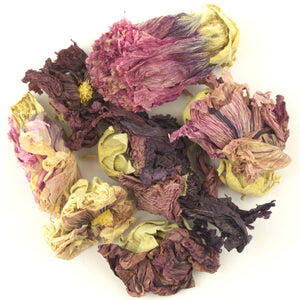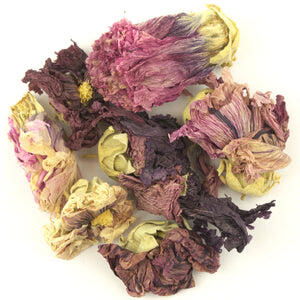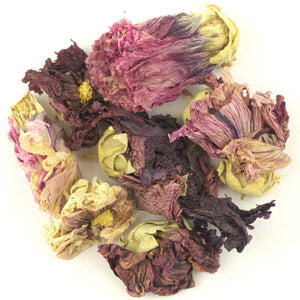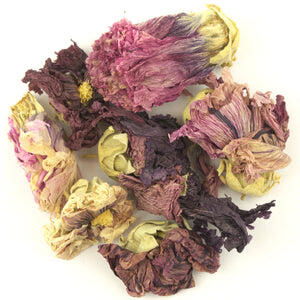


Dried hollyhock flowers are the whole flowers of Alcea rosea, a tall plant of the mallow family, Malvaceae, that grows to about 2.4 m and flowers from July to September. These come from a purple form of the same species that gives the much darker black hollyhock. The shade of the petals varies between batches.
A garden plant with an old name
Tall, grown as a biennial and unknown in the wild
Hollyhock is a perennial, but gardeners usually grow it as a biennial, because the plants are prone to rust. Its tall flower spikes draw birds and butterflies. The plant is not known in the wild, and the floras do not agree on where it first arose. It has been grown in European gardens since at least the 15th century.
Holy mallow
The English name goes back to the Middle English holihoc of the 13th century. It probably joins holi, “holy”, and hoc, “mallow”, from the Old English hocc, so the name probably means “holy mallow”. A story that the plant was brought back from the Holy Land is often repeated, but nothing confirms it. Another old name for it was caulis Sancti Cuthberti, St Cuthbert’s cabbage. At first “hollyhock” meant the marsh mallow, and the word has carried its present meaning since the middle of the 16th century.
Petals, paper and litmus
Plants For A Future records several uses for the plant beyond the garden. The petals give a brown dye, and the fibre of the stems makes a light brown paper. The pigment of the flowers, an anthocyanin, has served as litmus, an indicator that shows whether a liquid is acid or alkaline. Plants For A Future records hollyhock petals and buds as eaten raw in salads.
How it is used today
- Flower infusion. Plants For A Future lists the petals as a plant part made into tea. Two or three whole flowers are enough for a cup.
- Decoration and crafts. Whole dried flowers in a glass jar or in dried-flower work.
For a much darker form of the same plant, see Black Hollyhock. Hollyhock is not the mallow in our Blue Mallow, which is Malva sylvestris, a different genus in the same family. More dried flowers for the cup and the kitchen are in our Flowers & Petals collection.
Purple hollyhock in your tea cupboard
The flowers come whole, so they are easy to count into a pot, and a few can go into your own herbal blends. Taste varies between batches, so brew your first cup for the shorter time and taste it before brewing longer.
Frequently asked questions
What are dried hollyhock flowers?
They are the dried flowers of hollyhock, Alcea rosea, a garden plant of the mallow family. This product is a purple form, sold as whole flowers.
Is hollyhock the same as mallow?
Not quite. Hollyhock (Alcea) and mallow (Malva) are different genera within the same mallow family, Malvaceae. This product is sold as Purple Hollyhock - Mallow; botanically it is a hollyhock, not a Malva. Our Blue Mallow is Malva sylvestris, a true mallow.
Can hollyhock petals be eaten?
Plants For A Future lists hollyhock petals and flower buds as eaten raw in salads, and the petals as used for tea.
Is purple hollyhock the same plant as black hollyhock?
Both are forms of Alcea rosea. Black hollyhock is an old form called ‘Nigra’, whose petals carry so much pigment that they look black.
Can I drink it during pregnancy or with medication?
If you are pregnant, breastfeeding, taking medication or have a health condition, ask your doctor before drinking flower infusions.
Where do the flowers come from?
The current batch comes from China.
Sources
- Plants For A Future, “Alcea rosea”, PFAF Plant Database, accessed 19 November 2026.
- Flora of North America Editorial Committee, “Alcea rosea”, Flora of North America.
- Online Etymology Dictionary, “hollyhock”, etymonline.com.