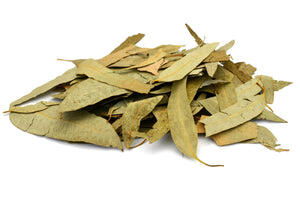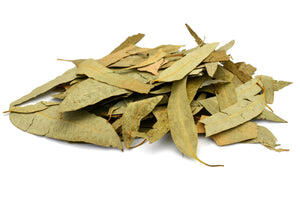


Dried eucalyptus leaves are the leaves of Tasmanian blue gum, Eucalyptus globulus, a tree of the myrtle family, Myrtaceae, that can grow to around 70 m tall. Its leaves change shape as the tree grows up, and the young ones gave it the name blue gum.
One tree, two kinds of leaf
Young and adult leaves
Young blue gum leaves are broad, set in opposite pairs on square stems and covered with a blue-grey, waxy bloom, which is where the common name comes from. Adult leaves are quite different: narrow, sickle-shaped and glossy dark green, 15 to 35 cm long.
Flowers, bark and honey
The cream flowers sit singly where the leaves meet the stem, and their abundant nectar makes a strongly flavoured honey. The bark is grey and deeply furrowed at the base, and higher up it peels away in long strips. A mature trunk can be up to 2 m across. In parts of Victoria, koalas browse blue gum alongside many other eucalypts.
A tree that travelled
The name
Eucalyptus comes from Greek words meaning ‘well’ and ‘to cover’, after the cap that covers the flower bud. Globulus, Latin for ‘a small ball’, describes the shape of the fruit.
Found by an 18th-century expedition
The French botanist Jacques-Julien Houtou de Labillardière collected the first specimen on Tasmania’s south-east coast in 1792 and 1793, during d’Entrecasteaux’s voyage in search of La Pérouse, and described the species in 1799. In the wild, blue gum grows mainly in south-eastern Tasmania, along the east coast and on King and Flinders Islands. On the mainland it is found only at Wilsons Promontory and Cape Otway in Victoria. It was proclaimed the floral emblem of Tasmania in 1962.
Planted far from home
Blue gum has been planted in New Zealand, South Africa, South America, California, India and around the Mediterranean, and it grows in large gardens in Cornwall. It reached California as an ornamental tree in 1853, and during the 1850s seedlings were already on sale in San Francisco nurseries.
How it is used today
- Light infusion. Half to 1 teaspoon per 250 ml, steeped covered in water just off the boil.
- Start small. Sellers suggest beginning with a small amount, as the flavour is strong.
For another dried leaf from a tree, see Olive Leaf, and for a leaf from the garden, Sage Leaf. More single herbs are in our Single Herbs collection, and other herbs for tea are in Herbal Tea.
Eucalyptus leaves in your home cupboard
A little goes a long way. Brew your first cup with half a teaspoon, taste it, and add more leaf next time only if you want a stronger cup.
Frequently asked questions
Can you make tea with eucalyptus leaves?
Sellers offer dried eucalyptus leaves for a light infusion and suggest starting with a small amount, as the flavour is strong. Eucalyptus essential oil is a separate product; this listing is for the dried leaf only.
How do I make eucalyptus leaf tea?
Put half to 1 teaspoon of dried leaves, about 0.5 to 1 g, in a 250 ml cup, pour over water just off the boil, cover and leave for 5 minutes, then strain.
Why is it called blue gum?
The young leaves are covered with a blue-grey, waxy bloom, which gives the tree its common name.
Can I drink it during pregnancy or with medication?
If you are pregnant, breastfeeding, taking medication or have a health condition, ask your doctor before drinking herbal infusions.
Where does the eucalyptus come from?
The current batch comes from China.
Sources
- Australian National Botanic Gardens, Floral Emblem of Tasmania: Tasmanian Blue Gum, anbg.gov.au, accessed 20 November 2026.
- Australian National Botanic Gardens and ABRS, Floral Emblems of Australia (PDF), anbg.gov.au.
- USDA Forest Service, History of Eucalypts in California (PSW-GTR-069), fs.usda.gov.
- Koala Clancy Foundation, How do koalas eat?, koalaclancyfoundation.org.au.