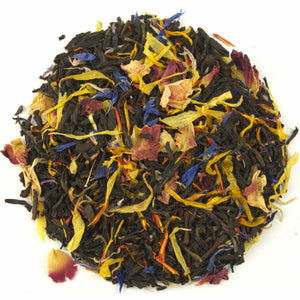
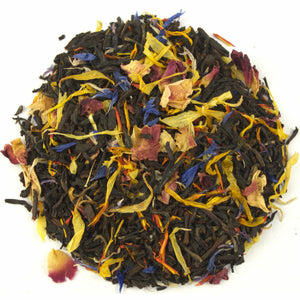
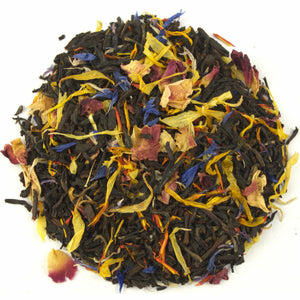
Earl Grey Rainbow is an Earl Grey with added flower petals in several colours. The base is loose-leaf black tea from Yunnan with added bergamot flavouring, and the rose, marigold, safflower and cornflower petals are there for the eye.
Colour on a black background
A name in advertisements
The oldest known mention of a tea bearing the name of Earl Grey comes from a newspaper advertisement from the second half of the 19th century. Charles Grey himself had led the government of Great Britain several decades earlier, and his only link with the tea is his name. Two London firms, Twinings and Jacksons of Piccadilly, later claimed that they had prepared the recipe for his family. Neither has a document from the period. The name caught on faster than any version of its origin.
Petals in tea
Teas with flowers were known earlier in China, where the flowers gave the scent. European blending houses also added petals for colour. Rose, marigold, safflower and cornflower keep their colour after drying. The blend therefore looks colourful in the packet and in a glass teapot. Each of these flowers is also available from us separately, for your own blends.
How Earl Grey Rainbow is made
The base is black tea from Yunnan. The leaves are withered, rolled, oxidised and dried. The finished tea is then combined with bergamot flavouring. Finally, dried petals are added. Each flower is dried separately, in the shade, so that it keeps its colour.
How it is used today
- Everyday tea. Drink it plain or with milk.
- A glass teapot on the table. The colourful petals can be seen in the infusion, which makes this a tea for guests.
- Alcohol-free punch. Chilled infusion with apple juice and orange slices.
- Iced, with fruit. The infusion with ice and seasonal fruit for a summer afternoon.
The classic version, with no added petals, is our Earl Grey, and the version with cornflower alone is Earl Grey Blue. Marigold Calendula Flowers are available separately. You will find the other versions in our Earl Grey collection.
Earl Grey Rainbow in your tea cupboard
This is an Earl Grey for people who like colourful blends.
Frequently asked questions
Is this tea flavoured?
Yes. This tea has added bergamot flavouring.
Does it contain caffeine?
Yes, the base of the blend is black tea. The amount of caffeine in the infusion depends on the amount of leaves and the brewing time.
Can I drink it during pregnancy or with medication?
It contains caffeine, so in these situations ask a doctor or pharmacist. A product description does not replace their advice.
Which flowers are in the blend?
Rose, marigold, safflower and blue cornflower petals.
How does it differ from classic Earl Grey?
It differs in the addition of colourful petals, which give very little taste to the infusion.
Sources
- William H. Ukers, All About Tea, New York 1935, vol. I, chapter XIII “Tea Characteristics”, p. 258 (flower-scented teas), and vol. II, chapter IX “Noted Firms in the British Isles”, pp. 156–157.
- Oxford English Dictionary, entry “Earl Grey”.
- Mary Lou Heiss, Robert J. Heiss, The Story of Tea: A Cultural History and Drinking Guide, Berkeley 2007, chapter “Manufacture: From Fresh Leaves to Distinctive Tea”, section “Scented and Flavored Teas”.
- Victor H. Mair, Erling Hoh, The True History of Tea, London 2009.
- EFSA, Scientific Opinion on the safety of caffeine, EFSA Journal 2015, 13(5):4102.