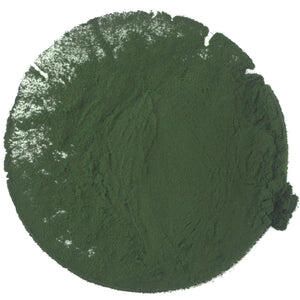
Spirulina powder is dried spirulina: the cyanobacterium Arthrospira platensis, turned into a dark blue-green powder. Our spirulina comes from China. It has a strong colour and a distinctive savoury, sea-like flavour, so a little goes a long way.
What spirulina is
Spirulina is neither a plant nor a true alga. It is a cyanobacterium, one of the organisms once called blue-green algae, which scientists have classed with the bacteria since the 1960s. Under a microscope it forms threads of cells twisted into a spiral, 50 to 500 thousandths of a millimetre long. Its scientific name is Arthrospira platensis, formerly Spirulina platensis, but the old name has stayed in the shops.
Where the colour comes from
Spirulina's main pigment is phycocyanin, which is blue. It also carries green chlorophyll and carotenoids, and together they give the powder its deep blue-green. Phycocyanin extracted from spirulina is used to colour foods blue, but whole spirulina powder contains all of these pigments, so it turns food green rather than bright blue.
A long history as food
Spanish chroniclers described how the Aztecs of Tenochtitlan gathered spirulina from the lakes with fine nets and made it into blue-green cakes. Lake Texcoco, the last remnant of those lakes, still holds living spirulina. By Lake Chad, the Kanembu people have long harvested it, dried it on the sandy shore and cut it into cakes called dihé, which are crumbled into a sauce of tomatoes and peppers and served over millet, beans, fish or meat.
How to use spirulina powder
- Smoothies and drinks. Half a teaspoon is enough to colour a glass of fruit smoothie; fruit and other strong flavours soften its sea-like note, while on its own the flavour comes through more clearly.
- Fresh pasta and noodles. Spirulina darkens pasta dough and turns it green, and it is already used commercially in noodles.
- Biscuits and cereal bars. Small amounts add colour with only a slight sea note.
- Savoury sauces. In the spirit of dihé, stir a little into a tomato and pepper sauce.
Prefer spirulina without a loose powder? See Spirulina Tablets. For a green rather than blue-green powder, try Chlorella Powder, or browse the rest of this range.
Storage
Spirulina powder absorbs moisture from the air, which is why producers pack it in sealed bags. Close the bag tightly after each use and keep it in a cool, dry, dark cupboard.
Frequently asked questions
What does spirulina taste like?
Savoury and sea-like, with a note often compared to seaweed. The flavour is strong in larger amounts, so start small and combine it with other ingredients.
Is spirulina a seaweed or an alga?
Neither. It is a cyanobacterium, a microorganism that grows in spiral threads. It was once grouped with the algae, which is why you may still see it called blue-green algae.
Will spirulina powder make my food blue?
No. It colours food green to blue-green. Bright blue foods are coloured with phycocyanin, a pigment extracted from spirulina, not with the whole powder.
Where does our spirulina come from?
Our spirulina comes from China.
Sources
- Habib M.A.B., Parvin M., Huntington T.C., Hasan M.R., A review on culture, production and use of spirulina as food for humans and feeds for domestic animals and fish, FAO Fisheries and Aquaculture Circular No. 1034, FAO (2008), accessed 24 November 2026.
- FAO, Spirulina extract. Chemical and Technical Assessment, 95th JECFA (2023), accessed 24 November 2026.
- Raczyk M. et al., Effect of Spirulina (Arthrospira platensis) Supplementation on Physical and Chemical Properties of Semolina (Triticum durum) Based Fresh Pasta, Molecules 27 (2022), accessed 24 November 2026.
- Ottombrino A. et al., Sensory Analyses Driven Formulation of Fruit Cereal Bars Enriched With Arthrospira platensis Dried Powder, Food Science & Nutrition 13 (2025), accessed 24 November 2026.