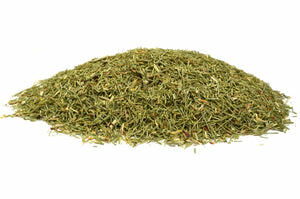
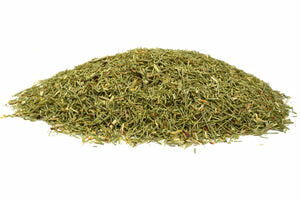
Dried horsetail herb is the cut green summer stems of field horsetail, Equisetum arvense, a plant that never flowers. In early spring it sends up short, pale stems tipped with a cone, and only after them come the familiar green, branched stems that last through the summer.
A plant without flowers
Two kinds of stem
Field horsetail belongs to the horsetail family, Equisetaceae. It is a perennial with creeping rhizomes, and it forms large colonies. Its stems are hollow, ribbed and divided into segments, and its leaves are reduced to small brownish sheaths. The spore-bearing stems come up very early in spring, often as the snow melts. They are brownish to whitish and carry a cone at the tip, 10 to 40 mm long. They soon wither and are followed by the sterile stems, which are green, carry whorls of slender branches and last through the summer.
Fields, hedgerows and roadsides
Field horsetail grows in open fields, on arable land, in waste places, in hedgerows and along roadsides, usually on damp soils. Its range covers the Arctic and temperate regions of Europe, including Britain, North America and Asia.
Field or marsh horsetail?
Field horsetail is told apart from the similar marsh horsetail, Equisetum palustre, by the first segment of its lowest side branches, which is longer than the sheath on the main stem. In marsh horsetail that segment is much shorter. The small scales at the base of the branches help too: they are pale in field horsetail and black in marsh horsetail.
Horse bristles and pewter
A horse’s tail
The name Equisetum joins the Latin equus, a horse, and seta, a bristle, after the bristly, segmented stems. The same picture lies behind the English names horsetail, bottle-brush and paddock-pipes.
Scouring and polishing
The rough stems of horsetails, above all those of the related Dutch rush, Equisetum hyemale, were once used to scour pewter and polish wood. Plants For A Future records that field horsetail stems were used to scour metal, as a fine sandpaper and for polishing brass and hardwood. Dutch rush earned its name because bundles of its stems were brought over from Holland for polishing, and it was also called pewterwort. Field horsetail stems also give a pale dye, and they have been made into whistles.
How it is used today
- Infusion. The dried green stems, steeped in boiling water.
- Natural dyeing. The stems give a pale dye.
For another plant of fields and roadsides, try Yarrow Herb, and for another green herb for the cup, see Stinging Nettle Leaf. More single herbs are in our Single Herbs collection, and other plants for the cup are in Herbal Tea.
Horsetail in your home cupboard
One seller describes the infusion as mild, grassy and earthy, with no bitterness and a flavour close to a light vegetable broth, pale gold to yellow-green in the cup. Taste varies between batches, so brew your first cup for the suggested time and adjust from there.
Frequently asked questions
How do I make horsetail tea?
Put about 2 g (1 to 2 teaspoons) of dried horsetail herb in a 250 ml cup, pour over boiling water and leave for about 8 minutes, then strain.
Does horsetail have flowers?
No. Horsetail is a spore-bearing plant. Its spores form in a cone on short, pale stems in early spring, and the green, branched stems that follow carry no cones.
Why is it called horsetail?
The Latin name Equisetum means horse bristle, after the bristly, segmented stems that look a little like a horse’s tail.
Can I drink it during pregnancy or with medication?
If you are pregnant, breastfeeding, taking medication or have a health condition, ask your doctor before drinking herbal infusions.
Where does horsetail herb come from?
The current batch comes from Poland.
Sources
- Jermy, A. C., Page, C. N. and Acock, P. J., Equisetum, Horsetails, BSBI Plant Crib, Botanical Society of Britain and Ireland, 1998.
- Plants For A Future, Equisetum arvense, PFAF Plant Database, accessed 19 November 2026.