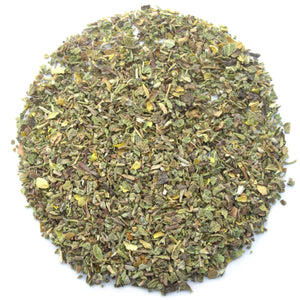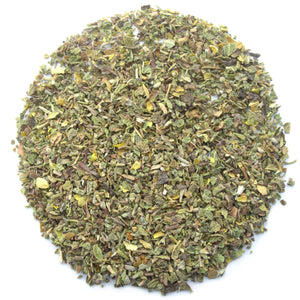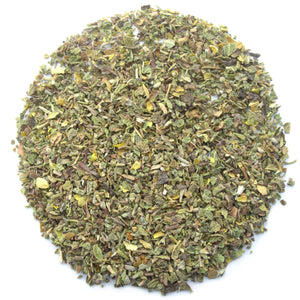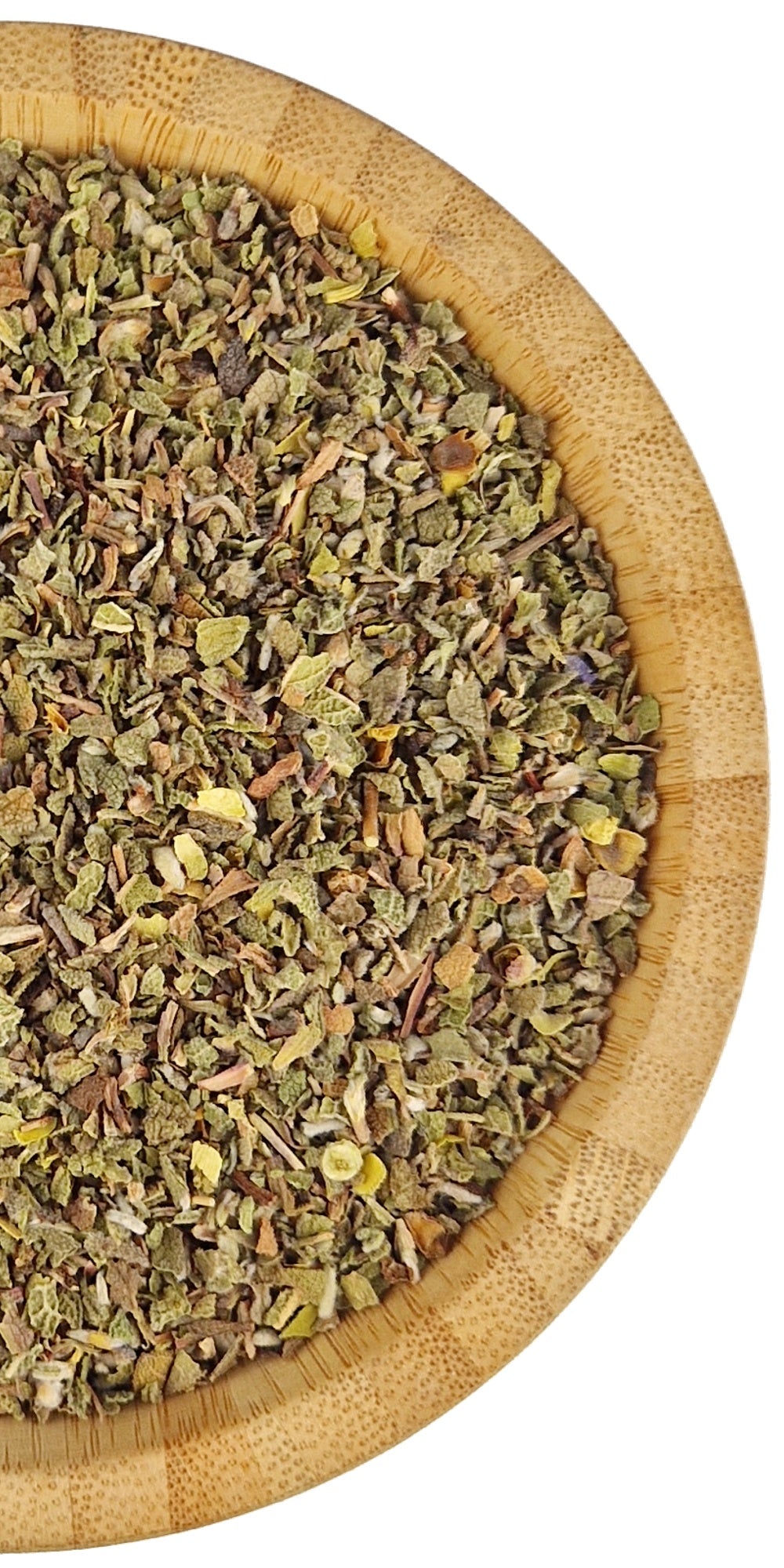
Rockrose tea, also sold as cistus tea, is made from the dried, cut leaves and twigs of Cistus × incanus, also known as Cistus creticus, a shrub of the Mediterranean maquis. Its leaves and young shoots carry tiny glandular hairs that give off a sticky resin, labdanum, used in incense and perfume.
A shrub of the maquis
Leaves, twigs and resin
Rockrose is a shrub of sandy, sunny ground and poor soils. Gardeners know the genus Cistus as robust and extremely drought-tolerant shrubs for Mediterranean-style gardens. Glandular hairs on the leaves and young shoots release labdanum, most of all in full sun. The dried herb is made of leaves and twigs, which in the trade are gathered mainly in spring and summer.
Rockrose or rock rose?
The English names can mislead. As the Royal Horticultural Society puts it, Cistus “rather confusingly” shares the names rock rose and sun rose with Helianthemum, a low-growing plant of the same family. In the British flora, Common Rock-rose is the native Helianthemum nummularium, a different plant from this shrub.
Labdanum, goats and perfume
Combed from goats’ beards
The Greek historian Herodotus wrote that the substance Greeks called ledanon was found in the beards of he-goats, though he placed it in Arabia. Labdanum was traditionally gathered from Cistus creticus on Crete and Cyprus. Goats grazing among the shrubs picked up the resin on their coats, and collectors also used the ladanisterion, a bow-shaped tool strung with leather thongs that was dragged over the bushes in the hottest part of the day. This old way of gathering survives in only one or two Cretan villages, and a piece of goat’s coat with labdanum caught in it is kept in the Economic Botany Collection at Kew.
Incense and perfume
Labdanum has served as incense and as a perfume ingredient since biblical times. It went into medieval perfumes in Byzantium, Italy and north-western Europe, and into chrism, a consecrated oil. In perfumery today labdanum belongs to the amber notes and is used as a fixative, but the commercial resin now comes from another species, Cistus ladanifer, from Spain.
How it is used today
- Infusion. Sellers suggest 1 teaspoon per 250 ml cup of water at or near the boil, covered, for 5 to 10 minutes. A tea guide and a seller describe the cup as tart and aromatic.
- Potpourri. One seller offers dried cistus herb as potpourri.
For other dried plants for the home, see Lavender and Pink Heather. More single herbs are in our Single Herbs collection, and other plants for the cup are in Herbal Tea.
The leaf, not the resin
This product is the dried leaves and twigs of the shrub, not labdanum resin. Brew it as a herbal infusion, or use it in potpourri.
Frequently asked questions
How do I brew rockrose tea?
Put 1 teaspoon (about 1.5 to 2 g) of dried rockrose in a 250 ml cup, pour over water at 95 to 100°C, cover and leave for about 6 minutes, then strain. A longer steep gives a more tart cup.
Is rockrose the same as rock rose?
Not always. In Britain, Common Rock-rose is Helianthemum nummularium, a low-growing native plant, not this Mediterranean shrub.
Is Cistus incanus the same as Cistus creticus?
In the trade the two names are used for the same shrub.
Can I drink it during pregnancy or with medication?
If you are pregnant, breastfeeding, taking medication or have a health condition, ask your doctor before drinking herbal infusions.
Where does rockrose come from?
The current batch comes from Turkey.
Sources
- Royal Horticultural Society, Cistus (rock rose), rhs.org.uk, accessed 19 November 2026.
- Botanical Society of Britain and Ireland, Helianthemum nummularium (Common Rock-rose), bsbi.org, accessed 19 November 2026.
- Page, R., Perfumery, The Cistus & Halimium Website, cistuspage.org.uk, accessed 19 November 2026.
- Batsaki, Y., Plant of the Month: Cretan Rockrose, JSTOR Daily, 23 February 2022.
- Herodotus, Histories III.112, tr. A. D. Godley, Wikisource, accessed 19 November 2026.
- Tee-Magazin, Cistus Tea (Rock Rose), tee-magazin.de, accessed 19 November 2026.