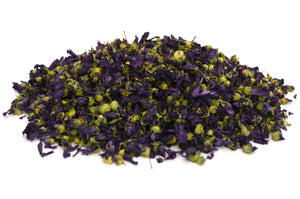
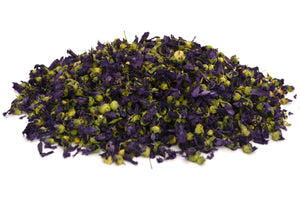
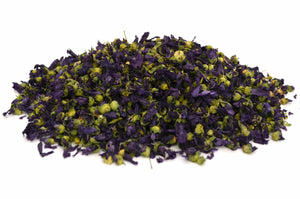
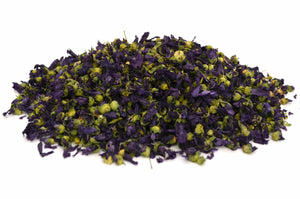
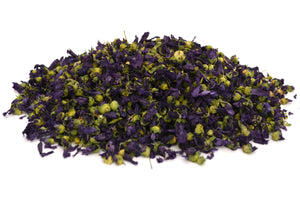
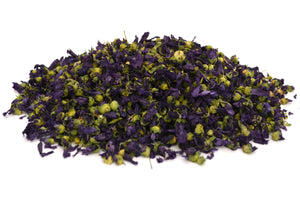
Blue mallow is the dried flower of the common mallow, Malva sylvestris. Its infusion is blue in the cup and turns pink with a squeeze of lemon, a natural pH effect of the flower's anthocyanin pigments. Steep the flowers hot or cold, pour the infusion into a glass and add the lemon at the table, where everyone can see the colour shift.
A plant eaten since antiquity
Where common mallow grows
Malva sylvestris is a biennial or perennial plant of the mallow family, Malvaceae. Kew's Plants of the World Online gives its native range as Macaronesia, Europe to Central Asia and the western Himalaya, which takes in North Africa and Western Asia. “Blue mallow” is the trade name for the dried flowers, after the colour of their infusion.
Mallow in Hesiod and Horace
For Greek and Roman writers, mallow was plain food. In Works and Days (lines 40–41), Hesiod speaks of “what great advantage there is in mallow and asphodel”, the fare of the poor; his Greek word for mallow was malache. In Odes 1.31, a prayer to Apollo, Horace writes “me pascunt olivae, / me cichorea levesque malvae”: olives, chicory and light mallows feed me. Pliny the Elder noted that both the cultivated and the wild mallow were “in magnis laudibus”, highly praised. A 19th-century note to Pliny by Bostock and Riley adds that the ancients commonly ate mallows as a vegetable, as people still did in China and the south of France.
Leaves in the pot, flowers in the cup
Mallow has been eaten as a leafy green since antiquity, and today the leaves, not the flowers, go into the pot. In Morocco mallow leaves are cooked as bakoula or khobiza, with parsley, olive oil and lemon, and finished with olives and preserved lemon. In Lebanon they become khobbeizeh bi zeit, and the Arabic name is sometimes explained as “little piece of bread”. Mallow is not molokhia, a different plant, Corchorus olitorius. The flowers have a use of their own: in Iran they go into sharbat-e panirak, a drink that, left unstirred, stays pink at the bottom and blue at the top.
Hot, cold, with lemon or layered
- Hot infusion. Blue to blue-violet in a glass cup. The blue fades fairly quickly in hot water, so it is brightest just after brewing.
- Cold infusion. Steeped in cold water, the infusion keeps its blue.
- With lemon. A squeeze of lemon juice turns the blue infusion pink.
- Layered drinks. Poured without stirring, as in sharbat-e panirak: pink below, blue above.
Other flowers for colourful infusions, among them Blue Cornflower Petals and Poppy Flowers, are in our Flowers & Petals collection. More plants for the cup are in Herbal Tea.
Who it suits
People who like to watch a drink change colour, and anyone who wants a blue cold infusion in a glass jug.
Frequently asked questions
Why does the infusion change colour?
Mallow flowers contain anthocyanin pigments, which change colour with acidity. In plain water the infusion is blue to blue-violet. Lemon juice makes it more acidic, and it turns pink.
Why does the blue fade?
In hot water the blue fades fairly quickly. For a blue that lasts, steep the flowers in cold water.
Is blue mallow the same as molokhia?
No. Blue mallow is Malva sylvestris. Molokhia is a different plant, Corchorus olitorius.
Where do the flowers come from?
From Poland or Iran, depending on the harvest.
Can I drink it during pregnancy or with medication?
If you are pregnant, breastfeeding, taking medication or have a health condition, ask your doctor before drinking flower infusions.
Sources
- Royal Botanic Gardens, Kew, Plants of the World Online, entry “Malva sylvestris L.” (accessed 19 November 2026).
- Horace, Odes 1.31, in Q. Horati Flacci Carmina, ed. P. Shorey and G. J. Laing, 1919, Perseus Digital Library, Tufts University.
- Hesiod, Works and Days, trans. H. G. Evelyn-White, Loeb Classical Library, London: Heinemann 1914.