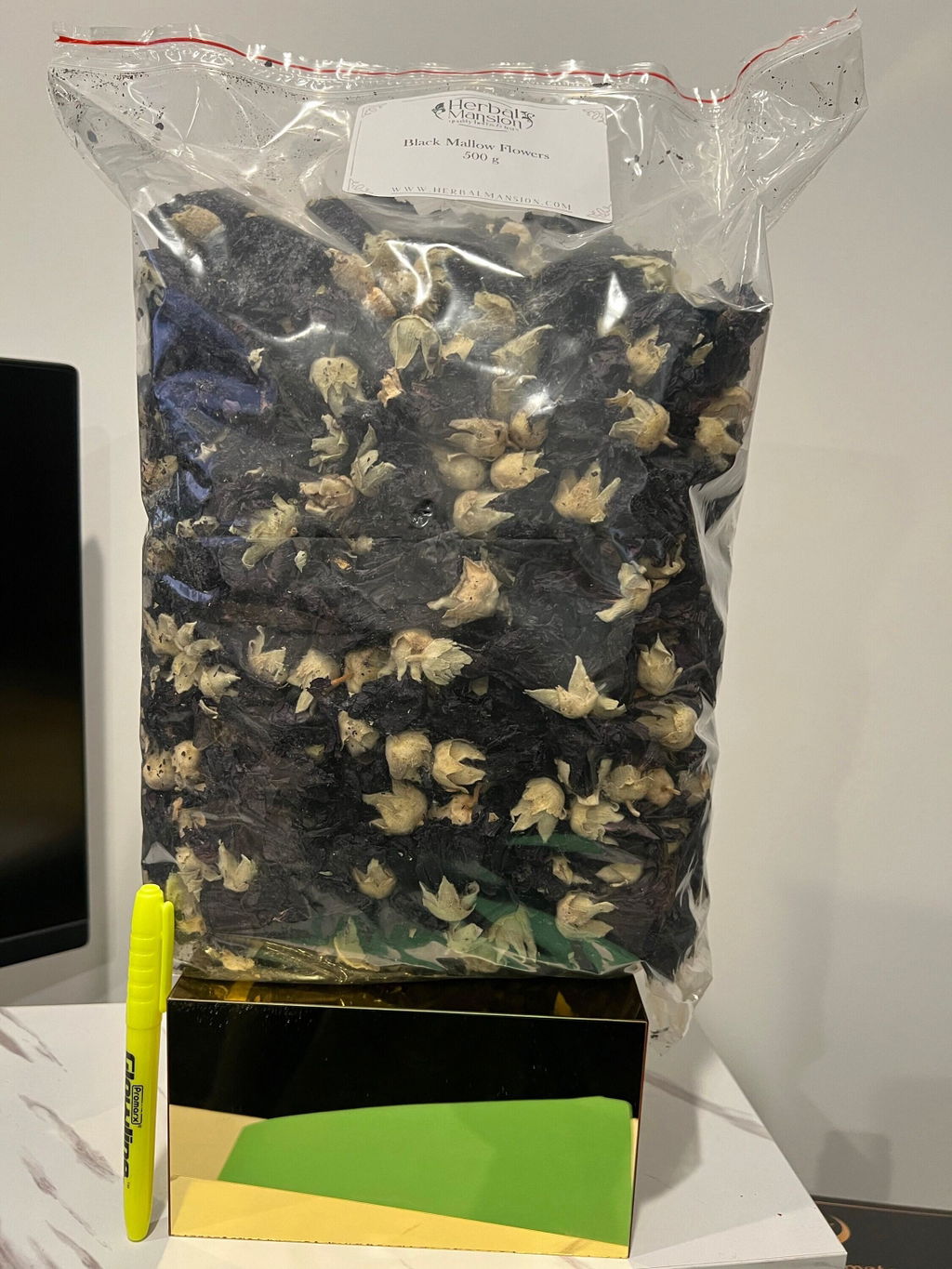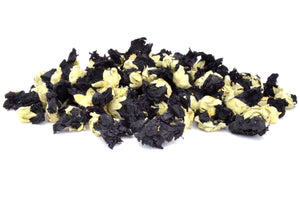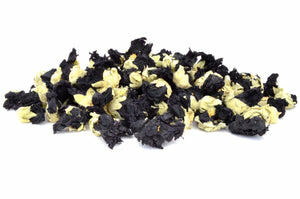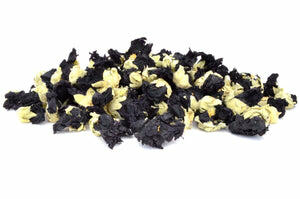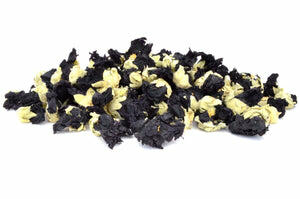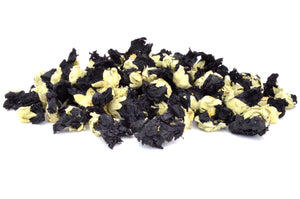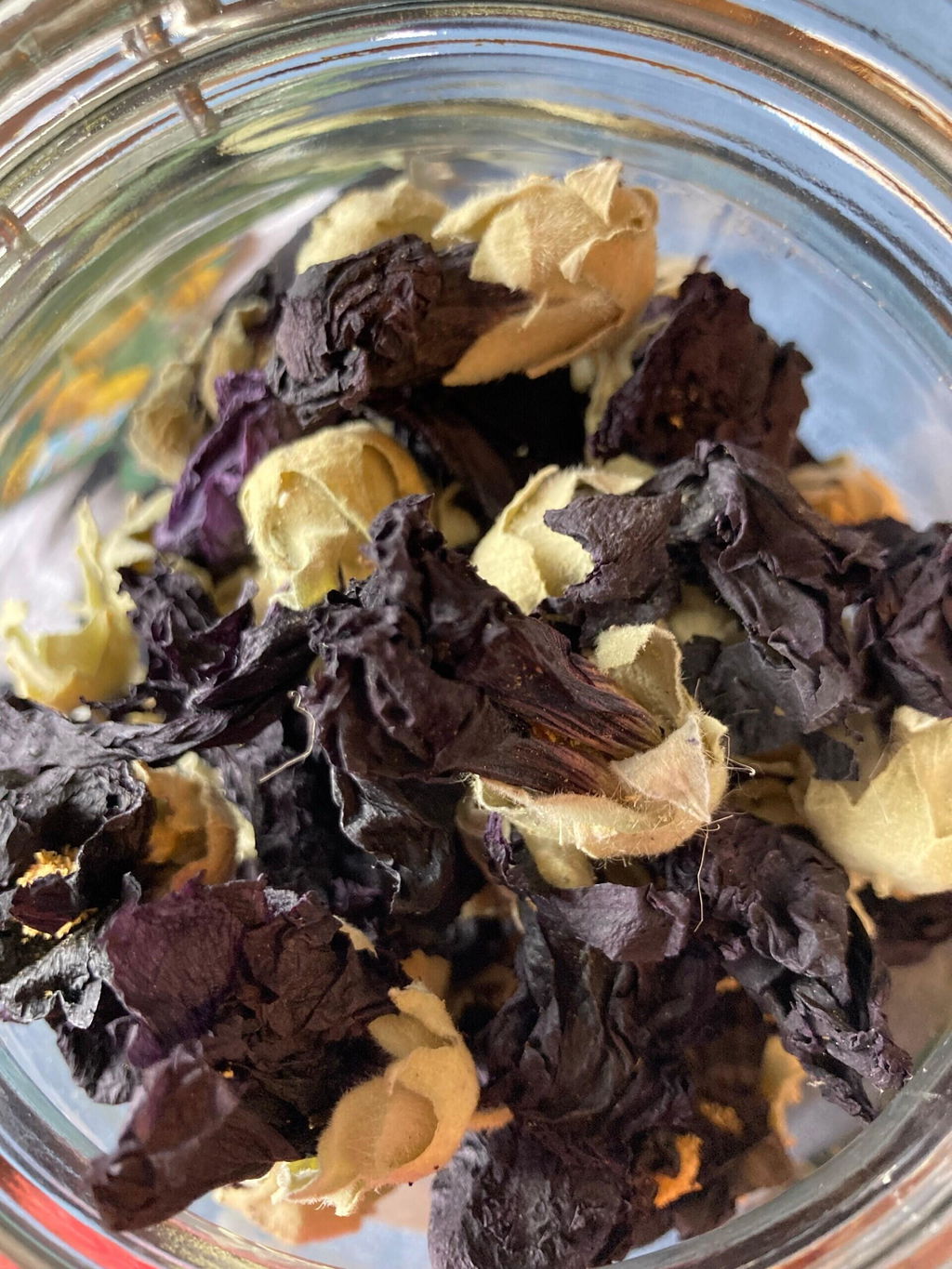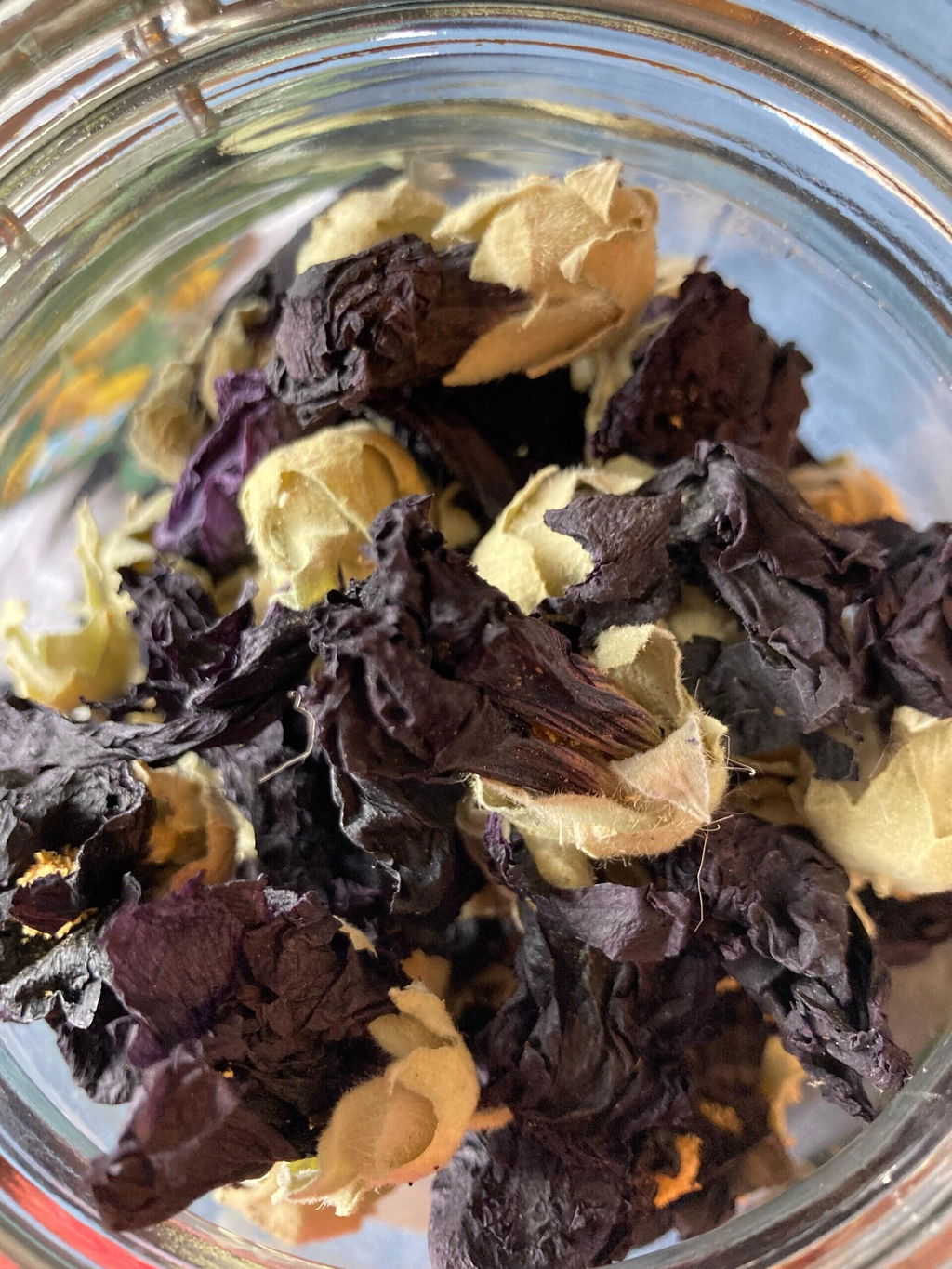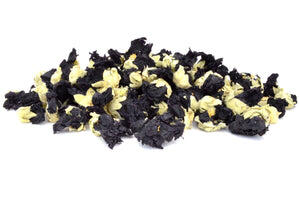


Black hollyhock, sold in the dried flower trade as black mallow, is Alcea rosea ‘Nigra’, an old garden form whose petals are not truly black but a very deep maroon-purple. Their colour comes from an unusually high load of natural pigment. These dried hollyhock flowers come whole, and their shade varies between batches.
The black form of the hollyhock
An heirloom called ‘Nigra’
‘Nigra’ is an heirloom hollyhock with single flowers that seed sellers describe as shimmering burgundy-black. It is also sold as ‘Jet Black’, ‘Single Black’ and ‘The Watchman’. Its flower spikes reach 1.5 to 2.4 m and bloom in July and August, and in good conditions a plant lives for three or four years. Like every hollyhock it belongs to the mallow family, Malvaceae, and it is a garden plant unknown in the wild. Cambridge University Botanic Garden describes hollyhocks as vigorous and easy to grow. Plants For A Future records hollyhock petals and buds as eaten raw in salads.
Why the petals look black
Black flowers are not truly black. In a 2012 study, Hosaka, Mizuno and Iwashina isolated nine anthocyanins from the petals of ‘Nigra’, derived from delphinidin, cyanidin, petunidin and malvidin. They found that the black colour comes from a high accumulation of these anthocyanins alone, not from co-pigmentation with other compounds. What the eye reads as black is a very deep purple.
An old garden story
John Parkinson is said to have described a black hollyhock in 1629, in his Paradisi in Sole Paradisus Terrestris, as “of a dark red like black blood”. The plant is also said to have been grown by Thomas Jefferson at Monticello.
How it is used today
- Flower infusion. Two or three whole flowers make a cup. One seller describes the infusion as deep, dark violet, sweet and mild, with a hint of dried cranberry and a light acidity.
- Natural dyeing. Cambridge University Botanic Garden gives a recipe in which fresh or dried petals heated in water with alum give purple. Tin with a little chalk gives a pale blue, and alum with chalk a grey-green.
- Crafts. Dried black hollyhock is also sold for making candles and soap.
For a lighter form of the same species, see Purple Hollyhock. Despite its trade name, black mallow is not the plant in our Blue Mallow, which is Malva sylvestris. Other flowers for the cup and for crafts are in our Flowers & Petals collection.
Black hollyhock in your tea cupboard
A few flowers are enough to colour a pot, or a blend of fruit and herbs of your own. Brew the first cup for the shorter time and taste it before brewing longer.
Frequently asked questions
Is black mallow the same as hollyhock?
In the dried flower trade, black mallow is the usual name for black hollyhock, Alcea rosea ‘Nigra’. Botanically the name is loose. Hollyhock belongs to the genus Alcea, while true mallows, such as the Malva sylvestris we sell as Blue Mallow, belong to Malva. Both genera are in the mallow family, Malvaceae.
Are the flowers really black?
No. They are a very deep maroon-purple. A 2012 study traced the colour to a high accumulation of anthocyanin pigments in the petals.
Can I drink it during pregnancy or with medication?
If you are pregnant, breastfeeding, taking medication or have a health condition, ask your doctor before drinking flower infusions.
Where do the flowers come from?
The current batch comes from Poland.
Sources
- Plants For A Future, “Alcea rosea”, PFAF Plant Database, accessed 19 November 2026.
- Cambridge University Botanic Garden, “Alcea rosea ‘Nigra’”, Dye Trail, botanic.cam.ac.uk.
- Hosaka, H., Mizuno, T. and Iwashina, T. (2012), study of the flavonoid pigments and flower colour of black hollyhock, Alcea rosea ‘Nigra’, Bulletin of the National Museum of Nature and Science, Series B 38: 69-75.
- Parkinson, J. (1629), Paradisi in Sole Paradisus Terrestris, London.