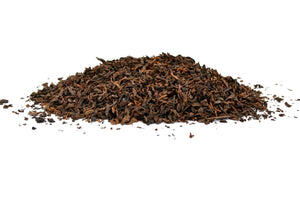
Pu Erh Milk is a ripened pu-erh tea with added milk flavouring, which combines an earthy taste with a milky, creamy note. In Poland and some other European countries pu-erh is known as red tea; in China it belongs to the dark teas. The infusion is dark and full, and it can be served on its own or used as the base of a drink with milk. In the first cup it is worth getting to know the tea itself before you choose your own proportions.
A ripened tea in a new guise
Caravans and changing tastes
Pu-erh is bound up with the history of the tea trade from Yunnan. Caravans carried pressed tea to distant buyers, and the way it was transported and stored influenced its later character. Over time Hong Kong became an important market, where a mature, dark infusion was valued. The history of this style includes both the work of the producers and the tastes of tea drinkers in other regions. Its present-day image took shape through these contacts.
Ripening in piles
In the 1970s a method of accelerated ripening of tea was developed in Yunnan. Moistened leaves are laid in piles, and the conditions of the process are controlled. Shou pu-erh made in this way has a different character from young sheng tea. The changes take place with the involvement of microorganisms, temperature and humidity. The process requires supervision and subsequent further drying of the leaves.
How the base of Pu Erh Milk is made
Making pu-erh involves the initial processing of the picked leaves, heating, rolling and drying. In the case of shou, the next stage is controlled ripening. In the pile, moisture and warmth allow changes brought about by microorganisms. When ripening is complete, the tea is dried further and prepared for further use. The milk flavouring is then added: in this tea the earthy profile is the background for the creamy note.
How it is used today
- On its own. The tea by itself lets you discover the combination of an earthy background and a milky note.
- Tea with milk. Milk or a plant-based drink of your choice can be added to the strained infusion. Taste the tea before adding milk, because it already has a creamy note. If the infusion is to be the base of a drink with more milk, you can use more tea.
- Iced drink. Tea brewed stronger can be chilled and served with ice.
- With a spice. A small pinch of cinnamon added to the finished drink gives a different flavour combination.
Our Pu Erh Tea collection also includes the loose Pu Erh Tea. Oolong Milk is a milky tea with a different base.
Pu Erh Milk in your tea cupboard
What stands out in Pu Erh Milk is the combination of an earthy base with a creamy scent. Your own brewing proportions let you choose how strongly you want each of them to come through in the cup.
Frequently asked questions
Is Pu Erh Milk flavoured?
Yes, this tea is flavoured: the milky note comes from added flavouring.
How does it differ from Oolong Milk?
In the type of tea base. Pu Erh Milk is a ripened pu-erh tea, while Oolong Milk is an oolong.
Do the leaves need to be rinsed before brewing?
It is not an obligatory step. You can compare brewing with a short rinse and without one, keeping the other parameters the same.
Does Pu Erh Milk contain caffeine?
Yes, caffeine occurs naturally in the leaves of this tea.
Can I drink it during pregnancy or with medication?
It contains caffeine, so in these situations ask a doctor or pharmacist. A product description does not replace their advice.
Sources
- Jinghong Zhang, Puer Tea: Ancient Caravans and Urban Chic, University of Washington Press, Seattle 2014, chapter 1, p. 44 (artificial fermentation, Kunming 1973) and pp. 160–165 (the Hong Kong market).
- Victor H. Mair, Erling Hoh, The True History of Tea, Thames & Hudson, London 2009.
- Mary Lou Heiss, Robert J. Heiss, The Story of Tea: A Cultural History and Drinking Guide, Ten Speed Press, Berkeley 2007, chapter “Manufacture: From Fresh Leaves to Distinctive Tea”, section “Pu-erh Tea” (shou, wo dui, the 1970s).
- William H. Ukers, All About Tea, The Tea and Coffee Trade Journal Company, New York 1935, vol. II, chapter I “Trading in Producing Countries”, p. 26 (pressed tea from Yunnan, caravans to Tibet).
- EFSA, Scientific Opinion on the safety of caffeine, EFSA Journal 2015, 13(5):4102.