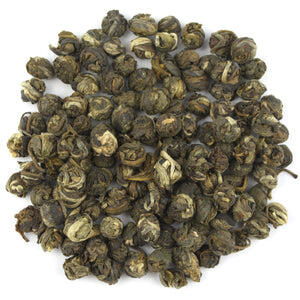
Dragon Pearls is a green tea with a mild, sweetish taste and a light floral note. It gives a pale yellow infusion whose strength can be adjusted by changing the brewing time. Shaping the leaves into pearls by hand is part of its traditional processing.
A tea rolled by hand
The tea workshops of Fujian
Pearl teas are linked, among other places, to the tea workshops of Fujian, a region also known for its jasmine teas. Dragon Pearls are the plain version, made without jasmine or any other additions.
Dragon pearls and tea names
The Chinese long zhu translates as dragon pearls, and the English Dragon Pearls refers to the same term. Images taken from nature and associations with the form of the leaves often appear in tea names. Today pearls are made in various regions, including Fujian and Yunnan. They are an example of a craft in which the way the leaves are shaped has become a recognisable part of the name. In a teahouse such tea can be brewed in a glass vessel, so you can watch the leaves unfurl in the water. This way of serving combines getting to know the taste with the brewing itself.
How Dragon Pearls are made
The basic step in making green tea is heating the picked leaves, which limits oxidation. Young leaves together with the tips of the shoots are then processed further and shaped. When rolling by hand, a small portion is given the desired shape, after which the tea is dried. The way these steps are carried out affects how the tea later brews.
How it is used today
- A cup on its own. A plain infusion lets you get to know the sweetish, floral profile of this tea.
- Cold brew. A longer brew in the fridge gives an alternative to a hot cup.
- With fruit. The chilled tea can be served with thin slices of pear or lemon.
A starting point for comparisons is our Loose Green Tea collection, with teas such as Jade Eyes or Dragon Well. A separate option is the jasmine version, Jasmine Phoenix Pearls.
Dragon Pearls in your tea cupboard
Dragon Pearls is a choice for people who like sweet, lightly floral green teas. Without jasmine or any additions, it is easier to taste the leaf itself.
Frequently asked questions
How do they differ from Jasmine Phoenix Pearls?
In scent. Jasmine Phoenix Pearls are green pearls with added jasmine flavouring, while Dragon Pearls have no flavouring or other additions.
How many pearls should I measure for a cup?
It is best to weigh about 3 g. The size and weight of individual pearls can vary, so counting them is less accurate.
Do Dragon Pearls contain caffeine?
Yes. The amount of caffeine in the infusion depends on, among other things, the quantity of tea and how it is brewed.
Can I drink it during pregnancy or with medication?
It contains caffeine, so in these situations ask a doctor or pharmacist. A product description does not replace their advice.
Sources
- Mary Lou Heiss, Robert J. Heiss, The Story of Tea: A Cultural History and Drinking Guide, Berkeley 2007, chapter “Manufacture: From Fresh Leaves to Distinctive Tea”, sections “Green Tea” and “Scented Teas”, pp. 159 and 161 (Dragon Pearls).
- Kevin Gascoyne, François Marchand, Jasmin Desharnais, Hugo Américi, Tea: History, Terroirs, Varieties, Richmond Hill 2011, chapter on Chinese teas.
- Victor H. Mair, Erling Hoh, The True History of Tea, London 2009.
- William H. Ukers, All About Tea, New York 1935, vol. I, chapter XIII “Tea Characteristics”, pp. 232–233 (scented teas from Foochow) and p. 258.
- EFSA, Scientific Opinion on the safety of caffeine, EFSA Journal 2015, 13(5):4102.