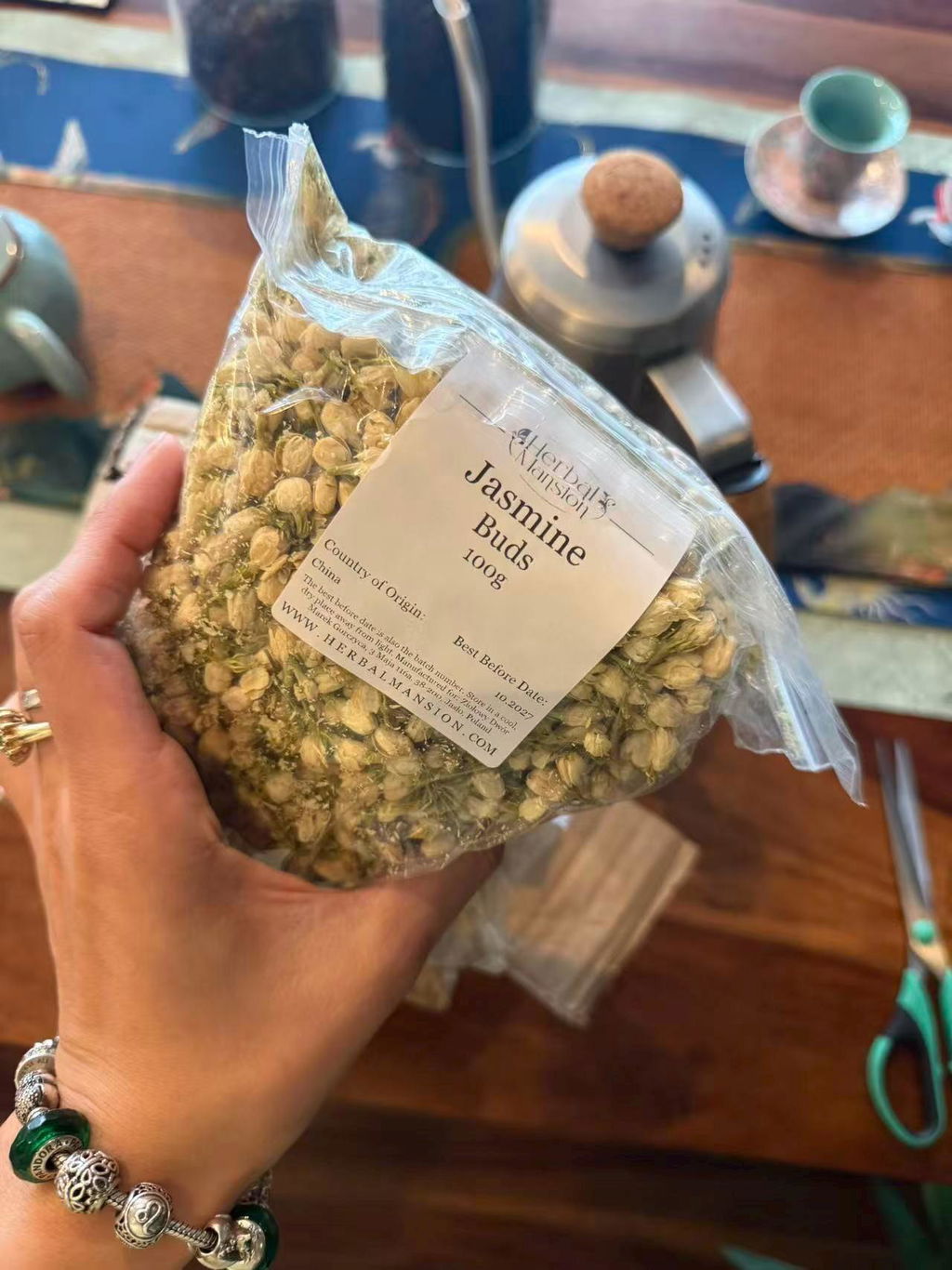
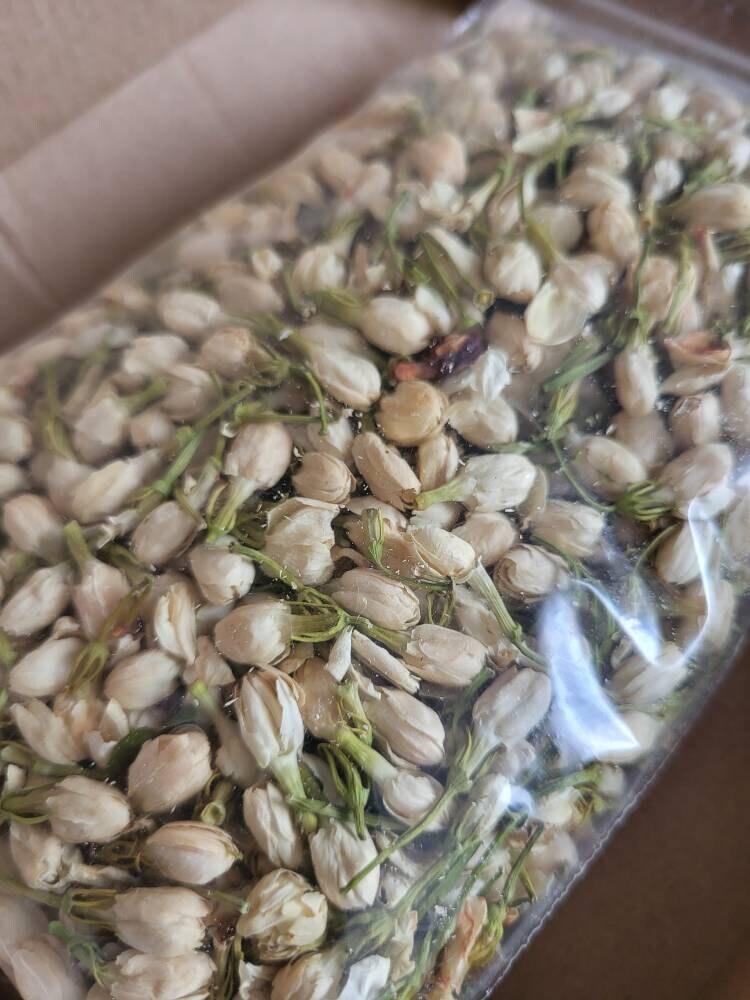
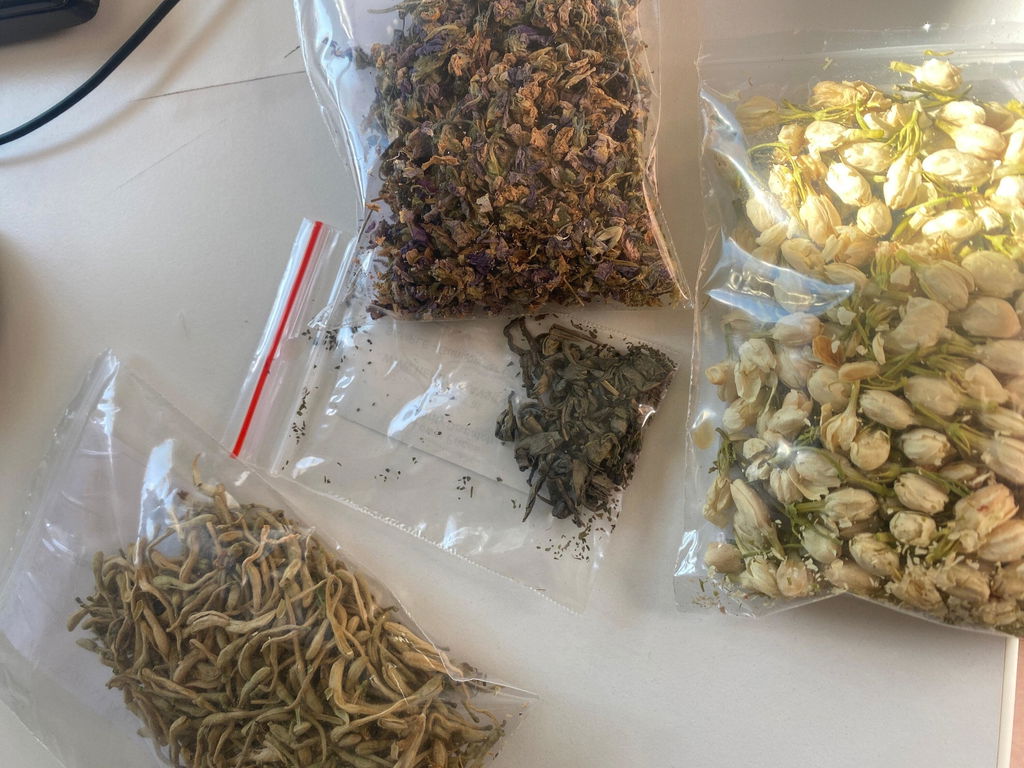
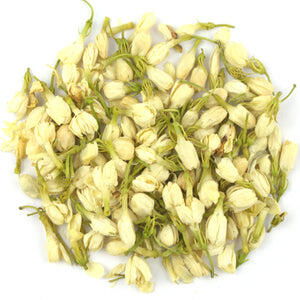
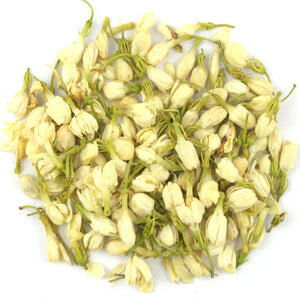
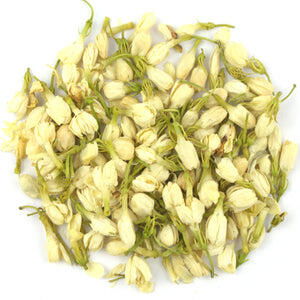
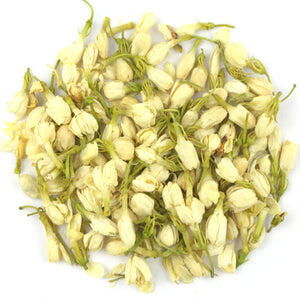
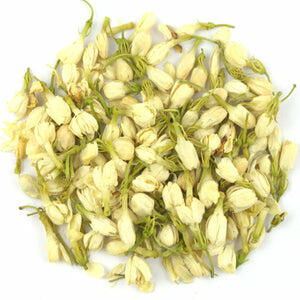
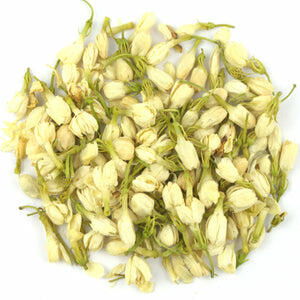
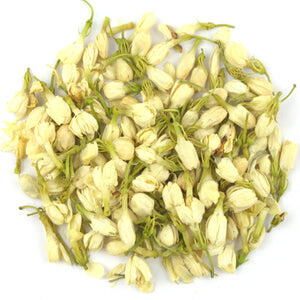
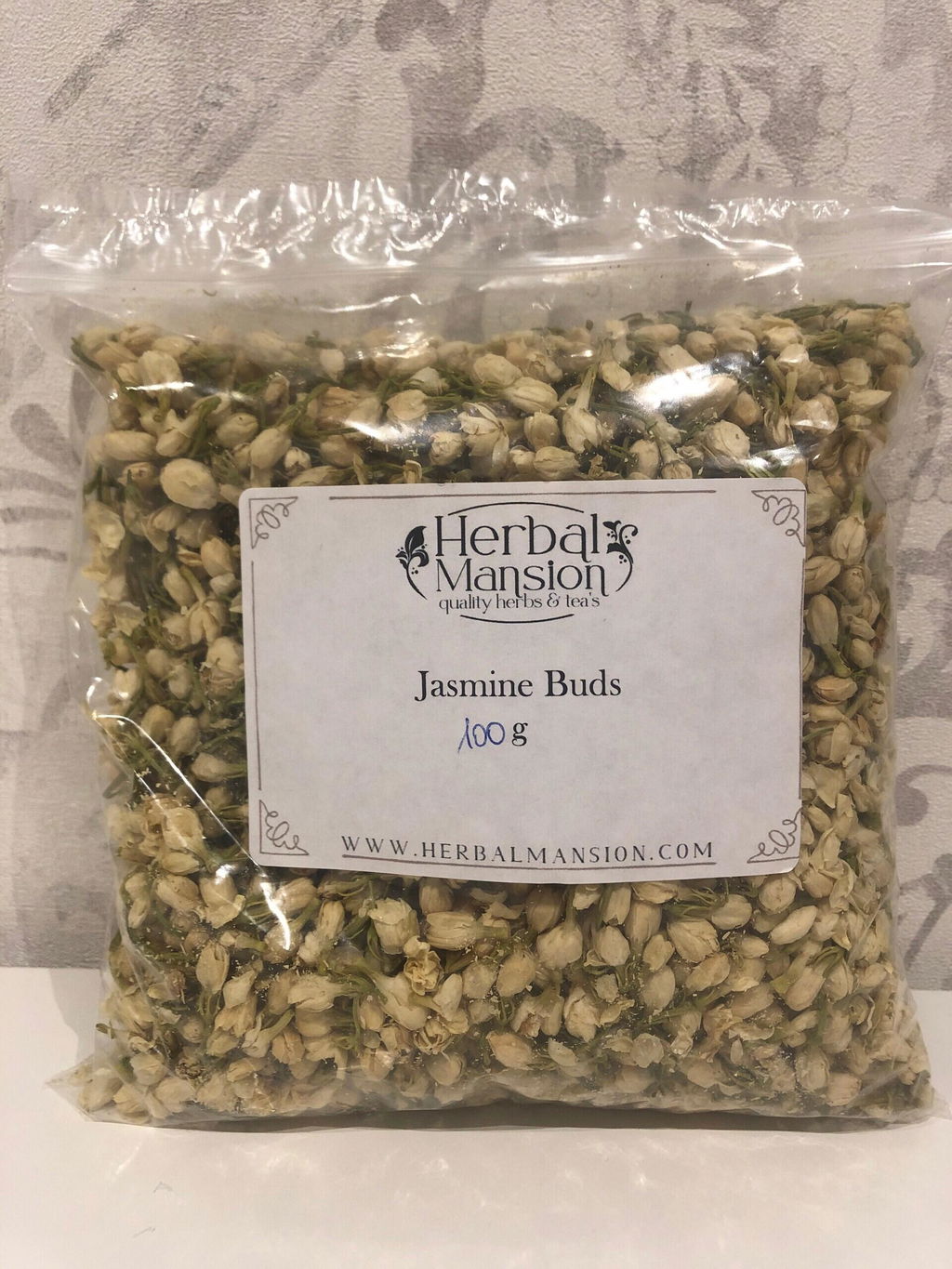
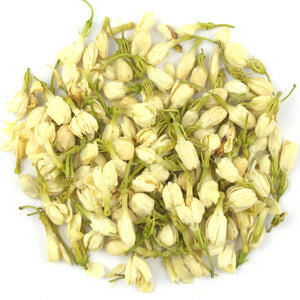
Dried jasmine buds are whole flowers of common jasmine, Jasminum officinale, dried while still closed. Each bud is creamy white and rounded, with a pointed tip and a short green calyx; some still have their stalk.
Use a few in a pot of green or white tea, brew them on their own as a flower infusion, or set them whole on cakes and desserts. They also go into homemade tea blends and potpourri.
Buds, flowers or petals
We sell common jasmine in three forms. Buds are flowers dried before they opened, small and compact, with the green calyx still on. Jasmine Flowers are whole open flowers. Jasmine Petals are loose petals with no green parts at all.
Common jasmine
Common jasmine is a climbing shrub of the olive family, Oleaceae, native from the Caucasus and Iran across the Himalaya to south-west China. It is hardy to about −15°C, and in cultivation it flowers from June to September. Its white flowers grow in small clusters, and each opens from a slender tube into five lobes.
Four sorts of jasmine in 1597
John Gerard's Herball, printed in London in 1597, counted “fower sorts of Iasmine”: white, great white, yellow and blue. The white one is the jasmine of English gardens, which the World English Historical Dictionary identifies as Jasminum officinale, the ordinary jessamine of English literature.
Storage
Keep the buds in a closed container in a cool, dry place, away from direct light.
Frequently asked questions
How do I make tea with dried jasmine buds?
For a 250 ml cup, take about a teaspoon of buds (8 to 10), pour over water at 80 to 85°C, cover and steep for 3 to 4 minutes, then strain. To scent green or white tea, add a few buds to the leaves in the pot.
Is this jasmine tea?
No. These are jasmine buds on their own, without tea leaves. Ready-made jasmine teas are in our Jasmine Tea collection.
Are jasmine buds edible?
The Plants For A Future database lists the flowers of common jasmine as edible and as used to flavour or scent tea. We sell the buds for tea, blends and decoration.
Is this the same as yellow jessamine?
No. Yellow or Carolina jessamine, Gelsemium sempervirens, belongs to a different family, Gelsemiaceae, and is poisonous. Only the English names are alike.
Can I drink it during pregnancy or with medication?
If you are pregnant, breastfeeding, taking medication or have a health condition, ask your doctor before drinking flower infusions.
More dried flowers for tea and decoration are in our Flowers & Petals collection.
Sources
- Royal Botanic Gardens, Kew, Plants of the World Online, Jasminum officinale L.
- Flora of China, vol. 15 (Oleaceae), Jasminum officinale, eFloras.org.
- World English Historical Dictionary, entry “Jasmine”, quoting John Gerard, The Herball (London, 1597).
- Plants For A Future, Jasminum officinale, pfaf.org, accessed 25 November 2026.