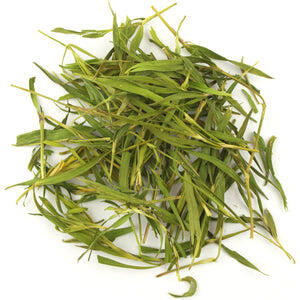
Bamboo leaf tea is made from the dried leaves of common bamboo, Bambusa vulgaris, a clumping bamboo whose stems, called culms, grow 10 to 20 metres tall. Bamboo is a grass, and this species is grown across the tropics and subtropics. Sellers describe the infusion as light and grassy, with a mild sweetness.
A grass that grows like a tree
Bamboo is a grass
Bamboos make up the subfamily Bambusoideae within Poaceae, the grass family, and Encyclopaedia Britannica calls them tree grasses, with often woody stems. In the words of INBAR, quoted by CIFOR Forests News in 2012: “Bamboo is a grass, not a tree.”
Clumps, culms and rare flowers
Bambusa vulgaris grows in open clumps, and a mature clump adds three or four new culms a year. Each culm stands upright or slightly zigzag, 4 to 10 cm thick. Flowering is not common: a culm that flowers produces many flowers but no fruit, and then dies. The species probably originated in tropical Asia and grows mainly in the wet tropics.
Green, golden and Buddha’s belly
PROSEA, the survey of South-East Asian plant resources, describes three groups: plain green culms; yellow culms, often striped with green, as in ‘Vittata’, known as golden bamboo; and Buddha’s belly bamboo, about 3 m tall, with short, swollen lower internodes. PROSEA calls it arguably the most widely cultivated bamboo in the tropics and subtropics, and CABI notes that it is the only Asian bamboo that is common in the New World.
From culm to leaf
What the culms are made into
The culms are the main material of the bamboo furniture industry and give a good quality pulp for paper; trade in the species covers furniture, handicrafts and paper. They also become masts and boating poles, carrying poles and fencing, and in Irian Jaya, traditional combs.
The leaves
The leaf blades are narrow, 6 to 30 cm long and 1 to 4 cm wide. Bamboo leaf tea is a trade name rather than a species name: sellers offer the dried leaves of different bamboos under it, and not all of them say which one. Ours is Bambusa vulgaris.
How it is used today
- Infusion. About 2 g of leaves per 250 ml cup, steeped in water just off the boil.
- A second cup. Sellers suggest the same leaves can be infused again once or twice.
For another leaf brewed on its own, try Kuding or Stinging Nettle Leaf. More are in Single Herbs and Herbal Tea.
Bamboo leaf tea in your home cupboard
Sellers describe the infusion as light and clean, with hay-like notes; one also finds a cocoa aroma. Taste varies between batches, so brew your first cup for about 5 minutes and adjust the leaves next time.
Frequently asked questions
Is it made from real bamboo?
Yes. The leaves come from common bamboo, Bambusa vulgaris. Bamboo belongs to the grass family, Poaceae, even though its culms grow as tall as trees.
How do I brew bamboo leaf tea?
Put about 2 g (1 to 2 teaspoons) of leaves in a 250 ml cup, pour over water at 90 to 95°C and leave for about 5 minutes, then strain. The leaves can be infused again once or twice.
Can I drink it during pregnancy or with medication?
If you are pregnant, breastfeeding, taking medication or have a health condition, ask your doctor before drinking herbal infusions.
Where does the bamboo come from?
The current batch comes from China.
Sources
- PROSEA (Plant Resources of South-East Asia), Bamboos: Bambusa vulgaris, Naturalis Biodiversity Center, accessed 19 November 2026.
- Royal Botanic Gardens, Kew, Bambusa vulgaris Schrad. ex J.C.Wendl., Plants of the World Online, powo.science.kew.org.
- CABI, Bambusa vulgaris (common bamboo), CABI Compendium, doi:10.1079/cabicompendium.8398.
- Encyclopaedia Britannica, Poaceae, britannica.com.
- CIFOR Forests News, Bamboo carbon credits now on sale in China: INBAR, forestsnews.org, 2012.