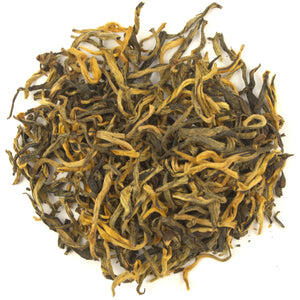
Yunnan Gold Bud Tips is a black tea in the Yunnan dian hong style, a style in which downy buds make up most of the tea and the twisted dark leaves are only an addition. In this style, the buds take on a golden colour. They give a thick, sweet, copper-coloured infusion with a note of honey, cocoa and baked sweet potato. Once infused, the buds in this style sink slowly and stand upright in the teapot. This is a tea for people who like sweet black teas and want buds in the packet rather than leaves.
Gold buds in history
A tea of golden buds
In their handbook the Heisses give Yunnan as the region in their profile of Dian Hong, which they call Golden Buds. In Ukers' 1935 glossary, a tip is the leaf bud of the tea plant, also called Pekoe tip, and a golden tip is an orange-coloured tip in black tea. Ukers calls teas with white or golden tips tippy. The gold bud style is therefore a tippy tea in its extreme form, because it has more tips than leaf.
Jin ya, golden bud
In Chinese, tea made from golden buds is called jin ya. Jin ya means golden bud, and the name Gold Bud Tips is its English equivalent.
How Gold Bud Tips is made
In this style, the buds are picked in early spring, before they open, from large-leaf bushes, and the tea uses the bud alone or a bud with one small leaf. The harvest withers, is then lightly rolled so as not to break the buds, and rests in moist warmth until the leaf darkens. In this style, the fine hairs on the buds do not darken the way the leaf blade does, and after drying they stay golden, which gives the finished tea its light, coppery look. Finally the buds are dried at a low temperature. The steps are the same as for other black teas; only the rolling is gentler.
How it is used today
- Drunk plain. A sweet infusion with no additions, also in the second and third infusion.
- For chocolate truffles. The tea infused in cream for the chocolate filling.
- With ginger and honey. A warm infusion with ginger for cold days.
- For the festive table. A copper-coloured infusion with gingerbread and oranges.
In our Black Tea collection you will also find Black Needle, in straight needles, and Golden Monkey, with a twisted leaf. Yunnan OP is a simpler whole-leaf tea.
Gold Bud Tips in your tea cupboard
This is a tea for people who like sweet black teas and want buds in the packet rather than leaves. It suits those looking for a black tea to drink plain and to use in chocolate desserts.
Frequently asked questions
How does Gold Bud Tips differ from Black Needle?
In the share of buds and in shape. In this style the buds make up most of the tea and are loosely twisted, while in Black Needle they are an addition to dark, straight needles. The infusion of Gold Bud Tips is lighter and sweeter.
Why are the buds golden?
Because in this style they are covered with fine hairs which, during oxidation, do not darken the way the leaf blade does. After drying they stay coppery.
Can the infusion turn bitter?
With a longer brewing time, astringency and bitterness can appear. Start with 3 minutes at 95°C and shorten the time with the next cup if the infusion is too strong for you.
Does Gold Bud Tips contain caffeine?
Yes. Like every tea from the tea plant, it contains caffeine, and the amount in the infusion depends on the quantity of leaves, the brewing time and the water temperature.
Can I drink it during pregnancy or with medication?
It contains caffeine, so during pregnancy and when taking medication regularly, ask a doctor or pharmacist. A product description does not replace their advice.
Sources
- Mary Lou Heiss, Robert J. Heiss, The Tea Enthusiast's Handbook: A Guide to Enjoying the World's Best Teas, Ten Speed Press, Berkeley 2010, p. 122 (profile of Dian Hong, Golden Buds).
- William H. Ukers, All About Tea, The Tea and Coffee Trade Journal Company, New York 1935, vol. II, glossary, pp. 512–513 (golden tip) and pp. 515–516 (tip, tippy teas).
- Mary Lou Heiss, Robert J. Heiss, The Story of Tea: A Cultural History and Drinking Guide, Ten Speed Press, Berkeley 2007, chapter “Manufacture: From Fresh Leaves to Distinctive Tea”, section “Black Tea”.
- EFSA, Scientific Opinion on the safety of caffeine, EFSA Journal 2015, 13(5):4102.